Cardio Without Running: A 4-Week Low-Impact Plan That Builds Real Endurance
Full disclosure: Some links in this article are affiliate links. We may earn a small commission at no extra cost to you if you make a purchase through them. Our recommendations are based on what real users report, not on commission size.
Why Skipping Running Still Lets You Build Serious Cardio
I tried running for years. Every cycle went the same way: two motivated weeks, then a sore knee or a bored brain, then nothing. When I switched to a rower and an incline walker, I figured I was settling for a lesser workout. That wasn’t what happened. After three weeks, my work intervals were 15 seconds longer, my breathing recovered faster, and the four-floor stair climb at my office stopped feeling like a punishment.
Your cardiovascular system adapts to effort, not to mode. It doesn’t care whether your feet hit pavement, a pedaling motion, or the floor of a pool. It cares about how hard you push and for how long. Low-impact training can raise your heart rate just as well as running when you build in intervals, sustained efforts, and steady overload. The difference is that you avoid the repetitive pounding that makes running miserable for a lot of people.
There are plenty of solid reasons to skip running: joint discomfort, tight hamstrings, plain boredom, or just not liking how it feels. Those aren’t character flaws. I’ve trained with former runners who now work mostly on bikes and still have strong cardio. Avoiding running doesn’t mean you’re stuck with weak conditioning.
This plan uses four sessions per week, about 30 minutes each. You don’t need a gym full of equipment. Comfortable shoes, a water bottle, and access to one or two cardio machines are enough. A rowing machine or exercise bike works as the main tool. You can swap in the elliptical, swimming, incline walking, or kettlebell swings when you want variety.
Each session has a warm-up, one or two work intervals, a recovery period, and a cool-down. You’ll breathe hard and feel your heart pumping, but you won’t be running. The focus is on effort level, not distance. As you improve, the work intervals get longer or the number of rounds increases. That gradual increase is what actually builds endurance.
By week four, you’ll have a repeatable system that raises your conditioning, gives you clear feedback on how hard you can push, and asks nothing of your shins or knees. You can build real cardio without ever lacing up for a run.
The 4-Day Low-Impact Cardio Starter Schedule
If you hate running, a seven-day training week that kicks off with a 5K run isn’t going to work. This four-day schedule uses rowing, cycling, swimming, elliptical, incline walking, and kettlebell swings. You get one steady-state session, two interval sessions, and one hybrid session that blends cardio with light strength. That’s enough volume to build real endurance without pounding your joints.
Every session starts with a 5-minute easy warm-up on the same machine you’ll use. This primes your legs and slowly brings your heart rate up. Skip it and the first few minutes of any interval will feel twice as hard.
The week at a glance
- Monday: Steady-state cardio, 20–35 minutes (start at 20, add 2–3 minutes each week)
- Tuesday: Rest or easy mobility
- Wednesday: Intervals A – 60 seconds hard, 120 seconds easy, 6 rounds
- Thursday: Rest or easy mobility
- Friday: Intervals B – 30 seconds hard, 90 seconds easy, 8 rounds
- Saturday: Hybrid cardio + light strength, 25–30 minutes
- Sunday: Rest or easy walk
Treat the week at a glance as a skeleton. The exact reps, rest times, and weekly progressions for every session live in the full 4-week plan. That way you know what this week looks like without getting buried in numbers before you’ve even warmed up.
If four days feels like too much, start with three and drop Wednesday. Keep the Friday interval as your weekend challenge. That still gives you one steady day, one interval day, and one hybrid day – plenty for the first few weeks.
Monday: Steady state
Pick one machine and keep it boring. Cycle, row, swim, or do incline walking at a pace where you can say a short sentence but you wouldn’t want to recite a speech. Stay at a perceived effort of 5 to 6 out of 10. If you’re new, start at 20 minutes and add 2 to 3 minutes each week until you hit 35 or 40. I’ve had Mondays where the steady state felt like the only reasonable workout on my calendar, especially after a weekend of bad sleep. That’s fine. The point is to build a base, not to prove anything.
Wednesday: Intervals A
After the 5-minute warm-up, do 60 seconds at a hard effort (7 to 8 out of 10) followed by 120 seconds easy. Repeat that 6 times. That’s 18 minutes of work plus warm-up and a 5-minute easy cool-down. In the later weeks of the 4-week plan, you’ll shorten that recovery to 90 seconds. For now, keep the longer rest so you can hold good form through every repeat.
On a bike, this means standing or increasing resistance. On a rower, take longer, stronger strokes. On an elliptical or incline treadmill, raise the incline or speed and keep your upper body relaxed. If you can’t maintain pace through the last repeat, back off the hard effort slightly next time.
Friday: Intervals B
This session uses shorter bursts: 30 seconds hard, 90 seconds easy, repeated 8 times. The shorter work period lets you move faster without worrying about impact. On the bike, spin at a quick cadence. With an incline walk, bump the incline and drive your arms. As you get comfortable, add one round each week. By the end of three weeks, those short efforts will feel sharper and you’ll be less out of breath going upstairs.
Saturday: Hybrid session
This is the day that keeps the schedule from feeling like the same cardio grind. Start with the same 5-minute warm-up on whichever cardio machine you plan to use first, then do 3 to 5 minutes of cardio, stop, and do a light strength move. Alternate for 25 to 30 minutes. One setup I’ve used at home: 4 minutes on a cheap spin bike, 10 goblet squats, 8 push-ups, repeat. If you have a kettlebell, 3 minutes of rowing followed by 10 kettlebell swings and 8 step-ups per leg works well. You’re not going for max intensity. You’re teaching your body to switch from an aerobic effort to a loaded movement without falling apart.
Making it fit your life
Real life will get in the way. If Monday turns into Tuesday, fine. If Friday’s interval gets pushed to Saturday, do the hybrid on Sunday and take an extra rest day. The one rule I stick to is to leave at least one rest day between interval days. That means no hard interval work on back-to-back days.
For progression, change one variable per week: add 3 to 5 minutes to the steady state, add one interval round, or increase resistance or incline slightly. Don’t change speed and time on the same day, or you won’t know which one caused the extra fatigue. If your schedule feels unmanageable, drop to three days for a week and return to four when your energy comes back. This isn’t a test of willpower. It’s a schedule you can actually keep.
If a simple heart-rate monitor or a pair of comfortable headphones would make these sessions easier, check current prices on Amazon. Then pick a day, start your first warm-up, and come back to the comments to tell us which day surprised you the most.
Six Non-Running Cardio Modalities Compared
Running punishes your joints in ways that don’t show up until later. I’ve used all six of these while dealing with cranky ankles, and the thing that decides whether you stick with them is usually access, not results. Here’s a side-by-side before we dig into each:
| Modality | You will need | Skill level | Best used for |
|---|---|---|---|
| Rowing | Rowing machine | Medium | Full-body endurance intervals |
| Cycling | Bike or stationary bike | Low | Steady longer sessions |
| Swimming | Pool, goggles, swimsuit | Medium | Zero-impact whole-body work |
| Elliptical | Elliptical machine | Low | Running-like motion without joint impact |
| Incline treadmill walk | Treadmill | Very low | Leg endurance and simple progression |
| Kettlebell swings | One kettlebell | Medium | Short home cardio sessions |
Rowing
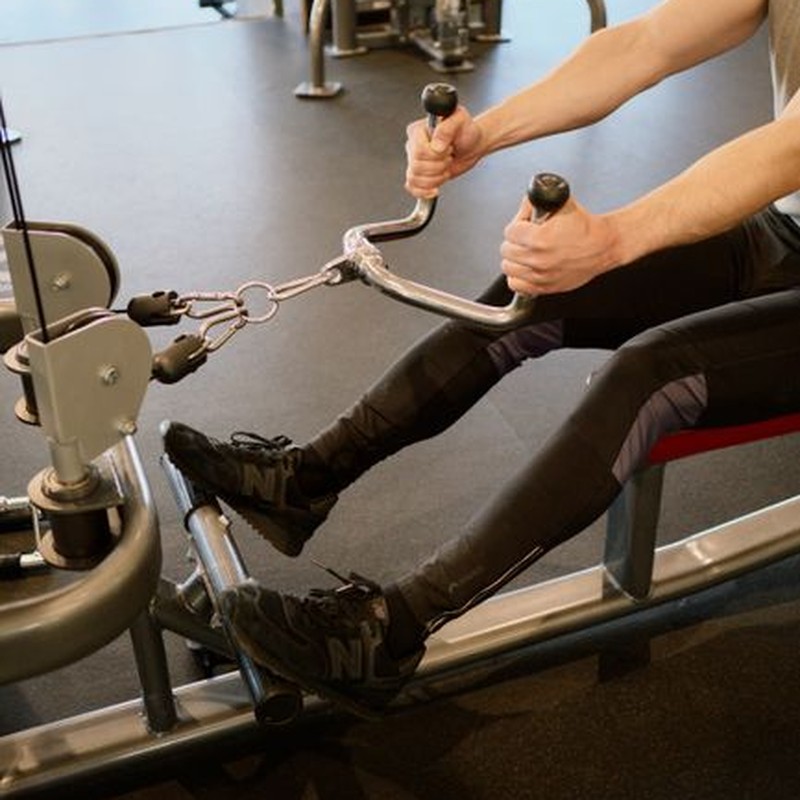
Rowing recruits your legs, back, and arms in one stroke. It’s the closest thing to full-body cardio that doesn’t involve ground contact. The drive starts with your legs, then your hips, then your arms. On the recovery, reverse the order: arms, body, legs. It takes a few sessions to learn the rhythm, but once it clicks, the machine stops feeling awkward.
Start with 10 minutes at a calm stroke rate near 20-24 strokes per minute. Keep the resistance moderate, not heavy. If you’re gasping early, slow the recovery and make it smooth.
Cycling
Cycling is gentle on the knees because the saddle carries most of your weight. A basic stationary bike, spin bike, or used road bike on a trainer all work. The motion is simple enough that you can settle into a 30-minute ride and let your mind wander.
For a beginner, keep resistance low enough to hold a smooth cadence around 80-90 rpm. Try two minutes at a slightly harder gear, then two minutes easy. Repeat that five times.
Swimming
Swimming is the only option on this list that takes your body weight off completely. It needs a pool or lap lane, goggles, and the patience to relearn breathing. If you haven’t swum since high school, start with 25-meter repeats with generous rests, or split the session between kicking and easy swimming.
A practical first-week set: 8 x 25 meters with 30 seconds rest after each one. Push off the wall, keep your neck neutral, and exhale underwater.
Elliptical
The elliptical gives you a running-like stride without the ground contact. The main cue is to keep your weight off the handlebars. I’ve seen people lean on them so hard that their heart rate never climbs. Let your arms glide along lightly and push through your legs instead.
Set the ramp near the middle and keep resistance low for the first 10 minutes. Then raise the incline or resistance until your lungs are working but you can still say a short sentence.
Incline Walking on a Treadmill
Incline walking is brutally effective with almost zero skill. Set the treadmill to 3 mph and raise the incline to 8-12 percent. Your calves and glutes will protest quickly. Keep your hands off the rails; holding on makes the treadmill do the work and destroys the point.
For a first session, walk five minutes at 0 percent to warm up, then raise the incline by one percent every minute until you reach 10. Hold it there for as long as you can. The speed stays slow, but the effort does not.
Kettlebell Swings
Kettlebell swings aren’t what most people picture for cardio, but they work. With one bell, you can hit your cardiovascular system in 12 minutes. The hinge is a hip snap, not a squat. That distinction is what protects your lower back.
Start with an 8-12 kg kettlebell (roughly 18-26 lb) and do 15-20 swings. Rest one minute and repeat three or four times. If your arms are doing the work, slow down and drive the bell with your hips.
Try Each Modality Before You Commit
If you’re not sure which to start with, pick the one you can do tomorrow without buying anything. For many people, that means a treadmill or a kettlebell they already own. The exact choice matters less than showing up three or four times this week.
The seven-day rotation below is a sampler, not the 4-day plan in this article. Its job is to let you feel each modality once so you can choose two or three you want to train with. If you know you hate swimming, skip that day and repeat one you like.
- Day 1: 20-minute incline treadmill walk
- Day 2: Rowing: 5 rounds of 2 minutes easy, 1 minute rest
- Day 3: Rest or easy 20-minute bike ride
- Day 4: 15-minute elliptical with active arms
- Day 5: Swim set: 8 x 25 meters with 30 seconds rest
- Day 6: Kettlebell swings: 4 rounds of 15-20 swings
- Day 7: Rest
To progress in whatever you pick, add two to three minutes to one steady session each week, or raise the incline or resistance by one small step on another day. Keep the speed steady. Breathing should be heavy but manageable, not panicked.
If you need home equipment, check current prices on Amazon for a rowing machine, stationary bike, or single kettlebell. Start with the cheapest option that fits your space. After you try one of these for a week, share your experience in the comments. Tell me which modality you actually stuck with and what made it easier or harder than expected.
Your 4-Week Progression Plan for Low-Impact Cardio
Bookmark this section. Every session type in this plan is defined below, and the rest of the article will point back to these details. We are using three cardio sessions per week: one longer steady-state day, two interval days, and one optional hybrid session if you want a fourth day. You can do every session on a rower, bike, elliptical, steep treadmill incline, in a pool, or with kettlebell swings. Mixing equipment works too.
Use RPE Instead of a Heart Rate Number
RPE stands for rating of perceived exertion. It’s a 1-to-10 scale. A 1 is lying on the floor. A 10 is a sprint you could only hold for a few seconds. For this plan, steady-state days should sit around 5 or 6. Hard intervals should hit 8 or 9. Recovery intervals should drop down to 3 or 4, where you could keep moving for another minute if you had to.
I tell clients to use RPE instead of staring at a heart rate monitor. Monitors lag, and heart rate can be affected by medications, stress, and sleep. RPE puts the decision in your hands. A simple test: during a hard interval you should only be able to answer a question with one word.
Session Templates
- Steady state: 5-minute easy warm-up, 20-30 minutes at RPE 5-6, 5-minute easy cooldown.
- Intervals: 5-minute easy warm-up, chosen rounds of hard and easy intervals, 5-minute easy cooldown.
- Hybrid (optional): 5-minute easy warm-up, 15-20 minutes of easy cardio at RPE 4-5, 3-4 rounds of bodyweight strength, 5-minute easy cooldown.
Don’t skip the cooldown. It is tempting to stop as soon as the last interval ends, but those 5 easy minutes are why you can walk down stairs the next day.
Week 1: Establish the Pattern
- Monday: Steady state — 20 minutes at RPE 5-6.
- Wednesday: Intervals — 5 rounds of 60 seconds hard at RPE 8-9, then 90 seconds easy at RPE 3-4.
- Friday: Same as Wednesday.
- Saturday (optional): Hybrid — 15 minutes easy cardio, then 3 rounds of 10 bodyweight squats and 5 push-ups. Rest between rounds if needed.
Repeating the same interval workout twice in week 1 is deliberate. You need to learn how to pace the hard rounds before I ask you to add more volume. If Saturday feels like too much, skip it. Week 1 is about building the habit.
Week 2: Add Time to the Steady State
- Monday: Steady state — 25 minutes at RPE 5-6.
- Wednesday: Intervals — 6 rounds of 60 seconds hard at RPE 8-9, then 90 seconds easy at RPE 3-4.
- Friday: Same as Wednesday.
- Saturday (optional): Hybrid — 15-20 minutes easy cardio, then 3 rounds of squats and push-ups.
The interval rounds go from 5 to 6, but the work-to-rest ratio stays at 60/90. That means the only change is a small increase in total workload. That’s the progression. You’re not trying to redline every session; you’re slowly building capacity.
Week 3: Change the Interval Ratio
- Monday: Steady state — 30 minutes at RPE 5-6.
- Wednesday: Intervals — 6 rounds of 75 seconds hard at RPE 8-9, then 75 seconds easy at RPE 3-4.
- Friday: Same as Wednesday.
- Saturday (optional): Hybrid — 20 minutes easy cardio, then 4 rounds of squats and push-ups if the first 3 felt smooth.
The 75/75 ratio feels different from 60/90 because your recovery time now matches your work time. That is harder than it looks on paper. Most of my clients complain during week 3. That’s normal. Keep the hard rounds honest and use the full 75 seconds of recovery.
Week 4: Push Work Capacity
- <
- Squats – bodyweight or goblet squat with one dumbbell
- Lunges – alternate legs, hold a wall for balance if needed
- Push-ups – from knees or against a counter if you are starting out
- Rows – use a resistance band or a dumbbell
Recovery, Strength Work, and How to Keep Progressing
Four weeks of low-impact cardio can change how your heart handles work, but only if you give your body time to rebuild. That means scheduling recovery on purpose, not just when you feel tired.
I slot two full rest days into every week. Wednesday and Sunday work well for me. Those are not do-nothing days if you hate sitting still. If you feel stiff, take a short walk or do 10 minutes of easy stretching. I usually do a slow 15-minute walk and then stretch my hips and shoulders. That keeps blood moving without adding stress.
What counts as a true rest day
A true rest day means no structured cardio and no intervals that leave you gasping. You can play with your kids, walk the dog, or do yard work. Those activities are fine. What you want to avoid is another interval session or a long workout that makes you feel drained. Your heart and leg muscles adapt during downtime, not during the workout itself.
If you wake up tired and your legs feel heavy, take an extra rest day. I have done this plenty of times. Missing one workout will not ruin your progress. Pushing through exhaustion will.
How to fit strength work into your week
You do not need a separate strength program to get better at low-impact cardio. Two short sessions on rest days are enough, especially if you are new to strength training. If you add them, keep them light and treat them as support work, not a second full workout. Choose four compound movements and do 2 sets of 8-12 reps each.
Do these at a moderate intensity. That means you finish the last two reps thinking you could have done two or three more. If you feel shaky or your form breaks, stop. Strength work is meant to support your cardio, not exhaust you before your next session.
I tried this setup at home with a light kettlebell and a resistance band. It worked well because I never needed more than 20 minutes. On Tuesday I did the strength circuit after a short walk. On Thursday I did it before lunch. It was simple enough to stick with.
Keep a simple training log
After four weeks of your low-impact plan, you need to know what pushed you and what did not. A simple log works. Write down the date, the workout type, how hard it felt on a scale of 1-10, and how many hours you slept. That is it.
Sleep quality often determines whether you can push harder the next time. I have had mornings where a 30-minute incline walk felt brutal because I slept five hours. I wrote "short, tired" in the log and moved on. Had I ignored that, I would have blamed the workout instead of the real issue.
How to keep progressing after week 4
The plan does not end after week 4. You can repeat the Week 4 interval session and see what happens. If you complete all 8 rounds without dropping your pace, push a little further the next week. Two ways to do this: extend the interval time or add one minute to the total workout.
For example, if your interval session was 8 rounds of 30 seconds hard with 90 seconds easy, try 8 rounds of 40 seconds hard with 80 seconds easy. Or add one minute to the entire workout. Either option works. Just do not increase both at the same time. That is the quickest way to end up sore and discouraged.
Another option is to increase incline, resistance, or pace on your steady-state workouts. On a bike, add one gear. On a rower, add one stroke per minute. On the elliptical, add 5% resistance. Small changes add up over the next four weeks.
What to do if progress stalls
If you repeat Week 4 and the intervals feel harder than a few weeks ago, stop and look at your log. Maybe you are sleeping worse. Maybe you missed a rest day. Maybe stress at work is higher. Those factors affect your cardio as much as your training plan. Back off to Week 3 volume for one week, then try again. I have done this more times than I can count. It works.
One last thing about buying equipment
If you have been using a machine at the gym and want your own, or if you need a new resistance band or rower, do not buy blind. Before you buy any cardio machine, check current prices on Amazon and read recent customer reviews. That will save you from wasting money on something that feels cheap or breaks quickly. Then share your experience in the comments below.

Medical & Editorial Review: This article was reviewed by Liam Smith, founder of Apexfito, for accuracy and safety. Content is for educational purposes and is not a substitute for professional medical advice. Consult your physician before starting any exercise or nutrition program.