Swimming for Lower Back Pain: What It Helps, What It Doesn’t, and How to Start
Full disclosure: Some links in this article are affiliate links. We may earn a small commission at no extra cost to you if you make a purchase through them. Our recommendations are based on what real users report, not on commission size.

What the Water Actually Does for a Hurting Back
Before anything else, a boundary: what follows is general education, not medical advice. If your back pain comes with leg weakness, numbness, or changes in bladder or bowel control, that’s a conversation with a clinician, not a lifeguard. For the more common nagging, mechanical kind of low back pain, the pool is worth understanding.
Your spine doesn’t care how hard you’re breathing. It cares how much load is stacked on it, and water changes that math in about thirty seconds. Stand in chest-deep water and a large share of your body weight stops running through your hips, knees, and lumbar spine. You can hinge, step, kick, and swing your arms through a real range of motion while your heart rate climbs, without paying the toll that walking or lifting charges in repeated compression. For someone who feels every sidewalk crack on the way to the mailbox, that trade is worth taking. Buoyancy is the headline, and it explains why a person who can’t tolerate a twenty-minute walk often handles twenty minutes of swimming or aqua-jogging without a flare.
The second mechanism gets less attention. Water pushes on you evenly from all sides, and that even pressure reads as a held, supported feeling, like something is carrying part of the job your muscles have been doing alone. Warm water adds to it, quieting the involuntary bracing that makes a stiff back feel worse than the tissue actually is. Walk into a warm therapy pool braced for impact and you’ll often walk out standing an inch taller. That shift is usually neuromuscular, not structural, but it’s real and it’s useful.
The research is roughly in that territory. In October 2026, Verywell Health reported on a study suggesting swimming may reduce low back pain. It lines up with what clinicians have been watching for years, and it’s encouraging if you’ve been told your only options are lying still or accepting a sore back as your permanent address. But a single study doesn’t tell you which stroke to swim, how many days a week to go, or how long a session should run. Read it as permission to try the pool, not as a prescription with a dose printed on the label.
There’s an aerobic story here that gets buried under the pain-relief headline. Being able to climb a hill or haul groceries up a flight of stairs without getting winded changes how much you lean on your back all day. Tired people brace. Tired people round their spine to pick things up. The pool builds that conditioning with close to zero impact, which makes it a sensible starting point when the pavement isn’t your friend yet.
Here’s the part I’d rather say early. Water unloads your spine; it does not build the hip, trunk, and grip strength that keeps a back resilient once you’re back on land. Feeling loose and easy for forty-five minutes in the pool says nothing about your capacity the next morning over a laundry basket. That isn’t a reason to skip swimming. It’s a reason to pair it with two short land sessions a week once the pool stops feeling like a negotiation, which is where this article goes next.
Practical friction matters too. Pool access and cost are real constraints, and not every town has a warm therapy pool. Chlorine bothers plenty of people, especially in busy indoor facilities. A 25-yard lap pool with no shallow end can feel genuinely intimidating when your back is angry and you’re not sure you can get out gracefully.
- Ask the front desk which pool on the schedule runs warmest and shallowest. Therapy and arthritis classes usually get those slots.
- Start at chest depth, not at the wall of the lap lanes. Ten to fifteen minutes of walking and gentle movement counts as a first session.
- If you want flotation, a basic belt is enough. You’re renting confidence, not buying performance.
- Go mid-morning or early afternoon when you can. Crowded lanes push beginners to move faster than their back is ready for.
The pool is a good place to move without being punished for it. It is not a fix, and relief during a session is a signal that you found a tolerable entry point, not proof the underlying problem is solved.
Which Strokes Help and Which Ones Work Against You
Stroke choice does more to decide how your back feels afterward than lap count does. The water takes weight off the spine, but it does not fix your position for you. How you set your hips, ribs, and head is what determines whether 20 minutes in the pool leaves you looser or stiffer.
One thing worth clearing up first. When Verywell Health reported in October 2026 on a study suggesting swimming may be effective at reducing low back pain, that finding was about swimming as a whole, not a comparison of strokes against each other. Nothing in that reporting tells you backstroke beats breaststroke. What follows is based on how each stroke loads the lumbar spine, combined with how your own body responds. Think of it as a starting filter you test on yourself, not a prescription.
And build in a delay before you judge anything. Pool sessions rarely give you honest feedback in the moment, because the water unloads the spine while you are in it. Give it 24 to 48 hours. A stroke that felt neutral during the set and left you tight the next morning was not neutral.
Backstroke: the usual starting point
If the back is cranky right now, this is where most people should begin. The water supports your arch, there is no rotational demand driving through the lumbar spine, and you can breathe without lifting your head. That last piece is what makes backstroke sit well with an irritable low back — no repeated extension under load.
Two cues are enough for a first visit. Keep your head still and your gaze up, not tipped back toward your feet. Then keep your hips near the surface; if the legs sink, a pull buoy between the thighs solves it faster than extra effort does. Small, quick kicks from the hip beat big splashy ones.
Freestyle: fine if you breathe to the side
Freestyle works when you rotate to breathe and works against you when you lift your face forward. Head-up breathing and a dropped hip both push the low back into extension, stroke after stroke, which is how a set that felt easy in the water turns into a stiff evening on the couch.
The fix is rotation, not lifting. One goggle in the water, one out. Exhale fully into the pool so you are not holding your breath and rushing the next turn. Bilateral breathing every three strokes keeps the rotation more even, which helps if one side of your back is fussier than the other. Picture your ribs staying stacked over your pelvis instead of your chest rising to find air.
Breaststroke: test it, don’t assume it
This is the one to approach carefully. The head-up, arched-back position combined with the whip kick puts the lumbar spine into extension under load, and that pairing is exactly what many irritated backs tolerate worst. Plenty of people swim breaststroke for decades without trouble; others feel it before they finish a length. Both are real, and only your own response settles which one you are.
So test it in small doses. Two or three lengths, then stop and go do something else. Check in that evening and again the next morning. If the back is unchanged, add a little more next time. If it tightened up, set breaststroke aside for a few weeks rather than trying to fix your technique mid-flare.
Butterfly and dolphin kick: skip them for now
Both are heavy lumbar extension under speed. While the back is symptomatic, leave them out entirely, even if you swam them competitively years ago and your body still remembers the rhythm. The undulation comes from the same segment that is currently complaining. They will still be there in a couple of months.
Kickboards: small gear change, different load
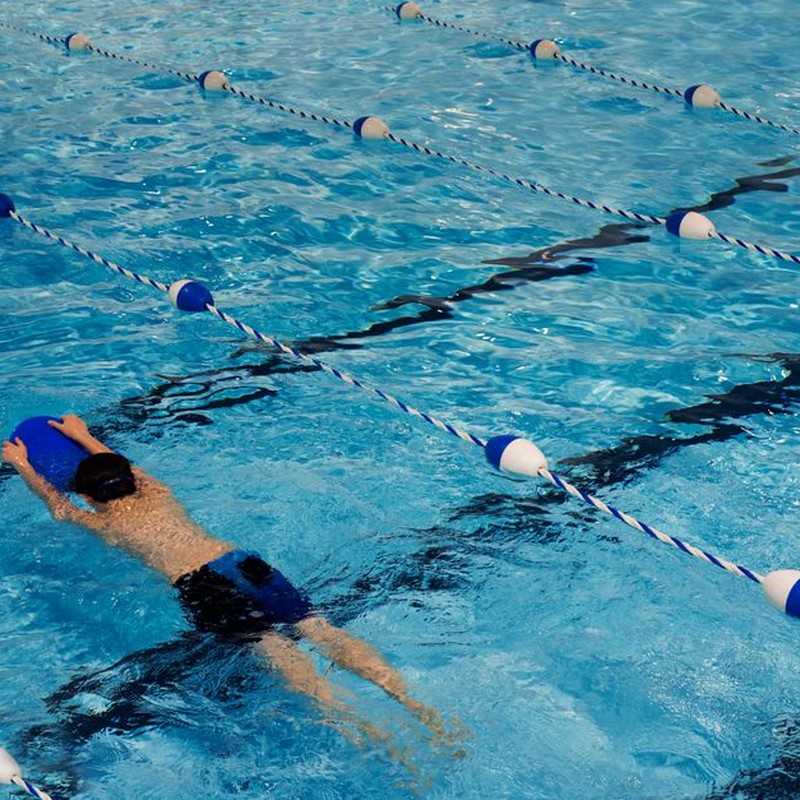
A full-size rectangular board held at arm’s length pushes the back into an arch and loads the shoulders at the same time. If you want to keep kicking, use a smaller board, hold it closer to your chest, or kick on your back with your arms at your sides. That last version is usually the most comfortable of the three, and it keeps your spine in the same supported position that makes backstroke work.
If you are buying gear, pull buoys, compact boards, and flotation belts swing quite a bit in price week to week, so check current prices on Amazon before you commit rather than paying whatever the pool pro shop charges.
If continuous laps aren’t happening yet
You do not need a stroke at all to get the cardio benefit. Water walking, side shuffles, and shallow-end marching cover the same low-impact ground, and in deep water a flotation belt lets you walk or jog with the spine fully unloaded. For a lot of people in the early weeks, 20 minutes of that is a better session than 600 yards of badly positioned freestyle — and it comes with far less risk of a two-day setback.
Pick one option, keep the first session short, and judge it by tonight and tomorrow morning rather than by how it felt mid-lap. Then adjust from there. If you have already found the stroke that treats your back well, I would like to hear which one it was and what you had to change to make it work — leave it in the comments.
Building a Pool Routine That Doesn’t Flare You Up
Most pool routines for back pain fail in one of two directions. Someone swims 40 minutes of breaststroke on day one and spends the next three days on the couch. Or they paddle for eight timid minutes, feel nothing, and decide water doesn’t work for their back.
The way out is a dose small enough that you can actually read your body’s response, then moving up in boring increments. The recent reporting on swimming and low back pain is encouraging, but no study can tell you how your specific spine will handle your first month in the water. You collect that data yourself.
Start smaller than feels impressive
Fifteen to 20 minutes, twice a week. If “3 or 4 out of 10” means nothing to you, here’s the scale: 0 is sitting still, 10 is a pace you could only hold for about a minute before you had to stop. A 3 or 4 is where your breathing gets a little deeper but you can still hold a full conversation without gasping, and you finish with enough left that you could have done another ten minutes.
Add about five minutes per week, and only if the following day is no worse than your baseline. If a session feels great and you want to double it, bank the enthusiasm. The capacity will still be there next week, and you skip the trap of turning one good swim into a two-week setback.
Judge the session the next morning
Discomfort mid-swim is a poor signal. Water unloads the spine, so plenty of people feel loose and pain-free in the pool and stiffen up that evening. The pattern over the next day or two is what tells you whether the dose was right.
Mild stiffness that eases within about an hour of getting out is generally fine. Pain that keeps climbing and is still elevated 24 to 48 hours later means cutting the next session’s volume by roughly a third, not quitting. Cut, then reassess. Most bad flares I hear about came from adding a second variable at the same time, like more time and a faster pace in the same week.
Use the same structure every visit
A predictable shape makes it easier to identify what changed when something goes wrong.
- Warm-up, about five minutes. Shallow-water walking forward and backward, hands on hips, small easy circles with the low back, a few gentle knee lifts. You’re raising tissue temperature, not training yet.
- Main block. Your swim or water-walking portion at that 3 or 4 out of 10 effort. Rest at the wall between lengths as needed; rest is part of the plan, not a failure.
- Cool-down, two or three minutes. Easy standing stretches for hip flexors and calves while you’re still warm, one hand on the wall for balance. Skip deep forward folds and anything that cranks your spine into rotation.
Form cues worth repeating to yourself
Head neutral, eyes toward the pool floor rather than forward at the wall. Ribs stacked over the pelvis without arching hard to keep the hips up. A pull buoy between the thighs lifts the legs and removes most of the kick, which helps when kicking irritates your back or when you want a session that’s mostly upper body.
If flutter kick makes things worse, water walking, side-lying leg work, or pulling with the buoy are fair swaps. You don’t have to swim a stroke to get the benefit.
Move one variable at a time
Time first, then pace, then stroke variety, and never all three in the same week. Two or three pool sessions a week is plenty for a beginner; the days between are where you find out whether the work fit. A first two weeks might look like two 15-minute sessions in week one, then two or three sessions of 15 to 20 minutes in week two, adding a couple of minutes to the main block only if your mornings stayed clean.
Stop adjusting and get checked if
Some symptoms mean the question isn’t workout dosage anymore. Talk to a clinician before starting or continuing if you notice new numbness or weakness in a leg, numbness around the groin or saddle area, any change in bladder or bowel control, unexplained weight loss, fever, or pain that wakes you from sleep.
Also worth a conversation rather than a solo experiment: recent spine surgery, a known disc issue with nerve symptoms running down a leg, or osteoporosis that makes diving and twisting a genuine risk. None of those rule out the pool, but they change how you should use it.
To be clear about what this is: nothing here is medical advice or a diagnosis. It’s a template for testing a low-impact exercise gently and tracking what your back does with it. For anything on that list, the right call is a clinician or a physical therapist who can actually examine you.
Remove the friction
Adherence usually dies on logistics, not motivation. Goggles that don’t leak, a water bottle on the deck, shower shoes, and a lane or time of day where you won’t feel pressured to match the pace of faster swimmers. A 20-minute session you actually repeat beats a perfect 45-minute one you dread.
If you’re piecing together gear, check current prices on Amazon before you buy, since pull buoys and decent goggles swing a lot month to month. And if you’ve already found a pool rhythm that keeps your back calm, share the specifics in the comments; that’s what helps the next person.
Where Swimming Falls Short, and How to Fill the Gaps
People find the pool for the right reason and then stay there. The water quiets the back down, laps feel productive, and months pass without any other training. That is usually when progress stalls.
The pool never stopped working. It was never asked to do the whole job. Here are three beliefs that cause trouble, plus a short land routine and a few habits to cover what the water leaves behind.
Myth one: swimming fixes back pain
The pool is a load-management tool. It lets you move and train your heart while the back is irritated. A study reported in October 2026 and covered by Verywell Health suggests swimming may be effective at reducing low back pain, which fits what coaches see.
But less pain is not more capacity. The glutes, hamstrings, trunk and hips change in response to progressive resistance. Water removes so much load that you can swim faithfully for a year and still brace when you pick up a laundry basket. Swimming buys the window. Strength work fills it.
Myth two: more pool time is always better
Repetitive extension, hours of chlorinated air, and no recovery days can leave a back sorer than it started. In my experience, when someone jumps from two swims to five, pain often goes up. Three moderate sessions usually beat one ninety-minute grind. If you are wrecked the day after, cut volume rather than adding more.
Myth three: stretching is the answer
A back that feels tight often feels tight because it is guarding, not because it is short. Stretching a guarded spine can feel good for ten minutes and change nothing about why it tightened. Gentle mobility is fine as a warm-up. Chasing a deeper stretch will not build the capacity that keeps symptoms away.
Two short land sessions a week
Twenty minutes, twice a week, is enough to start. You need floor space and a pair of dumbbells. Run the same session both days for the first month so the movements get familiar.
- Hip hinge pattern: a glute bridge (2 to 3 sets of 10 to 12) or a light deadlift once your form is clean (2 to 3 sets of 8).
- Dead bugs: 2 sets of 6 to 8 per side, slow, ribs down.
- Side planks from the knees: 2 sets of 15 to 25 seconds per side.
- Split squats or step-ups: 2 sets of 8 per leg, holding a dumbbell once bodyweight feels easy.
- Farmer carry: 30 to 40 yards with weight in each hand, two trips.
Add a rep or a little load most weeks. Mild soreness that settles inside a day is normal. Pain that lingers, worsens over the following days, or travels down a leg is a signal to pull back and get it checked by a clinician rather than push through.
Fill the movement gap too
Long sitting blocks are their own problem, and no pool session undoes eight hours in a chair. Stand up every 45 to 60 minutes, walk for two or three minutes, and take 10 to 15 minutes of easy walking after meals. Daily low-level movement does more for most backs than one ambitious swim.
Sleep and stress belong here too. A back running on five hours of sleep and a rough work week will tolerate less training. Cutting volume during a bad stretch is smart programming, not weakness. I have scaled back to walking and two easy swims during deadline crunches and come out fine.
Gear that keeps you showing up
The best equipment removes a small friction that would otherwise keep you home. For pool work that usually means leak-free goggles, a kickboard for supported kicking, a pull buoy for lower-body rest between intervals, a flotation belt if you walk in deep water, and pool shoes for slick decks.
Nothing here needs to be expensive. Check current prices on Amazon before you buy, and skip anything you will not use twice a week. Some links may earn a small commission, which supports the site at no cost to you.
If you have been swimming through a cranky back, share what helped. Did the land sessions change anything, or was it the walking? Leave a comment.