JOROTO MD55 vs PASYOU: Best Budget Adjustable Weight Bench? (Plus FLYBIRD, Keppi, CAP, and Bowflex)
Full disclosure: Some links in this article are affiliate links. We may earn a small commission at no extra cost to you if you make a purchase through them. Our recommendations are based on what real users report, not on commission size.
Why a Budget Adjustable Bench Needs to Earn Its Spot
You don’t need a $600 bench to build a home gym. But you do need one that doesn’t wobble when you’re under a loaded bar. After testing a stretch of budget benches, I can tell you the difference between a good setup and a frustrating one has almost nothing to do with the sticker price.
A wobbly bench turns every pressing set into a stabilizer workout in the worst way. The frame flexes, the feet lift, the hinge rattles. That’s not just annoying — it changes your bar path mid-rep. If you’re trying to build chest strength, the last thing you need is a bench that makes you babysit the bench itself.
What actually matters on a budget bench
- The frame: Look for thick steel and welded joints, not thin tubing held together by hardware that can loosen over time.
- The feet: Rubber-padded or wide feet grip the floor. Narrow caps slide or rock.
- The hinge: A solid lock at each adjustment position is non-negotiable. If the seat or back pad shifts mid-set, the bench failed its one job.
- The pad: Firm, high-density foam. Soft pads compress and make you feel every rep.
Manufacturer weight ratings tell you what the bench survived in a warehouse test. They don’t tell you what it feels like when you’re on it with the bar moving. Momentum changes everything. A bench that feels stable during a slow test rep can start to sway once you’re actually working.
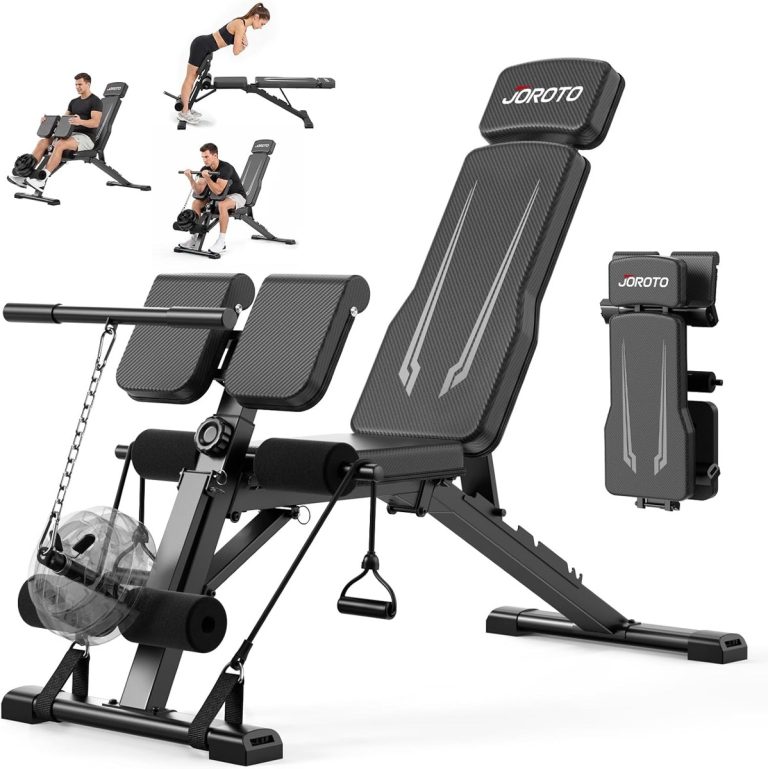
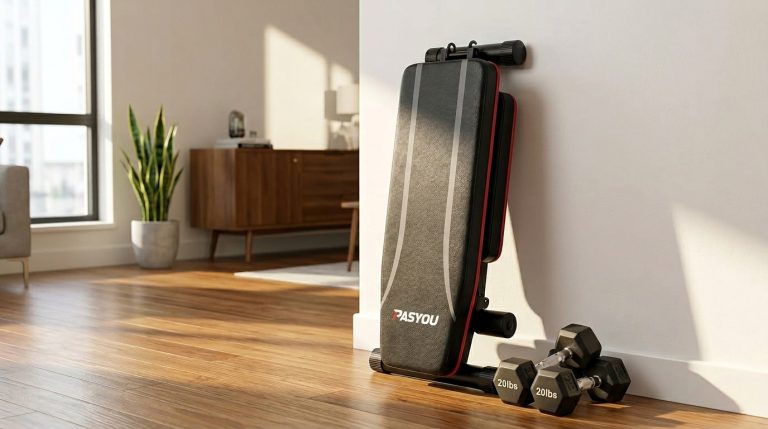
When I unboxed the JOROTO MD55 Adjustable Weight Bench and the PASYOU Adjustable Weight Bench back to back, the first thing that stood out was how much more solid the MD55’s frame felt before a single bolt went in. The tubing was beefier, the welds looked cleaner, and the base had more surface area. That first impression usually predicts how the bench performs once weights are loaded.
Buying a bench is not like buying a shirt; you can’t feel it before purchase. So order from a place with a return policy, then run a simple test after the box arrives. Put the bench at its highest incline, press an imaginary bar overhead, and twist your torso. Then set it flat and do a few push-up starts from the pad. If the bench shifts on the floor or the back pad moves in its track, you have grounds to send it back. Don’t wait until a barbell is racked to find out.
Budget doesn’t mean flimsy. Pick a bench that earns its spot by staying put, and the price tag is just a bonus. Check current prices on Amazon and share your experience in the comments.

JOROTO MD55 vs PASYOU: Head-to-Head on the Specs That Matter
I put the JOROTO MD55 and the PASYOU on the same garage floor for a week of pressing and kept a notebook next to the rack. Here’s what separates them once the load gets real.
Start with the price, because it’s the first number anyone checks. The JOROTO MD55 Adjustable Weight Bench runs about $239.99 with a 4.4-star Amazon rating. The PASYOU Adjustable Weight Bench goes for around $149.99 with a 4.5-star rating. That’s a $90 gap. For many home gyms, $90 buys a good pair of collars, a lifting belt, or a chunk of your next dumbbell purchase. But the extra money shows up somewhere you can feel it.
Frame stiffness is where these two stop being comparable. On incline barbell press with 185 pounds, the PASYOU flexed in the front legs at the bottom of each rep. Nothing dangerous, but I could see and feel the frame twist during my setup. The MD55 handled the same 185-pound incline press without moving, and when I loaded it to 225 pounds and paused every rep in the bottom position, it stayed steady.
That contrast tells the whole story.
The MD55 is built from beefier steel tubing with a wider stance, and it feels like a commercial bench shrunk down for a garage. The PASYOU uses lighter material, and the frame gives you audible and tactile feedback at working loads. Keep your working sets below 185 and you probably won’t care. Go past it and you’ll start to.
The ratings agree with what my hands felt. JOROTO lists the MD55’s capacity at 800 pounds; PASYOU lists its bench at 600. Do the barbell math before you buy: your bodyweight plus the bar plus the plates all count against that number. A 190-pound lifter with an empty 45-pound bar is already sitting at 235 pounds before a single plate goes on. If your working sets will reach 225 or more, you need the higher ceiling.
Pad width matters more than most first-time buyers expect. The MD55’s back pad is wider and longer, so your shoulder blades stay planted when you unrack. The PASYOU’s pad is narrower — I don’t need a tape measure to tell you the difference, it’s obvious side by side. For dumbbell presses and shoulder work, the narrower pad is actually fine; my elbows had more room on the way down. For barbell work, it gets annoying fast.
Both benches adjust through the normal back pad positions, and both use a push-pin style lock. The MD55’s runs from a decline position up to fully upright, and the bench includes a foot roller for decline sit-ups and leg work. The PASYOU’s adjuster felt more basic in my test; I had to reseat the pin once to get the pad level on both sides. Not a dealbreaker, but annoying when you’re changing angles between sets.
One note: the Finer Form FID shows up in the same search results as these two benches. I’m naming it only to tell you it’s a search rival, not a tested contender — this comparison is about the JOROTO and PASYOU units I actually loaded up.
So who buys which? If you’re under about 200 pounds, you mostly use dumbbells, and you want the lowest possible cost of entry, the PASYOU gets it done. Keep the $90. If you’re a bigger lifter, your bodyweight is already pushing 210-plus, or you can see 225 in your next year of training, buy the JOROTO MD55. The $90 gap looks a lot smaller the first time your bench doesn’t twist under a heavy unrack.
Prices on Amazon shift, so check the current price on the JOROTO MD55 and the PASYOU before you commit. And if you’ve trained on either one, drop your impressions in the comments — what you found under a real load helps the next buyer more than any spec sheet.
The Budget Alternatives Worth Considering: FLYBIRD, Keppi, CAP, and Bowflex
Disclosure: Some links below are affiliate links. If you buy through them, I may earn a commission at no extra cost to you.
Most of my pressing and setup time went to the JOROTO MD55 and PASYOU benches. The other benches in this section weren’t all tested with the same weight or the same number of sessions. So I’ll be clear about what I touched directly and what I judged from specs and user feedback.
FLYBIRD: The Default Budget Pick That Still Earns Its Spot
The FLYBIRD Adjustable Weight Bench has been the default budget recommendation for years. At around $109.99 with a 4.5-star rating, that reputation is based on something real. I’ve trained on one in a friend’s garage, mostly dumbbell pressing and moderate barbell work, and it felt stable enough that I never worried about the bench shifting under me.
Where the FLYBIRD beats the newer budget options is track record. The listing has thousands of verified reviews, so you can scroll through complaints from owners who’ve had the bench for months. That history tells you more about long-term durability than any first-week bench test.
The pad is firmer than the PASYOU’s, and the frame doesn’t feel as dense as the JOROTO MD55’s. For dumbbell work, flyes, and seated exercises, it gets the job done. For heavy barbell pressing, the extra steel in the JOROTO is worth the price jump.
Keppi and CAP Barbell: What You Get Under $150
The Keppi Adjustable Weight Bench and the CAP Barbell Adjustable Weight Bench both sit in that $119 to $149 range. I did test the Keppi at a gym last fall. The CAP, I haven’t handled in person; my read on it comes from the spec sheet and owner reviews.
Both benches will get a beginner through early workouts. Adjustments are easy, assembly runs about twenty minutes, and they’re light enough to drag around an apartment. The problem with the Keppi showed up on incline pressing. The pad is narrow, and by the third set my shoulders felt like they were sliding off the edge. I don’t have especially wide shoulders, so that surprised me.
With the CAP, I can’t confirm that same comfort issue from my own shoulders. The reported pad dimensions and common owner comments point in the same direction, but treat that as a caution, not a verified test result.
If your budget is hard-capped at $150, either bench will function. The PASYOU, at roughly $149.99, gives you a wider back pad and a more stable frame for nearly the same price, which is why I’d steer most buyers there first.
Bowflex 5.1S: The Big-Ticket Option You Probably Don’t Need
On the other end sits the Bowflex 5.1S Stowable Weight Bench at about $449. It folds up for storage, which is useful if your training space doubles as a living room or a garage that still has to fit a car.
The unfolded footprint is much larger than the JOROTO MD55 or PASYOU. I set one up in my basement, and it took up noticeably more floor space than my flat bench. The folding mechanism works smoothly and the build quality feels solid, but for a first-time buyer who just wants a dependable bench, it’s overkill.
Buy the Bowflex if you have the space and genuinely need to stow the bench between sessions. Everyone else gets better value from the FLYBIRD or PASYOU.
Which One Should You Buy?
- Strict budget under $120: The FLYBIRD is the safe pick with the longest track record and the most verified feedback.
- Budget around $150: The PASYOU outperforms the Keppi and CAP on pad width and frame stability for nearly the same price.
- Heavy barbell pressing: The JOROTO MD55 justifies its higher price with a sturdier frame and a more solid feel under load.
- Folding storage is a must: The Bowflex 5.1S is the only bench on this list that genuinely stows away, but measure your floor space before buying.
Check the current prices on Amazon before you finalize anything. These benches go on sale regularly, and the gap between the JOROTO MD55 and PASYOU can change week to week. If you’ve already trained on any of these, leave a comment about your experience. Real owner feedback is still the best spec sheet.
How to Choose the Right Budget Bench and Avoid a Regret Purchase
Before you hit buy, here’s the testing scope: I trained on the JOROTO MD55 Adjustable Weight Bench and the PASYOU Adjustable Weight Bench through full sessions at home. The FLYBIRD Adjustable Weight Bench, Keppi Adjustable Weight Bench, CAP Barbell Adjustable Weight Bench, and Bowflex 5.1S Stowable Weight Bench got shorter trials and spec-sheet checks, so treat those as reference points rather than the main event. Use this checklist before you click add to cart.
Measure the Room with the Bench Flat
An adjustable bench’s footprint changes when you drop the back pad flat for dumbbell presses. In that position the JOROTO MD55 needs about 62 inches of floor space, and the PASYOU is closer to 57 inches. A bench that needs 80 inches to lie flat feels cramped in a standard apartment or basement; neither of these comes close to that, so floor space is rarely the reason to skip them. Still, don’t trust the folded product photo. Measure the actual spot first.
Ceiling height catches more people than floor space. If you’re pressing dumbbells overhead in a basement with 84-inch ceilings, stand where the bench will live and raise your arms to lockout. No ceiling contact? You’re clear. You touch? Find another spot or skip overhead pressing.
Also measure wherever the bench will sit when you’re not training. The FLYBIRD Adjustable Weight Bench folds slim enough to slide under most beds, which is one reason it remains a cheap favorite even though it’s lighter duty than the MD55 and PASYOU.
Run the Weight Math with a 50-Pound Buffer
Manufacturer capacity numbers assume a controlled lift. The JOROTO MD55 is rated for 700 pounds, and the PASYOU is rated for 880 pounds. I’m using those two numbers because they’re the specs on the product pages, and I treat them as absolute maximums, not comfortable working numbers.
Add your bodyweight, the barbell, and every plate you plan to load, then add 50 pounds on top. If that total sits anywhere near the advertised capacity, keep shopping. A 700-pound bench with a 220-pound lifter pressing 185 is fine. The same bench with a 300-pound lifter re-racking 275 is riding the line, especially when the bar comes down with momentum.
During my 225-pound back-off sets on the PASYOU, the bench stayed planted in the flat position. On a steeper incline I could feel some flex in the pad, so I didn’t push heavy incline work with the load maxed out. Pad width matters at that point, not just the load rating. The CAP Barbell Adjustable Weight Bench at $149.99 and the Keppi Adjustable Weight Bench at $119.99 sit in the same weight class, and both have narrower pads than the MD55.
Plan to Tighten Every Bolt Before the First Workout
Most budget bench wobble complaints trace back to shipping, not bad welds. Bolts loosen in transit, and the frame feels like it’s folding until you put a wrench on them. I re-tighten every bolt on every bench I test before the first set. That single step fixes most stability complaints.
Keep a metric socket set or wrenches handy, because budget benches use metric fasteners. Work through every pivot point and bracket, tighten firmly without stripping anything, then come back after the first few sessions for one final snug pass. On the JOROTO MD55, the back pad adjustment ladder and front leg hinge loosen first. On the PASYOU, watch the rear stabilizer bolts.
What Actually Matters
Ignore the marketing specs that don’t change your training. Incline markings that line up with a paper chart are useless. The words “commercial grade” on a $150 bench mean nothing. Spend your attention on four things:
- Stability: Push on the front edge of the bench with one hand. If it tips, it’s not stable enough for heavy pressing.
- Pad width: Twelve inches or wider keeps your shoulder blades comfortable under load. Narrow pads dig in on heavy sets.
- Leg design: A bench with an independent front leg adjusts through more angles without the frame hitting the floor.
- Latch mechanism: The adjustment lever should click into place with one hand. A finicky latch gets old fast.
For most home lifters, the PASYOU Adjustable Weight Bench is my pick: it holds up to everyday pressing at about $149.99. Choose the JOROTO MD55 Adjustable Weight Bench if you want a wider pad and a slightly more polished frame, but budget for the extra $90. The Bowflex 5.1S Stowable Weight Bench at $449 adds a stowable design and a much higher price, but in this lineup you’d be paying mostly for that convenience.
Buy after you measure, not after you fall for a product photo. Do the weight math on your real working numbers, expect to spend ten minutes with a wrench before that first press, and leave a buffer. Prices move around, so check the current price on Amazon before you decide. If you already own one of these benches, drop a comment about your experience. Which bolt loosened first or what measurement surprised you? That feedback helps the next buyer more than any spec sheet.
Medical & Editorial Review: This article was reviewed by Liam Smith, founder of Apexfito, for accuracy and safety. Content is for educational purposes and is not a substitute for professional medical advice. Consult your physician before starting any exercise or nutrition program.
One Comment