Recumbent vs. Upright Exercise Bikes for Seniors: Which Is Safer and More Comfortable?
Safety First: Why Seat Height and Stepping Over Matter for Seniors
Before you compare calorie burn or workout programs, ask yourself a more basic question: can I get on and off this bike without risking a fall? For older adults, the real difference between an upright bike and a recumbent bike often comes down to that single motion — mounting and dismounting.
I have watched my own father struggle with this. At 72, he can ride a stationary bike for 30 minutes without issue. But swinging his leg over the top tube of an upright bike? That is where the trouble starts. His balance is not what it was in his 50s, and the last thing he needs is a fall in the garage.
Upright Bikes: The Step-Over Problem
Upright bikes look like regular bicycles. The saddle sits over the pedals, and a top tube runs from the seat toward the handlebars. To get on, you lift one leg over that top tube, shift your weight, and swing onto the saddle. If you have good hip mobility and balance, this is easy. If your hip is tight or your balance feels shaky, this is exactly the kind of movement that causes accidents.
So measure the step-over height before you buy. Stand over the frame with your feet flat. The top tube should sit below your groin — a couple of inches of clearance if possible. If it touches or presses into your crotch, or sits level with your inseam, your foot will not clear it without a struggle. The Schwinn IC3 Indoor Exercise Bike is a traditional upright model, and on that style of frame the top tube sits fairly high. Check the clearance with your own body, not just with a tape measure on the floor.
People often ask me if a step stool solves the problem. It can help, but only if you use it the right way. Choose a wide, stable step stool, place it beside the bike, and keep one hand on the bike or a spotter nearby. Never use a step stool as a workaround for a frame that is too tall for you. If you are shorter, you may also find that the saddle on the Schwinn IC3 is higher than a typical chair. That means you are stepping up and then pivoting, which is exactly how falls happen.
There are upright models like the JOROTO X2 Stationary Exercise Bike and the Pooboo Indoor Cycling Bike that share the same basic geometry. These work fine for people who already have good hip mobility and confidence on a bike. If you have had hip replacement surgery, or you simply do not like lifting your leg high, think twice before picking one.
Why Recumbent Bikes Remove the Step-Over
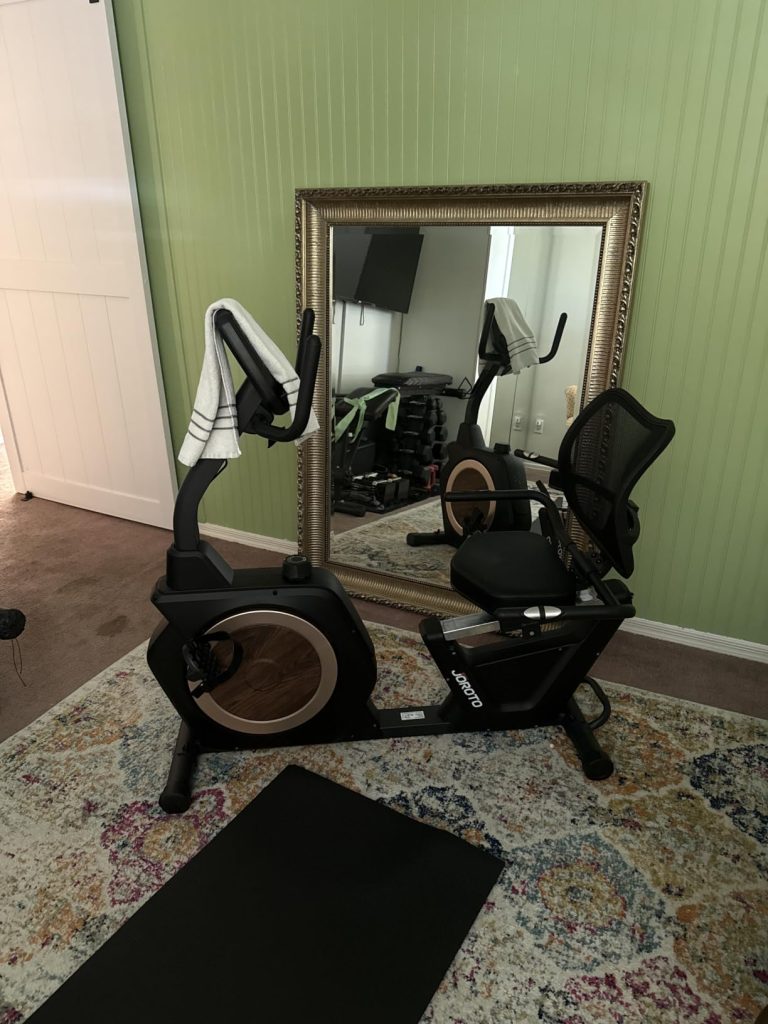
Recumbent bikes solve the mounting problem entirely. The seat is lower and wider, your legs reach forward to the pedals, and you basically sit down like you are taking a chair. No leg swing. No step-over. No balance challenge at the start of your workout.
This design is why I recommend recumbent models for most seniors who worry about falling. The Marcy ME-709 Recumbent Exercise Bike is an affordable model that is easy to mount and gives you solid back support. The JOROTO JH50 Recumbent Exercise Bike has a more adjustable seat and a frame that feels stable when you are settling into it.
Removing the step-over matters because a large portion of falls among older adults happen during transitions: getting on and off equipment, getting in and out of chairs, stepping over obstacles. A recumbent bike takes one of those transition risks off the table.
The Wall Test Before You Buy
Here is a simple test I use with anyone shopping for an exercise bike, upright or recumbent. Put the bike near a wall or a sturdy doorframe. Go through the motions of getting on and off. If you catch yourself reaching for the wall or doorframe to stay stable, that bike may not be safe for you. If you can do it without grabbing anything, that is a much better sign.
I had a client in her late 60s who bought an upright bike because it was on sale. The first time she tried to mount it, she instinctively pulled herself up using the handlebars, which strained her shoulders and threw her off balance. She returned it and switched to a recumbent model. The difference was night and day — she could sit down slowly, adjust herself, and start pedaling without any sudden movements.
Also look at the floor around the bike. A slippery surface or a loose rug can turn a simple mount into a hazard. Keep the area clear, and make sure the bike’s stabilizer bars sit flat on the ground. Recumbent bikes are usually heavier and more stable, which helps in this regard.
What to Look For When You Compare
- Step-over height on upright bikes — measure the top tube against your inseam, and look for a couple of inches of clearance below your groin.
- Seat height — the closer to chair height, the easier it is to get on and off.
- Frame stability — a wobbly bike is dangerous when you are mounting or dismounting.
- Handlebar position — you should not have to pull on the handlebars to stand up or sit down.
- Recumbent seat height — you want a seat you can lower yourself into without dropping too far.
If you cannot step over comfortably, choose a recumbent bike. That one decision removes the most dangerous part of using a stationary bike.
There is no shame in choosing the easier option. A bike you can mount safely is a bike you will actually use. A bike that feels intimidating to get on will collect dust after the second week. If you prefer an upright bike, make sure you can pass the wall test before you commit.
Check the current prices on Amazon and read recent buyer reviews before you decide. And if you have already gone through this decision, share your experience in the comments — what you bought, how the first mount went, and whether you would make the same choice again.
Recumbent vs Upright: Posture, Joint Load, and Pedaling Mechanics
The biggest difference between these two bikes is not how hard you pedal. It’s the angle of your torso. On an upright bike, you sit close to vertical with a slight forward lean. On a recumbent, you recline against a backrest with your feet reaching toward pedals out in front. That one change shifts the load on your lower back, hips, and knees in ways that matter more as the minutes add up.
An upright bike expects your body to hold itself up. Your feet push down on pedals below you, while the handlebars support part of your upper-body weight. Your shoulders and wrists take some load, and your torso has to stay balanced. For an older rider with arthritis in the hands or a stiff lower back, that position can start to feel uncomfortable after 15 or 20 minutes. I watched a friend with hand arthritis last through a 20-minute ride on an upright, then spend the next few minutes shaking her wrists out. On a recumbent, she could relax her fingers completely.
Recumbent bikes spread the load out. The seat is wider and includes a backrest that supports your lower back. Instead of holding your torso upright, you recline and push. Your hands stay free, your shoulders can drop, and the open hip angle takes tension off the lower back. That is why many older adults tolerate recumbent pedaling for longer stretches.
If you want to test the recumbent position without spending a lot, the Marcy ME-709 Recumbent Exercise Bike is a stable, budget-friendly option. It doesn’t have a lot of tech, but it does the important part: a wide seat, a solid backrest, and an adjustable seat track. You can check current prices on Amazon and see if it fits the way you want to sit.
How Hip Angle Changes the Ride
On an upright bike, your hips are flexed to roughly 90 degrees, with your knees tucked below your torso. On a recumbent, the cranks sit forward, so your hips open up and your legs reach out. That open angle usually feels easier on the lower back and lets your glutes contribute more. But it’s not a universal pass. Your individual fit, any prior injuries, and the specific range of motion your hips allow all determine how comfortable either position feels. Someone with tight hip flexors may actually prefer the upright position because it keeps the hips in a more familiar flexed angle.
If you had hip or knee replacement surgery, check with your physical therapist before choosing a recumbent bike. The reclined pedal position changes hip and knee angles in ways that can conflict with some implants and surgical protocols. This check matters more than the price tag on the bike. Do it before you drag one home.
Knee Stress Is Different, Not Automatic
Both bikes are low-impact, so neither one slams your knees the way running can. But the pedal-stroke geometry is not the same. On an upright bike, the knee bends and straightens directly below your hip, which resembles a partial squat. On a recumbent, your foot reaches forward, and the knee and hip travel through a more forward-reaching range in front of the seat. That shifts some work to the quadriceps and hip flexors. One rider may feel less pressure under the kneecap in this position. Another may feel more strain in the front of the knee, especially if the seat is set too far forward or too far back. The answer depends on your joints, your prior injuries, and how the bike fits your leg length.
Set the seat track so your knee keeps a slight bend at the bottom of the pedal stroke, whether you’re on a recumbent or an upright. On the Marcy ME-709, slide the seat until your leg is almost straight but not locked at the farthest point of the stroke. The JOROTO JH50 Recumbent Exercise Bike works the same way, with a little more padding and adjustability if you want those extras.
Those who lean toward an upright might prefer the Schwinn IC3 Indoor Exercise Bike, which has a smooth feel and a manageable seat height. If you catch yourself pulling hard on the handlebars after ten minutes, the recumbent position probably fits you better.
What To Check During a Test Ride
- Adjust the seat so your knee is slightly bent at the farthest point of the pedal stroke.
- On a recumbent, slide the seat forward or backward until the reach feels natural and your hips do not rock from side to side.
- Pedal for 10 minutes without gripping the handlebars hard. Notice if your shoulders crawl up toward your ears.
- Stop and stand up slowly. Check your lower back for any new ache.
Your body gives quick feedback. If the upright causes back or shoulder discomfort in the first ten minutes, don’t assume it will pass. A recumbent unloads the torso, and that alone makes it worth testing. Start with the Marcy ME-709 on Amazon and read recent owner reviews. If you have ridden both styles, share your experience in the comments; it helps other readers decide which one is easier on their back and knees.
Comfort Features Seniors Should Look for Before Choosing a Bike
Comfort is what keeps you coming back. I’ve watched older riders test bikes in showrooms, and the models that get the longest test rides are always the ones that fit without a lot of fussing. You can push through an uncomfortable seat for a week or two, but after that, tailbone pressure or a hard reach for the handlebars will win.
Before you compare prices or brand names, check four things: the seat, the range of adjustment, the type of resistance, and the display. Together they decide whether a bike feels like gym equipment or something you’ll actually use at home.
Seat Width and Padding
Recumbent bikes use wider seats with a backrest. The JOROTO JH50 Recumbent Exercise Bike, for example, comes with a padded bucket seat — a contoured seat that cups your hips and stops you from sliding forward. That shape spreads your weight over a larger area and supports your lower back at the same time. Upright seats are narrower and firmer by design, because your body sits more vertical and your arms help carry some of your weight.
For older riders, the recumbent setup is usually the safer pick. My own hips appreciate the wider base, and the backrest means my spine isn’t working to keep me upright for the whole ride. If you have tailbone pain or hip arthritis, that extra support can be the difference between a 10-minute ride and a 30-minute one.
A gel seat cover can help if you already have an upright bike. I keep one on my home trainer, and it softens the first few minutes. But it can’t fix a frame that’s the wrong size. If the saddle is too narrow for your sit bones or the handlebars sit too far away, no cushion will solve it. Look for a wider saddle or a different bike before you spend money on accessories.
Adjustability
Adjustability matters more than the console. A modest bike that fits you perfectly will treat you better than an expensive model that’s the wrong size.
Start with the seat. It should move horizontally and vertically so you can match it to your leg length and torso reach. The JOROTO JH50 Recumbent Exercise Bike has a sliding seat that moves front to back along a rail. The specs also list multiple handlebar positions, which helps you dial in your reach without leaning forward. That sliding seat is one of the main reasons I tell average-height and taller riders to look at this model first.
On upright bikes, seat height is your main fitting tool. Both the Schwinn IC3 Indoor Exercise Bike and the Pooboo Indoor Cycling Bike list a quick-release seat post in their specs. That means you don’t need tools to change the height, which matters if more than one person will use the bike. Before you buy, sit on the seat, put your feet on the pedals, and check that your knee has a slight bend at the bottom of each stroke. If you rock your hips to reach the pedals, the seat is too high. If your knee locks out, it’s too low.
Don’t forget the floor. Place the bike on a mat to protect your flooring and give the bike a stable grip. A cheap exercise mat also keeps the bike from shifting when you pedal hard.
Magnetic Resistance
Resistance type changes how the bike feels from the first ride. Magnetic resistance uses magnets to create drag without physical contact, so the motion stays quiet and smooth. The JOROTO X2 Stationary Exercise Bike uses this system. Owner reviews I’ve read mention the same quiet feel, and the tension changes gradually when you turn the dial mid-ride. No sudden jump, no grinding noise.
Felt-pad resistance presses a brake pad against the flywheel. It’s cheaper to build and works fine on many budget bikes, but the pads wear out over time. I’ve also found felt systems can feel sticky when you increase tension while pedaling. That’s more noticeable if you have joint pain or a sensitive lower back. Magnetic systems avoid both issues, which is why I point older riders toward them first.
Displays
A simple display is enough. Time, speed, distance, and calories cover everything most riders need. The Marcy ME-709 Recumbent Exercise Bike has a basic LCD with large numbers. I haven’t used that exact model, but the product photos show the same clear layout I look for: read it at a glance, press a button to scroll, and ignore the rest.
Look for bold digits you can see without reading glasses. Some screens use thin grey type that looks sleek on the showroom floor but becomes annoying when you glance down mid-ride. Big numbers beat pretty design every time. If a more expensive console comes with apps and workout programs you’ll never open, you’re paying for features that won’t make you more comfortable.
The Pre-Purchase Checklist
Before you order, run through this list:
- Seat: Is it wide enough for your sit bones, and does it come with a backrest if you need extra support?
- Adjustment: Can the seat move both horizontally and vertically without tools? Can you reach the handlebars without stretching?
- Resistance: Is it magnetic or felt-pad? Magnetic is quieter and smoother for home use.
- Display: Are the numbers thick and readable from your riding position?
- Mobility: Can you get on and off without holding the wall? Does the bike have transport wheels if you need to move it?
- Floor: Does the bike sit level on your floor? A mat underneath will protect the surface and keep the frame from wobbling.
Take your time, test the adjustments, and check current prices on Amazon before you commit. A bike that fits your body today will still fit next year — and the right one will feel good enough that you’ll actually use it.
Have you tried a recumbent or upright bike recently? Share your experience in the comments below.
Which Bike Should You Pick? Practical Recommendations for Seniors
Disclosure: Some links below are affiliate links. If you buy through one, I may earn a small commission at no extra cost to you.
Here’s the short version: the safest bike is the one you can mount with confidence and pedal without pain. For most older adults, that points toward a recumbent. But floor space and personal preference matter too.
- You want the easiest mount with no need to swing your leg high over a crossbar.
- You have lower-back stiffness or want a chair-like backrest.
- You have enough length in the room for a longer frame.
Choose an upright if…
- Floor space is tight and you need a shorter bike.
- You want a position closer to a regular outdoor bicycle.
- You can lift your leg high enough to clear the frame comfortably.
Start with a recumbent if lower-back support and easy mounting matter most
A recumbent bike catches you with a chair-like seat before you’re fully lowered. There’s no balancing act, and your back stays supported the whole time. I’ve watched older riders who were hesitant about exercise bikes feel comfortable on a recumbent within five minutes.
If you want to keep the first purchase simple, the Marcy ME-709 Recumbent Exercise Bike is the budget-friendly pick. The seat is padded, the step-through is low, and it takes up less floor space than many recumbents. For a first bike, that’s a practical way to test whether recumbent cycling fits your routine.
The JOROTO JH50 Recumbent Exercise Bike is the more adjustable choice. It has a wider range of seat positions, and the heavier frame makes the pedal stroke feel smoother. The catch is length. This bike needs more open floor space in front and behind, so measure before you order.
Choose an upright only if you’re comfortable stepping over the frame
Upright bikes save floor space and put you in a position closer to a regular outdoor bike. The trade-off is mounting. Use the same inseam/groin comparison from Section 1: stand next to the bike and see where the top tube sits relative to your groin. If it’s at or above that level, you’ll have to lift your leg higher every time you get on.
The Schwinn IC3 Indoor Exercise Bike is a stable upright with a steel frame and a smooth belt drive. It also has a higher top tube, so it’s best if your hips and knees can handle that lifting motion. Expect a firmer saddle than a recumbent’s.
The Pooboo Indoor Cycling Bike is another compact upright that’s easy to fit in a small room. In my own test, the resistance dial was easy to reach, but the saddle is not plush. Keep the resistance low at first and focus on steady, easy pedaling rather than pushing hard.
If you want a third upright, the JOROTO X2 Stationary Exercise Bike has a similar footprint and an adjustable seat. Use the handlebar for support when you swing your leg over, and set the saddle high enough so your knee has a slight bend at the bottom of each pedal stroke.
Practical rules before you order
- Do the step-over test. Use the same inseam/groin comparison from Section 1. If the top tube is above that line, plan on using the handlebar for support every time you mount.
- Measure the full footprint. Recumbent bikes are long. Put masking tape on the floor and outline the front-to-back length. The Marcy ME-709 is compact for a recumbent, but the JOROTO JH50 needs more space.
- Set the seat height carefully. On a recumbent, you should be able to sit down and stand up without a big drop. On an upright, keep a slight knee bend at the bottom of the pedal stroke.
- Ask your physical therapist if you’ve had hip or knee surgery. Your recovery restrictions matter more than any online review. Ask whether a reclined seat angle or a more upright position is safer for you.
So here’s my take: if you want the easiest mount, the best lower-back support, and a more relaxed pedaling position, choose a recumbent. Start with the Marcy ME-709 Recumbent Exercise Bike for a simple, lower-cost ride. Choose the JOROTO JH50 Recumbent Exercise Bike if you want more adjustability and have room for a longer bike.
If you prefer a compact bike that feels more like a regular outdoor bicycle, the Schwinn IC3 Indoor Exercise Bike is a sturdy upright, and the Pooboo Indoor Cycling Bike can fit in a tighter space. Just be ready for a firmer saddle and a higher step-over.
Check current prices on Amazon before you order because deals change often. And if you’ve tried either style, share your experience in the comments. Real feedback from other seniors can make this decision easier for the next person.


Medical & Editorial Review: This article was reviewed by Liam Smith, founder of Apexfito, for accuracy and safety. Content is for educational purposes and is not a substitute for professional medical advice. Consult your physician before starting any exercise or nutrition program.