Rowing Machine vs. Exercise Bike for Weight Loss: Which Burns More Calories in 30 Minutes?
The 30-Minute Calorie Comparison: Rowing Machine vs Exercise Bike
Which burns more calories in 30 minutes: a rowing machine or an exercise bike? If you’re choosing home cardio gear, that’s usually the first question. The simple answer is that rowing tends to win, but the bike stays closer than many people expect.
For a 150-lb person, a hard 30-minute rowing session typically burns 250 to 400 calories. The same person on an exercise bike at moderate-to-vigorous effort usually lands around 200 to 350 calories. Those ranges overlap, so your effort on any given day often matters more than the machine itself.
What counts as “hard”? To keep the comparison fair, use the same scale on both machines: a perceived exertion of 8 out of 10, where you’re breathing heavily and can get out only one or two words at a time. On the rower, that usually means a stroke rate of 26 to 30 strokes per minute with a strong leg drive and a controlled pull. On the bike, it means a cadence of 80 to 90 rpm with enough resistance that your legs feel loaded but your pedal stroke stays smooth.
Rowing pulls ahead because it uses more muscle mass. Every stroke involves your legs, glutes, core, back, and arms. Cycling is mostly a lower-body workout; your upper body stays quiet. More active muscle tissue requires more fuel, which nudges the rower’s calorie count upward in the same 30-minute window.
The bike has its own advantage. Because your upper body isn’t working, you can often maintain a hard leg pace longer before fatigue ends the session. That’s why the 200 to 350 calorie range is realistic if you’re pedaling with purpose rather than spinning easy while you scroll through your phone.
Body weight shifts the numbers. A 220-lb person can cross 450 calories on a hard 30-minute row and land close to 400 on the bike. A 125-lb person might see roughly 200 to 320 calories on the rower and 170 to 280 on the bike. Resistance matters too. On a rower, you create resistance through your own stroke power, so a stronger drive and quicker arm pull make the work harder. On a bike, you turn the resistance dial or shift gears to force your legs to push more weight. Both approaches raise calorie burn, but only if you keep intensity high without letting your form fall apart.
The calorie display on either machine is an estimate, not a measurement. It doesn’t know your muscle mass, your metabolic rate, or whether you’re genuinely pushing. I’ve seen rower screens show numbers that seemed exaggerated and bike screens show numbers that seemed low. Use the readout as a rough guide, not a report card.
Here’s a 30-minute interval session that works on both machines:
- 3 minutes easy to warm up
- 5 minutes moderate pace, where you can speak in short sentences
- 20 minutes alternating 1 minute hard and 2 minutes easy
- 2 minutes easy to cool down
If you’re new to cardio, shorten the hard intervals to 30 seconds and extend the easy time to 3 minutes. Do this workout three to four times per week, with at least one easier day between sessions.
The machine that burns more calories will not necessarily win on your joints, floor space, or budget. Once you know which one you can realistically use three to four times per week, the buying decision shifts to comfort, noise, and cost. That’s where the next part of this comparison comes in.
Why Rowing Burns More Calories (and When the Bike Is the Better Fat-Loss Bet)
Jump on a rower and take ten hard strokes. Your legs push, your back engages, your arms pull, and your heart rate jumps almost immediately. On paper, the rower can win a 30-minute calorie contest because it uses more muscle mass and lifts your heart rate fast. An exercise bike, even an upright one, mainly works your lower body, and your upper body stays relatively quiet.
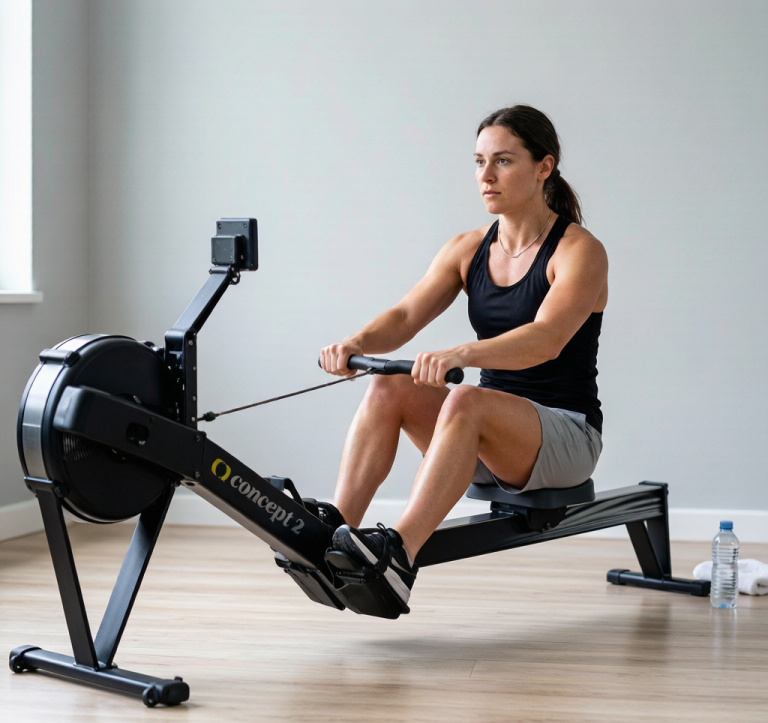
Rowing is efficient for intervals, but it demands attention. A common session I do at home is 10 rounds of 40 seconds hard, 20 seconds easy. By the second round, I’m breathing hard; by the fifth, I’m negotiating with myself to finish. That response happens because rowing toggles between strength and cardio demands with every stroke. The tradeoff is technique. If you row with a weak leg drive and overuse your arms, you’ll spike your heart rate but waste effort and leave your lower back sore. The fix is simple: start each stroke by pushing with your legs, then lean back, then pull with your arms. Once that sequence feels natural, your power output climbs, and your calorie burn follows.
The bike has a shorter learning curve. You sit down, clip in or strap your shoes, and start turning the pedals. No balance tricks. A beginner can hit a solid intensity much sooner because there’s no stroke timing or coordination to learn. That’s a big deal during your first few weeks, when the goal is to build a consistent habit. If you can complete a 30-minute ride at a steady effort, you’ll burn real calories. If you spend half your rowing session stopping to reset, you might burn less, even though the rower has a higher calorie ceiling. So the bike can produce equal fat-loss results for many people: you’re more likely to sustain the effort.
Cycling also lets me multitask. I can read a book or watch a show without the handle pulling me out of my rhythm. Rowing demands more attention. If you know you’ll only stick with cardio while doing something else, the bike is easier to sustain. And sustained effort, week after week, is what actually drives fat loss.
Comfort matters too. If you have lower-back discomfort or struggle with the saddle on a bike, rowing may feel better because your spine stays more neutral and your weight is supported through your feet and glutes. If you prefer a fully supported position, a recumbent bike takes the lower back out of the equation and lets you pedal with less core demand.
Here’s a quick test you can do before buying either machine: row for five minutes at an effort you can talk through, then ride a bike for five minutes at the same perceived effort. Notice which one feels smoother and which one keeps your heart rate higher. Pick the one you can repeat on a Tuesday night after work.
What Real-World Weight Loss Results Show About These Machines
After watching dozens of home exercisers rotate through both machines over the past few years, the machine itself rarely decides who loses weight. That’s an informal observation from my own circle, not a credentialed coaching claim. The people who lose weight are the ones who create a calorie deficit and repeat that process for months. That sounds boring, but it’s freeing: you don’t need to pick the ‘better’ machine. You need to pick the one you’ll actually use.
Let’s look at the actual numbers. The Compendium of Physical Activities assigns roughly 7 METs to moderate rowing and about 6.8 METs to moderate stationary cycling. For a 175-pound person, that works out to about 315 calories in 30 minutes on the rower and 306 on the bike. That’s a nine-calorie difference. Push both to a vigorous effort and the rower might edge out the bike by a few more calories, but the gap stays small. Your pace and how hard you’re willing to work matter more than the name on the machine.
I’ve coached a few friends through 8-week home cardio blocks. To be clear, that’s informal, not a credentialed coaching setup. The friends who lost weight didn’t pick the rower or the bike because it burned more calories. They picked one, scheduled it for the same time each day, and slowly made it harder. The ones who hopped between machines and always stayed in a comfortable zone saw little change.
A 30-minute interval format works especially well on both. On the bike, alternate 30 seconds hard with 90 seconds easy. On the rower, do 250-meter sprints followed by 2 minutes of steady rowing. Intervals drive average intensity higher than steady conversational effort, and they make 30 minutes feel shorter. If you can’t speak more than a few words during the hard intervals, you’re on target.
Track portions too. A 30-minute workout at this intensity burns roughly 300 calories for the 175-pound example. One large restaurant meal or a couple of beers can erase that gain. For the first few weeks, use a food scale to measure what you eat. That’s not forever, but it’s the most direct way to know your true calorie intake. Then adjust based on the scale and waist measurements, not on the machine’s display.
Machine calorie readouts are guesses. They don’t know your age, muscle mass, actual effort, or metabolic rate. I tested a rower and an exercise bike side by side at the same perceived effort, and both displays overestimated by roughly 15 to 20 percent. Use them as a rough workout tracking tool, not as a license to eat back your workout.
- Pick the machine you’ll use at least 4 days a week. Consistency beats a tiny calorie edge.
- Do intervals 2 or 3 days a week and steady work the other days.
- Add one extra resistance level or a few more meters per interval every week.
- Weigh yourself 3 times a week and track the trend, not the daily fluctuation.
- Use a food scale for the first 2 to 3 weeks to verify portion sizes.
Realistic expectations? Over 4 to 12 weeks, a consistent 300-calorie daily deficit leads to about 1 to 2 pounds of fat loss per week in the early phase, then slower as you adapt. That’s true whether you row or ride. The machine matters less than the consistency and the kitchen.
Before you buy, check current prices on Amazon for both machines and see which one fits your budget. And after you’ve used yours for a month, leave a comment with your own numbers — your results could be exactly what someone else needs to decide.
How to Choose Between a Rower and an Exercise Bike for Your Home Gym
Both machines can burn serious calories in 30 minutes, but the best purchase is the one that actually gets used. That sounds simple, but I’ve owned a magnetic rower for two years and used a spin bike at the gym for months, and the two machines feel completely different in daily life. This section walks you through a quick decision framework, then gives you a buying checklist, a simple interval session, and a few honest observations about comfort and space.
Three questions to narrow it down
- How much floor space can you commit? A rower is roughly 7 to 8 feet long when in use. Many models fold up, but you still need room to unfold it and move around it. An upright bike fits in a smaller corner and lets you read or scroll while pedaling. If you have a dedicated workout room, both work. If you need to tuck a machine into a bedroom corner, the bike probably fits better.
- What does comfortable mean to you? For rowers, comfort starts with the seat and footplates. For bikes, it’s the saddle and handlebar adjustments. I learned this the hard way when my first bike saddle made every ride miserable. Now I check those contact points before anything else.
- Are you willing to learn a new movement? Rowing has a skill element: legs drive first, then core, then arms, then the reverse on the recovery. That pattern takes a few sessions to feel natural. Cycling is easier to jump on, but some people find it monotonous after a few months.
What to look for in either machine
- Magnetic resistance. Rowers with magnetic drag feel smooth and don’t require pad changes. Bikes with magnetic resistance are quiet enough for apartment living.
- A clear time-and-calorie display. You want to read your numbers mid-workout without squinting. Rowers show strokes per minute and distance; bikes show RPM and speed. Either way, a readable screen keeps you honest with your intervals.
- Weight capacity with margin. Check the spec listing for your weight plus a safety buffer. Don’t assume one size fits all.
- Consistent motion. Test the flywheel and rail or drive system. If you feel a catch or clunk on a demo model, that won’t improve with use.
- On a rower: inspect the seat width and footplate angle. Your legs are the main engine, so an adjustable footplate that keeps your ankles comfortable matters more than a fancy handle.
- On a bike: focus on the saddle and handlebar adjustments. A saddle that tilts and slides, plus handlebars that move fore-and-aft, lets you position yourself without knee or back strain.
If you’re ordering online, read recent owner reviews for two specific details: noise during hard effort and assembly difficulty. A rower with a poorly fitted rail or a bike with a wobbly flywheel will kill your motivation fast.
Run this 30-minute interval workout
For your first session on either machine, keep it simple. Ride or row easy for five minutes. Then spend 20 minutes alternating one minute hard with two minutes easy. Finish with five minutes at a very easy pace. That’s the whole workout.
On a rower, hard means your split time drops and you feel your legs driving before your arms pull. On a bike, hard means you can speak in short phrases but not full sentences. If you’re gasping, take the next two-minute recovery slower than planned.
You can do this session three times a week as a beginner, and it also works as a repeatable benchmark. If you own both machines, try steady state on one and intervals on the other to avoid boredom.
Space, budget, and your final call
Space and budget often decide before preference does. A folding rower still needs length; an upright bike fits in a smaller footprint. If your room only allows one, choose the one that feels least like a chore. That’s the machine you’ll use.
If space and budget allow both, use one for steady-state sessions and the other for intervals. That gives you variety without turning your living room into a gym.
Before you order, check current prices on Amazon.com or Amazon.ca. Compare recent owner reviews for noise and assembly. Both machines appear across a wide price range, and a mid-priced magnetic model with solid reviews often beats a premium name with poor support.
Popular picks to start your search: For a rower, the Concept2 Model D remains the gold standard for serious home training, while the Sunny Health magnetic rowing machine delivers a smooth, quiet ride for well under 00. On the bike side, the JOROTO X2 stationary bike is a magnetic-resistance favorite that often lands under 00.
Disclosure: if you buy after clicking an Amazon link on this page, we may earn a commission at no extra cost to you. That doesn’t influence what we recommend.
I can’t tell you which one belongs in your home. Only your space, your joints, and your tolerance for repetition can do that. But I hope the calorie numbers, muscle talk, and this buying framework make the choice clearer. Take one machine for a test ride or find a friend who owns one. Then come back and tell us how it went — your experience might be the nudge someone else needs.
Medical & Editorial Review: This article was reviewed by Liam Smith, founder of Apexfito, for accuracy and safety. Content is for educational purposes and is not a substitute for professional medical advice. Consult your physician before starting any exercise or nutrition program.