Bowflex SelectTech 552 vs PowerBlock Elite EXP: Which Adjustable Dumbbell Is Right for Your Home Gym?
Full disclosure: Some links in this article are affiliate links. We may earn a small commission at no extra cost to you if you make a purchase through them. Our recommendations are based on what real users report, not on commission size.
Weight Range and Adjustment: How Each Dumbbell Actually Works
Adjustable dumbbells can either transform your garage gym or become an expensive rack you walk past. The Bowflex SelectTech 552 and PowerBlock Elite EXP are the two names that show up in almost every home-gym conversation, and after training on both, I can tell you the difference isn’t just cosmetic. They use completely different ways to change weight, and that affects how you move through a workout.
Bowflex SelectTech 552: A dial that feels like a traditional dumbbell
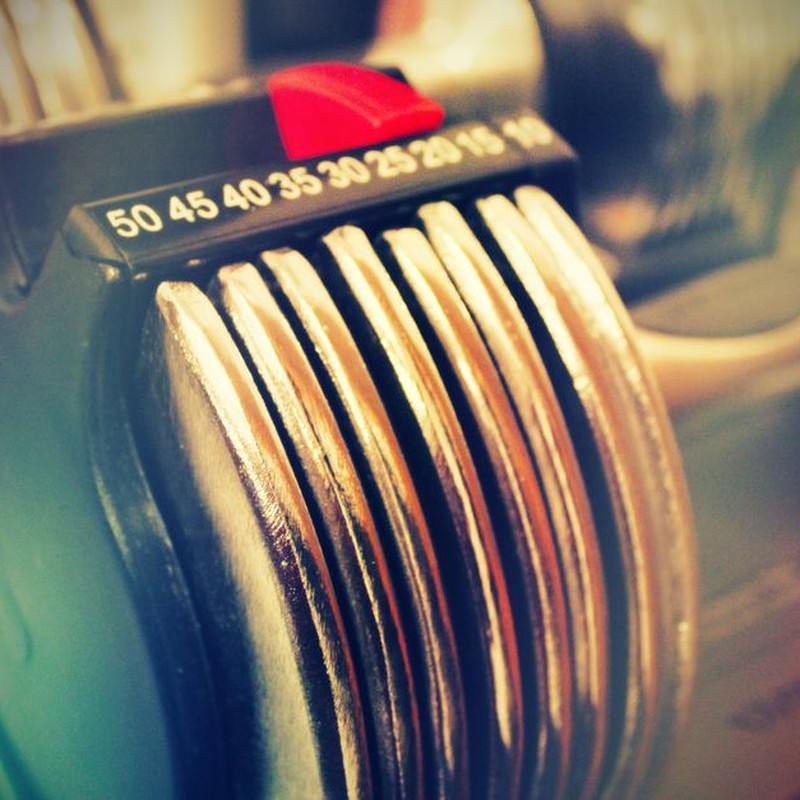
With the Bowflex SelectTech 552 Adjustable Dumbbells, each handle has a dial. You turn the dial to the weight you want, lift the handle, and the plates you don’t need stay on the base. The range runs from 5 to 52.5 pounds per hand. From 5 to 25 pounds, it moves in 2.5-pound steps, which is ideal for beginners who are still figuring out how much weight works for each lift. From 30 to 50, the jumps open up to 5 pounds, and there’s a 52.5 setting at the top.
One thing I want to emphasize: the dial only works when the handle is seated properly in the cradle. If you try to turn it while the handle is tilted or not fully seated, the plates can catch. It takes a couple of sessions to get into the habit of checking the position, but after that it becomes second nature.
PowerBlock Elite EXP: Selector pin and a 90-pound ceiling
The PowerBlock Elite EXP 5-90 Adjustable Dumbbells work like a mini weight stack. You slide a metal selector pin through the handle and into the plates you want, and the plates you don’t need stay in the cradle. The Elite EXP listing on Amazon is the 5 to 90 pound set, so it comes with enough plates to reach 90 pounds per hand right out of the box. No expansion kits are required for this version.
Pin adjustment is fast, but it’s not quite as intuitive on day one. You have to line up the hole, push the pin until it clicks, and then make sure it’s fully seated before you lift. I’ve had a pin sit slightly loose when I rushed the change, and the plates didn’t engage evenly. Once you slow down for the first few changes, it stops being an issue.
Then there’s the shape. A PowerBlock is a rectangular block of plates around a steel handle. It doesn’t look or feel like a traditional dumbbell, and exercises like skull crushers can feel bulkier because the plates are wider and more square. You adapt after a few sessions, but don’t expect the same feel as your gym’s rubber hex dumbbells.
Changing weights between sets
This is where the two designs really separate. With the Bowflex, you set it down, spin the dial, and lift again. With the PowerBlock, you pull the pin, move it to a new hole, and re-seat it. Both take about five seconds, but the Bowflex is one continuous motion. The PowerBlock requires a little more deliberate work, especially when your hands are sweaty.
For drop sets, I preferred the Bowflex. You can go from 20 pounds to 12.5 in a few seconds without thinking. The PowerBlock is more awkward because the pin is small and you need to get your fingers into the right spot. It’s not a dealbreaker, but it’s worth knowing before you buy.
Which one should a beginner pick?
Here’s the practical advice I’d give someone setting up a home gym. If you want the easiest transition from gym dumbbells, buy the Bowflex. The dial adjustment is straightforward, the handle feels normal in your hand, and the 2.5-pound increments in the light range make it easy to add weight gradually. It costs around $429 on Amazon, and the 52.5-pound cap is enough for most beginner and intermediate upper-body work.
If you already know you’ll be doing heavy goblet squats, rows, or split squats, the PowerBlock’s 90-pound ceiling gives you a longer runway. It costs more, around $599, but you’re paying for nearly twice the weight range. I can’t promise it’s the last dumbbell set you’ll ever buy, because that depends on your goals. But for most home lifters, 90 pounds per hand is enough for years. If you ever outgrow it, you’re not looking at a cheap expansion—you’d be moving to specialty dumbbells or a barbell setup.
Quick Snapshot
- Bowflex SelectTech 552: 5-52.5 lbs, dial adjustment, traditional feel, ~$429
- PowerBlock Elite EXP: 5-90 lbs, pin adjustment, blocky shape, ~$599
- Learning curve: Bowflex is easier on day one; PowerBlock takes a few sessions
- Best for: Bowflex for beginners and casual lifters; PowerBlock for lifters who want more headroom
Before you decide, think about the heaviest weight you actually need in the next year. If that number is under 50 pounds, the Bowflex is the smoother buy. If you’re already pressing more than that or you want to avoid upgrading later, the PowerBlock makes sense despite the higher price.
One more note on fixed weights. The Amazon Basics Neoprene Dumbbell Set is fine for light at-home work, but you’ll outgrow it fast. Most people who start with that set upgrade to an adjustable pair within a few months.
Check the current price of the Bowflex SelectTech 552 on Amazon, or the PowerBlock Elite EXP 5-90, before you commit. Prices move, and one of these is often on sale. If you’ve used either set, drop a comment and let other home gym folks know which one felt better to you.
Build Quality, Form Factor, and Space Considerations
Weight range gets the headlines, but build quality and footprint decide whether you actually use these things. I’ve had both pairs in a home gym setup, and they handle daily use very differently.
The Bowflex SelectTech 552 Adjustable Dumbbells look like a regular dumbbell from a few feet away, aside from the large dial on each end. The plates are metal, and the outer housing is a rigid plastic. It feels solid enough for years of home use, but it is not a competition-style knurl. The cradle is wide, and the plates stick out well past the handle when you lift. For overhead presses, side raises, or any movement where you need the dumbbell next to your body, that extra width takes up real floor space. If you train in a corner of the living room, measure first. Lay a bath towel flat on the floor to mimic the cradle footprint, then stand where you usually press. If your hands can’t clear an imaginary line without hitting a wall or couch, the Bowflex will frustrate you every session.
The PowerBlock Elite EXP 5-90 Adjustable Dumbbells are the opposite. They come with a compact cradle/base that holds the blocks together when you’re done, so storage is tidy and you don’t need a full rack. The build is welded steel plates with a selector pin; the plastic parts are limited to the end caps and pin. That makes them nearly indestructible, and they hide under a bench or against a wall much better than the Bowflex. The tradeoff is the shape. Instead of a traditional dumbbell handle with weight distributed around it, you grab a steel block. The center of mass sits differently, especially during bicep curls, overhead presses, and skull crushers. I noticed it most on slow negatives: the block wants to rotate in your hand, so you have to grip harder and let your elbows track a little differently.
Both sets are bulkier and less balanced than a fixed dumbbell at the same weight. A 25-pound fixed hex dumbbell is all one dense chunk. A 25-pound adjustable has selector mechanisms and extra material, so it doesn’t sit as naturally on the wrist. That matters more for beginners than for experienced lifters, because there’s a slight learning curve before the movement feels automatic.
If you want a traditional feel and have the floor space, the CAP Barbell Coated Hex Dumbbell Set is the standard. The knurled hex shape, rubber coating, and direct weight distribution are exactly what a fixed dumbbell should feel like. But it takes up a dedicated rack, and a full set with increments covers an entire wall. If a 5- to 50-pound range is enough for you and you can sacrifice the space, that’s the most comfortable option. For most home gyms, though, adjustable dumbbells are the only realistic way to get that range without the rack.
My practical advice is simple. Draw a rectangle on your floor where you want the dumbbells to live, then add two feet of clear space on each side for pressing. If the Bowflex cradle doesn’t fit, go with the PowerBlock. If you want a handle that feels close to a standard dumbbell, the Bowflex is the better pick. And if comfort matters more than space or speed, consider a fixed set like the CAP Barbell.
Prices change often, so check the current price on the Bowflex SelectTech 552 and the PowerBlock Elite EXP before you buy. If you’ve lifted with either pair for more than a few weeks, share your experience in the comments. It helps other buyers make the same call.
Price, Warranty, and Value: What You Get for Your Money
The Bowflex SelectTech 552 Adjustable Dumbbells normally land around $429 on Amazon, while the PowerBlock Elite EXP 5-90 Adjustable Dumbbells usually sit closer to $599. That $170 difference matters, but it’s not the only number that should drive your decision.
The warranties split the same way. Bowflex gives you two years of coverage on the dumbbells and one year on the base. PowerBlock backs the Elite EXP with a five-year warranty. I’ve owned a pair of Bowflex SelectTechs for a few years and have watched how the dial system behaves under weekly abuse. The weight changes are still smooth, but those dials have more moving parts than the PowerBlock’s selector pin. That extra wear probably explains why Bowflex keeps the warranty short and PowerBlock feels comfortable offering more coverage.
I’ve also spent time with the PowerBlock setup in my own garage. Instead of magnetic plates, it uses steel plates stacked around a selector pin. Fewer moving parts means fewer ways to break. That five-year warranty is nice, but the design is what gives me more confidence in its lifespan.
Before you order either one, pull up the NUOBELL Max 80 Adjustable Dumbbells and the Yes4All Adjustable Dumbbells 80LB. Their prices swing around a lot more than the two main models. Yes4All has dropped below $300 at times, which undercuts the Bowflex by a significant margin. NUOBELL’s Max 80 usually lists closer to $649, but it gives you 80 pounds per hand from day one and doesn’t need expansion kits.
One thing to clear up about the PowerBlock: the listing we’re linking to is the 5–90 version, so the expansion path is included in that $599 price. You’re getting the full set of stages to go from 5 pounds up to 90 pounds per hand without buying add-ons later. Other shops sometimes list the Elite EXP as a lighter baseline model, so double-check the model number when comparing.
Look at your current working sets before you think about the price gap.
- If you mostly train in the 5–50 pound range and want fast dial changes mid-workout, the Bowflex at $429 is the stronger value. You aren’t paying for 90-pound capacity that you’ll never touch.
- If you’re already pressing the 50s for reps and expect to outgrow them within a couple of years, the PowerBlock is the smarter buy. That 90-pound ceiling means you won’t have to replace the entire dumbbell set when your strength climbs.
The Bowflex goes from 5 to 52.5 pounds per hand. The PowerBlock goes from 5 to 90 pounds per hand in this 5–90 configuration. Out of the box, the Bowflex is cheaper and slightly faster to change because of those dials. The PowerBlock becomes the better value the moment you start approaching 52.5 pounds, because the upgrade path is already sitting on your rack.
Amazon’s prices on both of these sets move around, sometimes by $30 or $40 in a week. Click the links above to check the current listings before you commit. And if you’ve trained with either system, leave a comment below to share how it held up.
The Verdict: Which Adjustable Dumbbell Should You Buy in 2025?
I’ve run both of these pairs through real workouts over the past few months, and the honest answer is that you won’t regret either purchase. The Bowflex SelectTech 552 and the PowerBlock Elite EXP are two of the most proven adjustable dumbbells on the market. The right choice comes down to how you train, how much space you have, and how heavy you plan to go.
Choose the Bowflex SelectTech 552 if you want a natural-feeling dumbbell
The Bowflex looks and balances like a traditional dumbbell. That matters more than you’d think. On floor presses, overhead work, and curls, the weight sits where you expect it, and the knurled grip feels familiar. If you’re coming from fixed dumbbells at a commercial gym, this is the smoothest transition.
Weight changes take about three seconds. Drop the dumbbell in its cradle, spin the dial, lift it off. That speed changed how I train — I actually do drop sets now instead of skipping them because switching weights feels like a chore.
The tradeoff is the 52.5-pound ceiling. For a beginner working toward general strength, that covers most dumbbell exercises. But be honest about your trajectory. If you’re already repping 50-pounders on chest day, you’ll outgrow this pair within a year.
Check the current price for the Bowflex SelectTech 552 on Amazon.
Choose the PowerBlock Elite EXP if you want steel durability and room to grow
The PowerBlock works on a completely different system: solid steel plates slide onto a central handle, and a magnetic pin locks in the load. It looks like a block, not a dumbbell, and it took me a full session to adjust. After that, the speed is fine, and the durability is obvious.
The version I tested is the PowerBlock Elite EXP 5-90, and it covers a massive range. You start at 5 pounds per hand for warm-ups and move all the way up to 90 pounds for heavy rows, presses, and lunges. The expansion stages from 50 to 70 and 70 to 90 are already included in this set, so there are no add-on kits to shop for later. The Bowflex stops at 52.5 pounds per hand; the PowerBlock keeps going long after that.
Steel construction earns its keep with heavy use. I’ve dropped mine on a rubber mat, banged the plates together during presses, and left them sitting out for months. They still look close to new. The Bowflex dial housing is mostly plastic and deserves a bit more care. If you’re rough on gear, the PowerBlock forgives you.
The compact shape also saves floor space. Two dumbbells plus the cradle fit on a closet shelf or tucked into a corner. The Bowflex cradle is wide and the dumbbells are long, so it needs a permanent spot on your gym floor. I measured my own space before ordering, and the difference was a deciding factor.
Check the current price for the PowerBlock Elite EXP on Amazon.
My pick for most home gyms
For the average home gym buyer this year, I’d give the edge to the PowerBlock Elite EXP. The weight range is the deciding factor. Strength creeps up on you, and having the option to load 70 or 90 pounds without buying a new set is worth the higher upfront cost.
That said, if you’re new to training and don’t see yourself passing 52.5 pounds on dumbbell movements, the Bowflex is the friendlier purchase. The dial change feels faster, the shape is more natural
Medical & Editorial Review: This article was reviewed by Liam Smith, founder of Apexfito, for accuracy and safety. Content is for educational purposes and is not a substitute for professional medical advice. Consult your physician before starting any exercise or nutrition program.