Strength Training After 50: Strength or Cardio First? A 3-Day Beginner Plan
Full disclosure: Some links in this article are affiliate links. We may earn a small commission at no extra cost to you if you make a purchase through them. Our recommendations are based on what real users report, not on commission size.
Strength or Cardio First After 50? Start With the Question Behind the Question
Type "should I do cardio or weights first" into a search bar and you’ll get a hundred confident answers, most of them contradicting each other. Ask a metabolic health expert and you get something more useful handed back: a question about what you’re actually training for.
That’s the shape of a Fit&Well piece published September 24, 2026, titled "Should you prioritise strength training or cardio as you age? I asked a metabolic health expert." The short version, in plain language: there’s no universal correct order. Sequence should serve the outcome you’re chasing. Someone trying to hold onto muscle through their sixties and someone trying to blunt post-meal glucose spikes might get better results doing the opposite thing first. Neither is wrong for their situation.
One more thing worth knowing before we go further. Google Trends shows US search interest in "strength training after 50" has been essentially flat over the past 12 months, and low in absolute volume. That’s a rough signal, not proof of anything — search data can’t tell you what people do once they’re inside a gym. But it does hint that this strength-versus-cardio split isn’t a question most people over 50 are actively researching. Plenty are simply standing between the treadmill and the dumbbell rack, picking whichever one they dislike less that morning.
If that’s you, no judgment. Half the decision is showing up at all.
The four goals that change the answer
Before you can sequence anything, you need to know which of these you’re actually solving for. Most people over 50 are chasing two or three at once.
- Keeping muscle and bone. After 50, muscle mass and bone density drift down unless you give them a reason to stay put. Resistance training is one of the most direct levers for both at the same time, which is why it tends to sit at the front of the session for most people.
- Blood sugar and metabolic health. Working muscles pull glucose out of the bloodstream, and they keep doing it for a while after you rack the weights or step off the bike. Both types of training touch this, just through different doors — which is part of why the expert’s answer depends on your starting point.
- Heart and lung capacity. Climbing stairs without stopping halfway, carrying groceries up a hill, keeping pace with grandkids. That’s cardio’s home turf, and it responds to consistent, boring, repeatable effort more than clever programming.
- Staying pain-free enough to keep showing up. This one gets ignored, and it’s the one that quietly ends most programs. If your knees, shoulders, or lower back stay angry all week, you quit by week three. No training order fixes that. Sensible load management does.
Look at how different those goals are. One rewards lifting while you’re fresh. Another rewards holding a steady heart rate for 20 uninterrupted minutes. A third rewards not overdoing either one. That’s why blanket rules like "always lift first" or "always warm up on the bike" fall apart the moment you apply them to one specific person with one specific goal.
Order is a small lever. Weekly volume is a big one
Here’s the part that gets skipped: training order matters far less than how much total work you get done each week. Three sessions you actually complete will beat a perfectly sequenced five-day split you abandon in week three. I’ve watched this play out with people I’ve trained and in my own garage setup — the version that fits your real week is the version still running in month six.
So let’s stop optimizing the sequence and start building something you’ll still be doing in the spring.
Over the next few sections we’ll put together three training days, 30 to 45 minutes each, using optional dumbbells with bodyweight swaps for anyone who doesn’t own any. There’s one optional fourth day for walking or easy cardio, kept deliberately gentle so it doesn’t eat into recovery. Every session opens with a short warm-up and closes with two minutes of breathing or stretching, since that cool-down is often where the habit either cements or quietly disappears.
If you’re shopping for a pair of dumbbells to run this at home, prices on Amazon move around a fair bit month to month, so check current prices before you buy instead of assuming last month’s number still holds. One adjustable pair covers every exercise in the plan. And tell me in the comments whether you’ve been defaulting to the weights or the treadmill — I’m curious how many of us are winging it.
What Changes After 50, and Why You Need Both Kinds of Training
The question I hear most from adults over 50 isn’t which exercise to do. It’s what to cut. If you’ve got three days a week and about 30 minutes each, do you spend them lifting or walking?
You spend them on both. Not because balance makes a nice slogan, but because two separate systems in your body age on their own schedules, and each one needs its own kind of push to keep working.
That reframe showed up in a September 2026 Fit&Well column, where a metabolic health expert was asked to name a winner between strength training and cardio and more or less declined. The answer depends on what you’re training for. If your goal is healthy aging rather than a race or a lifting meet, you’re covering both bases instead of picking a favorite.
Muscle and strength fade quietly
Muscle mass and strength decline with age, slowly enough that most people don’t notice until something ordinary gets hard. The grocery bags feel heavier than they used to. Getting up off the floor after playing with a grandkid takes a hand on the couch.
Resistance training is the most direct lever for slowing that loss. It also puts load through your bones, which is one way to support bone density. Walking, hiking, stair climbing, and hauling groceries are weight-bearing too, so lifting is a big part of the picture, not the whole thing.
What matters just as much is joint stability. Strong muscles around the knees and hips keep those joints steady enough for hiking, gardening, and lifting a toddler without a wince.
Your heart, lungs, and blood vessels need their own work
Cardio trains a different system, the pump and the plumbing. Regular aerobic movement supports blood sugar management and builds the stamina that shows up as climbing a flight of stairs without stopping at the top to catch your breath.
I’ve watched this split play out with the people I train. The lift-only folks get noticeably stronger and still huff on a brisk walk. The walk-only folks feel fine on a flat mile and struggle to carry a loaded cooler across a parking lot.
Picking one side leaves a hole
Strong muscles with no aerobic base means you get winded easily, and that fatigue quietly shrinks what you’re willing to do. Good endurance with weak muscles means a higher injury risk during ordinary tasks, because endurance doesn’t teach your joints how to handle load.
Neither gap is dramatic on a Tuesday. Both show up on a vacation, a move, or a weekend of yard work.
The talk test: your intensity gauge, no monitor required
Beginners ask me how hard the cardio portion should feel, and I never hand them a heart-rate chart. I hand them a sentence.
- Full sentences, comfortable — easy pace. Use this for warm-ups and recovery days.
- Short phrases, slightly breathy — moderate pace. Most of your cardio minutes should live here.
- One or two words only — hard pace. Use it sparingly, maybe one short push per session after a few weeks.
That’s the whole system. If you can’t talk at all, back off. If you can chat through an entire walk, pick it up. I’ve used it with people who refuse to wear any device, and it beats staring at numbers.
One check-in before your first session
Talk to your doctor before starting if you have a heart condition, a recent joint replacement, uncontrolled blood pressure, or a new medication that affects heart rate or balance. That isn’t a scare tactic. It’s information your doctor can use to steer you toward the right starting intensity, and it takes one appointment.
Assuming you’re cleared, the practical move is a week that touches both systems instead of maxing out one. That means three days, roughly 30 minutes each, with dumbbells optional so you can start with bodyweight if that’s what you have at home.
The Weekly Split: A 3-Day Beginner Schedule With an Optional 4th Day
Three days a week is enough. Before you scroll to the schedule, sit with that for a second, because the instinct after 50 is usually to do more, not less. The metabolic health expert in that September 2026 Fit&Well piece made a point worth borrowing: the strength-or-cardio argument misses the real question, which is what you are actually training for. For healthy aging you need both, just not stacked on top of each other.
Here is the week I would hand to a friend with a job, grandkids, and maybe 30 free minutes on a good day. Four rules hold it together: strength twice, one real cardio session, at least one easy day between the hard days, and nothing running past 40 minutes.
Day 1 (Monday): Full-Body Strength, 30 to 40 Minutes
Warm up with five minutes of easy walking and a few arm circles, then run six exercises. Two sets each, 8 to 12 reps per set, 60 to 90 seconds of rest between sets. That is the whole prescription for the first four weeks. Around week five, if you are recovering well and sleeping fine, add a third set to each exercise. Not before. Beginners who jump straight to three sets tend to get sore, skip Friday, and start over from zero a month later.
The intensity cue matters more than the number stamped on the dumbbell. Stop each set when you think you could grind out two or three more clean reps. Beginners leave more in the tank than they realize, and that leftover gap is where the adaptations actually live.
The six movements cover what keeps you functioning in real life:
- A squat or sit-to-stand pattern
- A dumbbell row
- A hip hinge, like a Romanian deadlift
- An incline or floor push-up
- A step-up or split squat
- A farmer carry or dead bug for the core
Day 2 (Wednesday): Cardio Plus Mobility, About 40 Minutes
This one should feel almost boring, and that is on purpose. Do 25 to 35 minutes of steady walking, cycling, or rowing at a pace where you can talk in short sentences but not belt out a song. Save intervals for later in your training life. If you are walking outdoors, a slight hill does the job without you having to think about zones.
Then 8 to 10 minutes of mobility for the spots that quietly stiffen up: hips, shoulders, ankles. Hip flexor stretch, 90/90 hip switches, shoulder pass-throughs with a towel, slow ankle rocks, a few cat-cows. Ten minutes here buys you cleaner squat depth on Monday.
Day 3 (Friday or Saturday): Full-Body Strength, Same Structure, New Variations
Same six slots, same two sets of 8 to 12, same rest periods. Swap the movements so the week is not a rerun. Goblet squat becomes a box squat onto the chair. Two-arm row becomes a single-arm row with your free hand braced on the chair, or a chest-supported row if you happen to own a bench. Romanian deadlift becomes a single-leg version or a feet-elevated glute bridge. Push-ups move to the kitchen counter. Step-ups become reverse lunges with the chair nearby for balance. Farmer carry turns into a suitcase carry, or a slower-tempo dead bug.
Different angles, same muscles, less boredom, and a little less joint wear than repeating an identical session twice.
Optional Day 4 (Sunday): 20 to 40 Easy Minutes
An easy walk, a relaxed bike ride, a long meandering loop with the dog. Keep it fully conversational. This is recovery, not a fourth hard session, and if your legs are still sore from Friday, skipping it is the smarter call. That shape of week, two strength days plus one cardio day plus one optional easy day, stays the same for all 12 weeks. What changes over those months is how much weight you are moving, not how many days you are training.
What You Actually Need
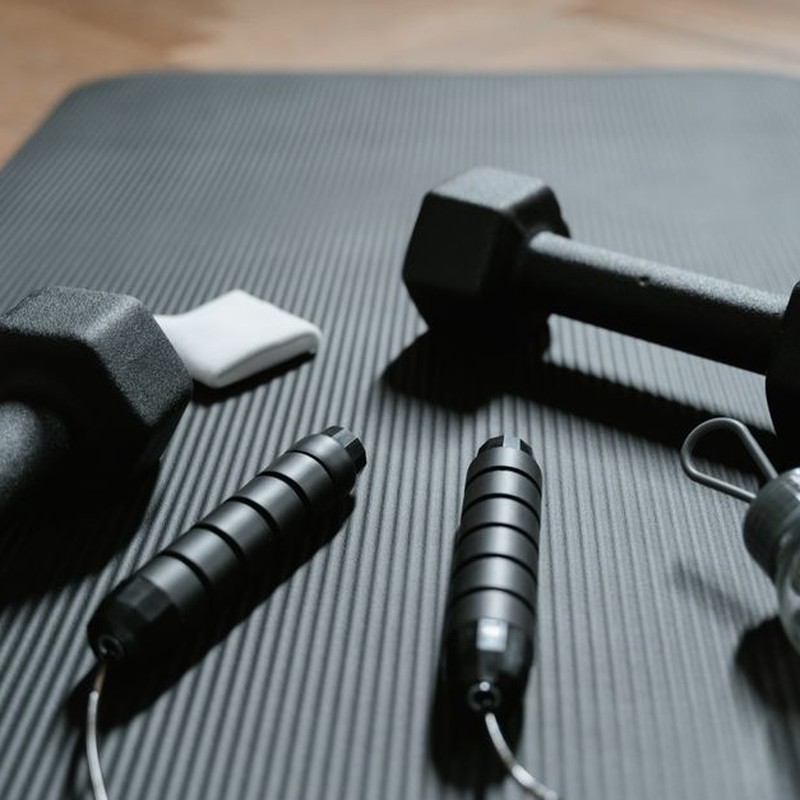
One pair of adjustable dumbbells, a sturdy chair, and about six feet of floor space. A bench is optional, and nothing in this plan requires one. There is no bench press in the program, so if you do not own a bench you are not missing an exercise. If you do have one, it is just a comfortable seat for rows or a taller step for step-ups. That is the whole equipment list, no barbell, no gym membership, no resistance bands you will never unroll. Adjustable dumbbell prices swing a lot, so check current listings on Amazon rather than trusting a screenshot you saved months ago.
A few rules for messy weeks. If Wednesday gets swallowed by a work thing, do not stack two sessions on Thursday. Move cardio to Thursday and strength to Saturday. If a week collapses and you only get two sessions in, do the two strength days. Small and consistent beats ambitious and abandoned.
Progression stays simple too. Once you hit 12 clean reps on every set of an exercise, add about five pounds and drop back to 8 reps. That one rule carries you through the first two or three months, and it applies whether you are on two sets or three.
Give the week a try and tell me in the comments how the Wednesday mobility block felt, or which exercise swap you ended up preferring.
What to Do First Inside Each Session
The strength-or-cardio-first question gets easier once you stop treating it as one decision for your whole week. In a September 2026 Fit&Well piece, a metabolic health expert framed the choice around what you are actually training for. That lens fits a beginner over 50 well. Every session has its own job, so every session can have its own order.
One rule sits above the others: warm up for five minutes before you touch a weight or pick up the pace. Order logic does not apply to muscles that have not moved yet. Easy walking, marching in place, arm circles, a slow turn on the bike, plus a few bodyweight reps like sit-to-stands or wall push-ups. Those five minutes do more to lower injury risk than any sequencing trick. If 30 minutes is all you have, count the warm-up as part of the session rather than an extra.
Lift first on strength days
When the main job is getting stronger, do your dumbbell work before cardio. You are fresher, your form holds up on the last rep, and you get more from fewer sets when your legs are not already cooked from 30 minutes of cycling.
A beginner version might be two sets of goblet squats, two sets of dumbbell rows, and two sets of push-ups done on a counter, a sturdy chair, or the floor, whichever lets you finish with clean form. Then 10 minutes of easy walking or cycling. If pressing a weight feels better than pushing your bodyweight, a dumbbell floor press works and tends to be kinder to older shoulders than a bench setup. Two sets is the plan. Someone eight or ten weeks into consistent training might add a third set to one or two lifts, but that is an optional progression, not a requirement for progress.
Flip the order when cardio is the point
Some days are cardio days, and there is nothing wrong with that. A Saturday hike, a long walk with friends, a ride on the bike path. Do that while you are fresh, then finish with a shorter strength session of one or two sets each rather than three. A set of squats, a set of rows, a set of push-ups, a set of hip hinges. The habit stays alive, the hike stays fun, and your muscles still get a reason to stick around.
If your doctor flagged blood pressure or blood sugar
Keep the intensity moderate and don’t jump from hard lifting straight into hard cardio. Add 5 to 10 minutes of easy movement in between so your heart rate slides down gradually — a slow walk around the block, gentle pedaling, or easy stretching with steady breathing. Use the talk test during the moderate parts: short sentences should still be possible. This is not about being fragile. It is about making the session repeatable tomorrow.
Save time with a push-pull superset
When 30 minutes is all you have, pair a push and a pull. Push-ups with dumbbell rows is the combo I still use at home: 8 to 12 reps of each, two rounds, resting 60 to 90 seconds between rounds. Two rounds fits the beginner plan. A third round is something to earn later, not a starting line.
Write down the weights and reps you used each session. Next week you have a starting point instead of a guess. If the last couple of reps felt smooth, add a small amount of weight or one rep. If your form broke down, stay at that weight and own it first.
Order matters less than showing up. Warm up first, lift first on strength days, do cardio first when cardio is the day’s main event, and put easy movement between hard efforts if your doctor flagged something. That is enough structure to keep a three-day week from feeling random. If you want to add load at home, check current prices on Amazon for a pair of adjustable dumbbells, and tell me in the comments which order ended up working for you.
Progression, Recovery, and Fitting Cardio Around Strength in Weeks 1-12
Twelve weeks sounds like a big commitment. It is really four short blocks, each with one job. Change one thing at a time and you rarely have to guess why something stopped working.
The Fit&Well reporting from September 2026, which asked a metabolic health expert whether strength or cardio should come first as you age, did not land on one universal answer. It depended on what you were training for. Progression runs the same way: the thing you are trying to improve decides how you arrange the week.
Weeks 1-2: Learn the movements, not the numbers
Two sets per exercise, with loads light enough that you could grind out three or four more clean reps on the final set. That is the whole assignment. A goblet squat with a 15-pound dumbbell that looks effortless beats a wobbly set with 30 that leaves your low back talking to you on Thursday.
Cardio in these two weeks is one scheduled session, 20 to 30 minutes of walking, biking, or rowing at a conversational pace, plus one optional easy day if your week has room in it. Not two or three hard sessions on top of the lifting. The strength work is the new stimulus here and it deserves the recovery.
Weeks 3-6: Turn one dial at a time
Now you can add a set or five pounds, whichever fits your setup, once the last rep feels easy two sessions in a row. Two, not one good day. And only one of those options per week.
Adding a set is on the table for every beginner at this point, not just people who feel advanced. It is simply off the table in weeks 1-2, when the job is learning the pattern and building the habit.
- Added a set? Keep the weight where it was.
- Added weight? Keep the sets where they were.
- Finish each session with roughly two or three reps left in reserve on the final set.
If you add a set and five pounds in the same week and your shoulder starts barking, you will not know which one caused it. Slow is faster here.
Weeks 7-9: Cardio gets the extra room
Strength volume holds steady now. Instead, add the optional fourth lifting day or stretch the cardio you already do by five to ten minutes. This is the block where the aerobic side can grow without asking your joints to recover from more load.
Order on the day itself still follows your goal. Leaning toward strength? Lift first and walk afterward. Training for a long hike or a group ride? Do the cardio fresh and lift after. Hard cardio the day before heavy legs is the combination that most often shows up as a cranky knee the next morning. In my own week, a full day of walking between lifting sessions has worked better than stacking them back to back.
Weeks 10-12: Deload, then repeat
Cut strength sets by about a third for one week and keep walking as usual. Same exercises, less work. Sleep and sore joints tend to catch up fast, and most people come out of a deload handling the same loads with less effort. Then run the four blocks again with slightly heavier starting weights.
Recovery beats anything in the supplement aisle
- Seven to nine hours of sleep. Everything else in this plan gets harder without it.
- Protein at each meal. A palm-sized portion is a workable target without weighing anything.
- One full rest day every week.
- Two lighter days when knees or shoulders feel off. Swap a set for a walk instead of skipping the session outright.
When life interrupts
Missed a week? Restart at roughly 80% of your previous loads and do not pile on extra sessions to catch up. That is how people end up sidelined in week five. Aerobic fitness comes back quickly, often within a few sessions, but tendons take longer. That gap is the practical reason to rebuild slowly instead of testing yourself on day one back.
Write your loads down. A note in your phone takes ten seconds and saves you from guessing whether the dumbbell in your hand is the one you used last Tuesday.
One thing to handle before you start
If you are still sorting out equipment, check current prices on Amazon before committing to adjustable dumbbells or a bench. Those two items move around more than anything else on a home gym list, and buying the version you will actually use inside a 30-minute window matters more than saving a few dollars on something that sits in the closet.
Which order has worked better for your body, strength first or cardio first? Tell me in the comments, including how you felt after the first month. Someone reading this next week will get more from your experience than from any general rule.
This article is general information, not medical advice. Talk with your doctor before starting a new program, especially if you have joint, heart, or blood pressure concerns or take medication that affects balance.