The 20-Minute Dumbbell Workout: A Beginner’s Full-Body Routine
Why a Pair of Dumbbells Is Enough: Choosing Your Starting Weight
One pair of dumbbells can cover every major movement pattern in this workout: goblet squats, single-arm rows, overhead presses, floor chest presses, Romanian deadlifts, and farmer carries. That’s why this full-body routine needs nothing else. The only decision that really matters is the weight you grab.
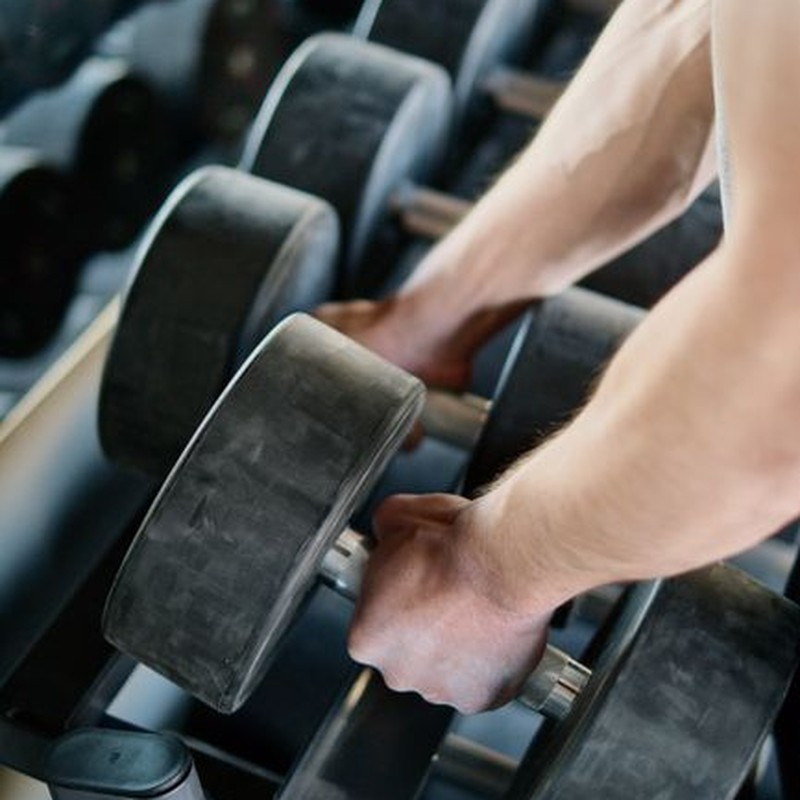
Let Your Overhead Press Pick the Weight
The overhead press is the strictest test in this workout. It’s also the move beginners mess up first when the weight is too heavy. So use it to choose your starting pair.
Grab a dumbbell and press it straight overhead. You want a weight you can handle for 8 to 10 clean reps. Clean means smooth: no shaking, no arching your back, no using your hips to heave it up. Can’t hit 8? Go lighter. Hit 10 without slowing down? Go heavier.
Don’t choose your set based on bicep curls. Curls are fun, and almost everyone can curl more than they can press. But this workout uses presses, squats, and rows, so the press test gives you a weight that works for everything.
For most total beginners, that lands somewhere around 10 to 25 lb per hand. Your exact number depends on your training history, not your gender. A former athlete might press 25 lb on day one; an office worker might start at 10 lb. The press test tells you which one you are.
When a Fixed Pair Won’t Be Enough
A fixed pair works well for the first few weeks. Then your muscles adapt, 15 lb stops feeling like work, and you need to go heavier. An adjustable pair solves that problem with one setup.
Disclosure: Some links below are affiliate links. If you buy through them, I may earn a commission at no extra cost to you.
If you want the easiest adjustable pair to use at home, the Bowflex SelectTech 552 Adjustable Dumbbells has you covered from 5 to 52.5 lb per hand for about $429. I’ve used these, and the dial system is quick enough that you’re not fighting with change plates between sets. They’re the pick I’d trust for a beginner who wants a clean-looking setup — and they hold a 4.6-star rating.
If you want more room to grow, the PowerBlock Elite EXP 5-90 Adjustable Dumbbells goes up to 90 lb per hand and costs around $599. That’s a buy-once setup for strength training, because you won’t need another pair once you leave the beginner phase. It takes a few seconds more to change weight than the Bowflex, but the extra range is worth it if you plan to keep training for years.
On the budget end, the Amazon Basics Neoprene Dumbbell Set is fine for starting at home for under $60. The neoprene is comfortable and won’t scratch your floor. But you’ll outgrow it quickly if your goal is visible strength, so I’d only buy it if you’re not sure you’ll keep training yet.
Check today’s price on Amazon before you order — dumbbell deals change often. And if you already train with a single pair at home, tell me in the comments how you picked your starting weight. I read every one.
The 20-Minute Full-Body Dumbbell Routine
This whole workout is one circuit: three rounds, five moves, and a short finisher. You don’t need a bench or a rack. Just one pair of dumbbells, enough floor space to lie down, and about 20 minutes. I’ve run this exact setup with a single adjustable pair at home, and it still works when all I have is 20 minutes before dinner.
Before you start, do one warm-up set of each movement with a light weight, or use just your bodyweight for the squat and push-up. Keep the reps easy, maybe 5 to 8. This isn’t the workout; it’s just to let your shoulders and hips know they’re about to work.
Complete 3 rounds of the circuit below. Rest 45 to 60 seconds between rounds. If you need a quick breather between exercises, take 30 to 45 seconds — that’s not cheating. Beginners often need those extra seconds to reset, especially before the shoulder press.
- Goblet Squat — 12 reps. Hold the dumbbell vertically against your chest with both hands, like you’re cradling something heavy. Keep your heels down and chest tall, then sit your hips down until your thighs are at least parallel to the floor. Go lower if your lower back stays happy. This move hits your quads, glutes, and core in one rep.
- Push-Up with Dumbbell Row — 6 push-ups + 8 rows per side. Set the dumbbells on the floor at shoulder width and grip the handles. Lower through a push-up, then press back up and row one dumbbell up toward your hip. Alternate until you’ve done 8 rows per side. If you don’t feel steady on the handles, do the push-up with your hands on the floor or on a bench, then stand up and row one dumbbell with a flat back and a slight knee bend.
- Dumbbell Romanian Deadlift — 12 reps. Stand with the dumbbells in front of your thighs, palms facing you. Push your hips back and hinge forward with a soft knee bend. Lower the weights along your shins to mid-shin. You want a real stretch in your hamstrings, then squeeze your glutes to stand back up. Don’t let your back round.
- Standing Dumbbell Shoulder Press — 10 reps. Bring the dumbbells to shoulder height with your palms facing forward. Brace your core and press both weights straight up until your arms reach lockout, then lower them with control. If you have to arch your lower back to chase lockout, the dumbbells are too heavy.
- Dumbbell Farmer Carry — 30 seconds. Hold a dumbbell in each hand at your sides, stand tall, keep your shoulders down, and walk around your living room. If space is tight, march in place. This finisher doesn’t look flashy, but it lights up your grip, upper back, and core.
Timing note: the three rounds themselves usually take about 15 minutes when you keep rest honest. Add the warm-up and any weight changes, and you’re close to 20. Some days it’ll run a little longer. That’s fine.
This circuit is why I keep at least one adjustable dumbbell pair at home. Your legs can handle more weight than your shoulders, so you don’t want to be stuck with one load for everything. The Bowflex SelectTech 552 Adjustable Dumbbells switch from light to heavy in a few seconds, and the PowerBlock Elite EXP 5-90 Adjustable Dumbbells goes up to 90 lb per hand if you want room to grow. For a simpler dial system, the NUOBELL Max 80 Adjustable Dumbbells feels closer to a traditional fixed dumbbell. On a tighter budget, the Yes4All Adjustable Dumbbells 80LB gives you about 8 to 40 lb per hand, which covers this whole routine. Check current price on Amazon if you want to see how these compare.
If you’re using fixed-weight dumbbells, pick a load that lets you press overhead without arching your back. A set like the CAP Barbell Coated Hex Dumbbell Set is a set of multiple dumbbells, not one pair, so check the listing carefully to see what’s included. I use the Amazon Basics Neoprene Dumbbell Set for warm-ups and light upper-body work, but you’ll want something heavier in your hands for the squats.
Run this circuit three times a week with at least one rest day between sessions. Monday, Wednesday, Friday works for most beginners. After the first week, if the final round feels easier than you expected, go a bit heavier on the squat and deadlift, or add a fourth round. Don’t skip the farmer carry — it builds grip for everything else you’ll do later.
Try it once and come back to the comments to tell me how the third round felt. And if you don’t own a set yet, compare those links above for current prices before you buy.
Weekly Structure: How Often Should Beginners Train?
You don’t need to live in the gym to see results. I’ve had clients try to jump straight to five or six sessions a week, and they usually burn out by week two. Three focused sessions build muscle and still leave room to recover.
The Simple Beginner Schedule
Try Monday, Wednesday, and Friday. That spacing gives your muscles roughly 48 hours between sessions, which is what your body needs to repair and grow. It also makes the habit easy to remember: work, recover, work, recover.
- Monday: Full-body dumbbell routine (20 minutes)
- Tuesday: Off — 20-minute walk or easy mobility
- Wednesday: Full-body dumbbell routine (20 minutes)
- Thursday: Off — 20-minute walk or easy mobility
- Friday: Full-body dumbbell routine (20 minutes)
- Saturday: Active rest — walk, stretch, or play with the kids
- Sunday: True rest — nap if you want
This schedule fits around a busy week. You’re done before most people even finish their warm-up.
How to Progress Without Overcomplicating It
Keep every session to 20 minutes for the first few weeks. Once that feels smooth, add one extra round to the routine or go up a few pounds. Extend time last, not first.
Adjustable dumbbells make this simple because you can change weight between exercises. If you’re working with the Amazon Basics Neoprene Dumbbell Set, that’s fine for month one — just plan to move to something heavier when the last reps stop feeling challenging.
What to Do on Off Days
Take a 20-minute walk or do some light mobility work. This gets blood flowing and can ease soreness. It also keeps you moving without stealing energy from your next lift.
When Your Schedule Gets Messy
Missed a Wednesday workout? Shift it to Thursday and take your rest day on Wednesday. Aim for non-consecutive days most of the time, but don’t obsess over one bad week.
Back-to-back days are the only option? Train normally on day one. On day two, use half the weight and slower tempos. You’ll still get a productive session without digging a fatigue hole.
Three days a week is enough. Stick with the schedule, keep sessions short, and let rest days do their job.
Check current prices on Amazon for the dumbbells in this article and share your experience in the comments.
Progression Guidance: Adding Weight Without Overcomplicating It
You don’t need a complicated program to get stronger. You need one clear rule and a simple way to check that it’s working.
Here’s the trap I fell into for my first few months with dumbbells: I stayed on the same 10 lb pair for weeks because I wasn’t sure when to move up. Then I jumped to 15s too early, my form fell apart, and I had to swallow my pride and drop back down. The fix was a system called double progression, and it took away all the guesswork.
Here’s how it works. Pick a rep range — for this workout, 12 to 15 reps per set. Use a weight that makes the last two reps of every set challenging but not sloppy. Stay with that same weight until you can hit 15 reps on every set of an exercise. Then increase the weight by 2.5 to 5 lb per dumbbell and drop back to 12 reps at the bottom of the range. That’s it.
No periodization spreadsheets. No apps. No “am I ready?” debates in your head. Just a target you can actually chase in a 20-minute session.
Practically speaking, this means mastering 12 to 15 reps on each move before you bump up the load. If you finish three sets of goblet squats with 15 clean reps and your last set felt controlled, you’re ready for more weight. If your knees start caving at rep 14, stay put for another session or two. The weight isn’t going anywhere.
Track every session in a phone note. Write down the weight, the reps for each set, and one line about how the last set felt — “left 2 reps in the tank” or “grindy but got it” is enough. After a week, the pattern will be obvious: either you’re hitting the top of the range and it’s time to move up, or you’re still grinding and you repeat the weight. Without that note, you’re guessing, and guessing leads to spinning your wheels.
Small jumps matter more than you think. Going from 10 lb to 15 lb per hand is a 50% increase, and your joints and tendons won’t thank you for it. A 2.5 to 5 lb jump per dumbbell is enough to force progress without wrecking your form. If you’re using adjustable dumbbells like the NUOBELL Max 80 Adjustable Dumbbells, you can dial in those small steps instead of hunting for a whole new pair of fixed weights.
One warning: don’t rush the first few weeks. Beginners often think they’re ready to add weight every session. You’re not. Muscle and connective tissue adapt at different speeds, and the connective tissue takes longer. Give yourself at least two full weeks at the same weight before you even think about moving up.
When you do hit your first weight increase across all exercises, that’s a real win. It means your body is adapting and the plan is working. Check current prices on Amazon if you’re thinking about upgrading your dumbbells, and come back to the comments to tell us how the first jump went.
Recovery Notes, Cardio Balance, and Smart Dumbbell Upgrades
You’ve done the hard part. What you do for the next 24 hours determines whether that session makes you stronger or just leaves you wrecked.
Recovery & Cardio
Sleep is the first lever. Aim for 7 to 9 hours a night. Deep sleep is when your body repairs the muscle fibers you stressed with those dumbbells. If you cut sleep short, you’ll feel sore and weak by the time your next session rolls around.
Protein is the second lever. Hit at least 0.7 grams per pound of body weight every day. A 150-pound person needs about 105 grams. Spread that across three or four meals and you’re basically done. Without enough sleep and enough protein, no workout plan will deliver the results you want.
Cardio can fit into that same schedule, but place it carefully. Put it on your lifting days, right after the dumbbell work. If your lift days are Monday, Wednesday, and Friday, add 15 to 20 minutes of brisk walking, cycling, or incline treadmill work right after each one. Keep the pace conversational — if you can say a sentence but not sing a melody, you’re in the right zone. Keep cardio off your full rest days. Rest days are for rebuilding, not for burning extra calories. If you feel fidgety, take a short walk or stretch.
Dumbbell Upgrades
As you get stronger, you’ll need more resistance. I get it: choosing upgrades feels like a whole other workout. Here are the three I’d consider first.
Disclosure: Some of the links below are affiliate links. If you buy through them, I may earn a commission at no extra cost to you.
If you want adjustable dumbbells and plan to train for years, the Bowflex SelectTech 552 is a best seller for a reason. The dial system is easy to use, the cradle keeps your floor clean, and the range from 5 to 52.5 pounds covers most beginners for a long time. It costs more up front, but it’s a set-once, train-forever kind of buy.
If you need a wider weight range without spending $400+, check the Yes4All Adjustable Dumbbells 80LB. They use a spin-lock collar, so swapping plates takes longer than a dial system and gets a little noisy. For the price, though, they’re one of the most dependable budget picks for progressive overload.
If you prefer fixed dumbbells, the CAP Barbell Coated Hex Dumbbell Set is a pick I keep coming back to. The hex shape won’t roll around, and the full set lets you move up through several weights from day one. You need floor space, but it’s the closest thing to a gym feel at home.
Before you order, check current prices on Amazon — they change often, and the links above go straight to the listings. Then leave a comment about which set you picked and how the workout went. I read every one, and I’m curious to hear what works for you.