Rowing Machine Benefits:
Full disclosure: Some links in this article are affiliate links. We may earn a small commission at no extra cost to you if you make a purchase through them. Our recommendations are based on what real users report, not on commission size.
Why Rowing Machines Deliver a True Full-Body Workout
Most cardio machines sell you on one thing. The treadmill works your legs. The bike works your legs. Even the elliptical — which claims to be full-body — mostly just moves your legs in an oval path while your arms hang on for the ride. Rowing is different. It forces your entire body to work together in a coordinated sequence, and that changes how you burn calories and build endurance.
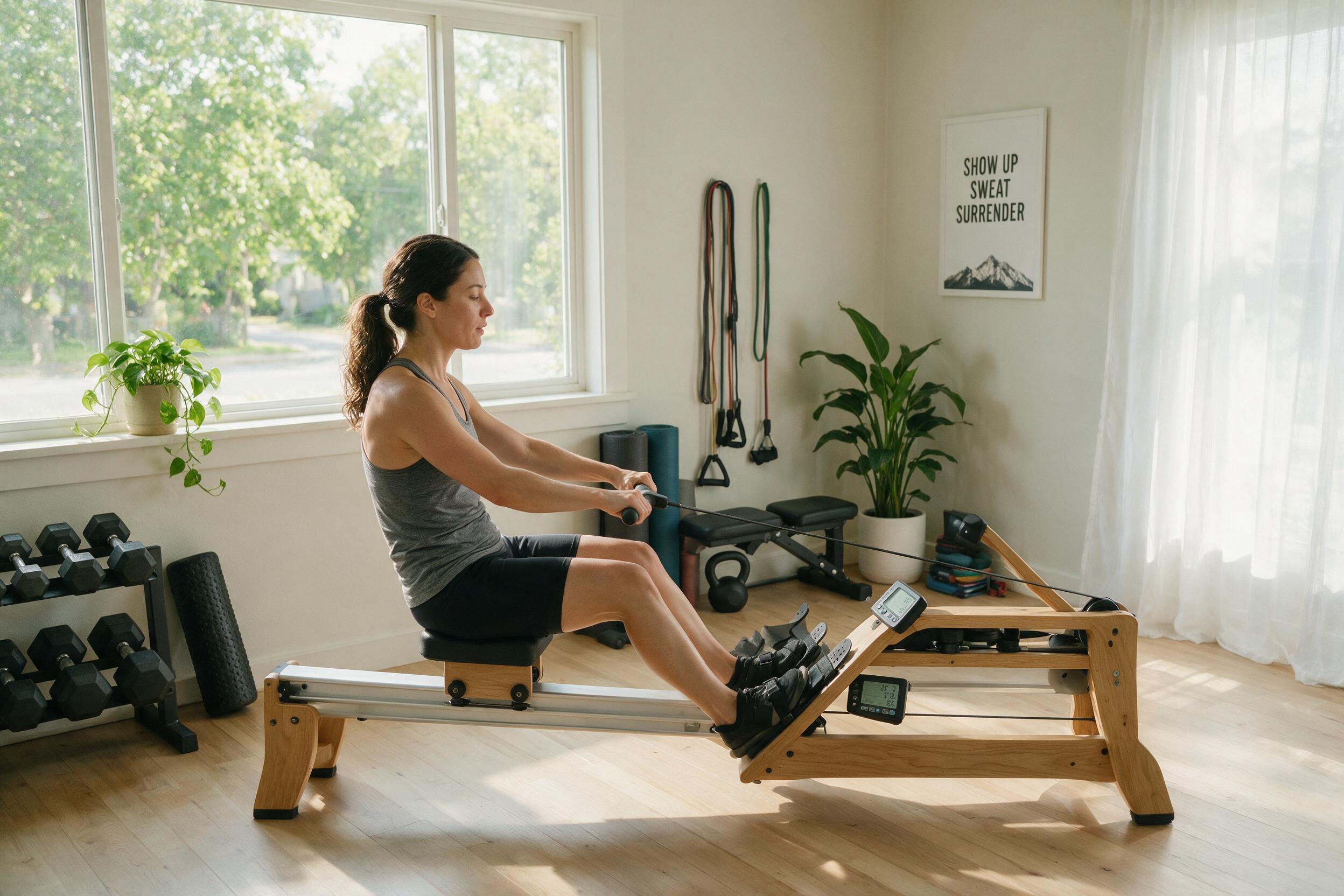
When you sit down on a rower, your legs do about 60% of the work during the drive phase. Your quads and glutes extend powerfully to push the seat back. That’s the same movement as a squat, just horizontal. Then your core engages to transfer that force through your torso. Finally, your back and arms pull the handle to your lower ribs. It’s one fluid motion — legs, core, arms — and it happens in under two seconds.
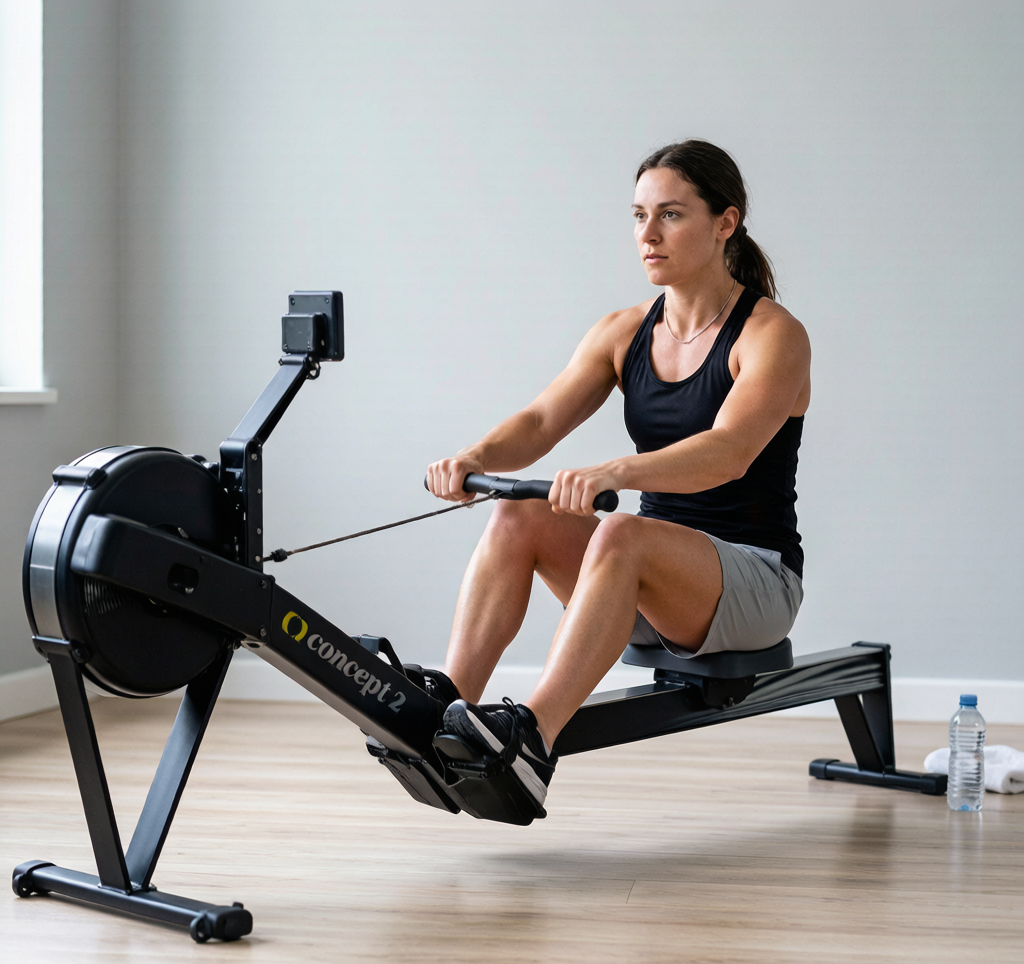
I’ve spent time on Concept2 and WaterRower machines at home and in gyms. The first time I tried to row for 20 minutes straight, my shoulders were burning, my lower back was tired, and my legs felt like I’d done a set of heavy squats. That’s the point. Rowing activates roughly 85% of your muscles in a single stroke, according to the American Council on Exercise. No other cardio machine comes close to that recruitment.
Compare that to cycling. On a stationary bike, your upper body sits relatively still. Your core might brace a little, but it’s not actively stabilizing through a dynamic range of motion. Same with the elliptical — your arms move, but they’re not pulling against real resistance. On a rower, every stroke requires your core to stay braced to transmit power from your legs to your upper body. If your core slacks off, your stroke falls apart and your lower back takes the load. That’s why rowing builds functional strength along with cardiovascular endurance.
The calorie burn reflects this full-body demand. A 155-pound person rowing at a moderate pace — around 24 to 26 strokes per minute — can burn roughly 260 to 300 calories in 30 minutes. That’s comparable to running at a 10-minute mile pace, but with far less impact on your knees and hips. I’ve had clients who couldn’t run due to joint issues drop 10 pounds in a month by replacing their treadmill sessions with rowing intervals.
Here’s a practical tip: when you start rowing, focus on the sequence, not the speed. Push with your legs first, then lean back slightly, then pull the handle to your sternum. On the recovery, reverse it — arms out, lean forward, bend your knees. Most beginners rush the recovery and end up rowing with just their arms. That’s a recipe for sore shoulders and poor results. Spend 10 minutes just drilling the stroke sequence before you try to go hard.
If you’re considering a rowing machine for home use, consistency matters more than intensity. Three 20-minute sessions per week will give you noticeable improvements in endurance and muscle tone within a month. And because rowing is low-impact, you can do it daily without the joint stress that comes with running or jumping rope.
Check current prices on Amazon to see which model fits your budget and space. And if you’ve tried rowing, share your experience in the comments — I’d love to hear what worked for you.
Rowing vs Treadmill: Which Machine Burns More Calories and Builds Better Endurance?
If you’re shopping for a cardio machine, you’ve probably stared at the rower and the treadmill wondering which will give you more bang for your buck. I’ve spent years coaching clients on both, and here’s the bottom line: they’re both excellent, but they work your body very differently.
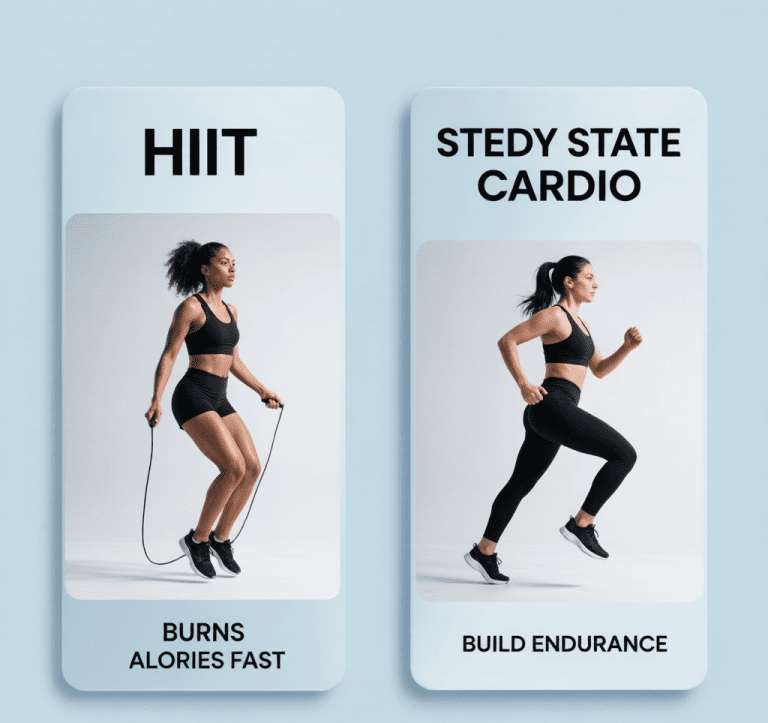
Let’s start with calories. At a comparable effort level—say, a steady-state pace where you can hold a conversation—a 155-pound person burns roughly 260 calories in 30 minutes on a rower and about 300 on a treadmill. Bump the intensity to intervals, and both can push past 400 calories in the same time. So for pure calorie burn, they’re in the same ballpark. But here’s the catch: rowing recruits your legs, core, back, and arms simultaneously. You’re not just moving your legs; you’re building muscular endurance in your posterior chain while your heart rate climbs. That means you get strength and cardio in one session.
Now, about impact. Every time your foot hits the treadmill belt, your body absorbs 2.5 to 3 times your body weight (source: Journal of Applied Physiology, 2016). For a 200-pound person, that’s 500 to 600 pounds of force per stride. Over a 30-minute run at a 9-minute mile pace, that’s roughly 3,000 foot strikes. That’s a lot of pounding on your knees, hips, and lower back. I’ve had clients with knee pain who couldn’t run a mile without discomfort, yet they could row for 20 minutes pain-free. Rowing is non-impact—your seat glides on a rail, and your feet stay strapped to the footplates. Your joints thank you.
But what about endurance? Treadmill running is king for building aerobic capacity because it forces your heart to pump blood against gravity. Rowing, however, builds both aerobic and anaerobic systems simultaneously. During a hard 500-meter sprint, your legs burn from lactate, your lungs scream, and your arms fatigue. That combo is hard to beat for real-world fitness. I’ve seen cyclists and runners improve their VO2 max by adding two rowing sessions per week.
If you have lower-back concerns, don’t write off the rower. Proper form—keeping your back straight, driving with your legs first, then hinging at the hips—actually strengthens your erector spinae and glutes. Many physical therapists recommend rowing for back rehab. Focus on avoiding rounding your lower back at the catch. Sit tall, engage your core, and let your legs do the heavy lifting.
Here’s my practical advice: if you love running and your joints can handle it, keep the treadmill. But if you want a full-body workout that spares your joints and builds real-world strength, the rower wins. Try this: do 3 x 1000 meters on the rower with 2 minutes rest between intervals. Keep your split time consistent. You’ll feel it in your lungs and your legs—and your arms and back too.
Before you buy, check current prices on Amazon—both machines have dropped significantly in the last year. And if you’ve tried both, share your experience in the comments. Which one do you prefer for fat loss and endurance?
How to Structure Rowing Machine Workouts for Fat Loss and Conditioning
Knowing the science is one thing. Putting it into practice is where the real change happens. Whether you’re a beginner or a seasoned athlete, these rowing workouts are structured to deliver measurable results. I’ve used each of these formats myself, and they’ve consistently outperformed steady-state running for fat loss and conditioning.
1. 500-Meter Repeats: Build Power and Aerobic Efficiency
Start with 500-meter repeats at a moderate pace—think 70–80% effort. Row one 500-meter piece, then rest for 90 seconds. Repeat 4–6 times. This format builds both anaerobic power and aerobic efficiency because you’re forcing your body to recover quickly between high-intensity efforts. I’ve seen clients drop their split times by 10 seconds per 500 meters after just three weeks of this twice a week.
2. Steady-State Zone 2: The Fat-Burning Foundation
For steady-state cardio, aim for 20–40 minutes at a stroke rate of 18–22 strokes per minute, keeping your heart rate in zone 2 (roughly 60–70% of your max heart rate). This is the sweet spot for building mitochondrial density and improving your body’s ability to use fat for fuel. It feels easy, but don’t underestimate it. I do this once a week on my recovery days, and it’s helped me maintain endurance without burning out my joints.
3. Interval Training: Spike EPOC for Post-Workout Burn
Interval training is where rowing really shines for fat loss. Row hard for 250 meters, then easy for 250 meters, repeating 8–10 rounds. The hard effort should be at 85–90% of your max, and the easy effort should be a slow paddle. This spikes excess post-exercise oxygen consumption (EPOC)—basically, your body continues to burn extra calories for hours after you finish as it works to return to its resting state. I’ve measured my own EPOC with a heart rate monitor, and it stays elevated for up to 12 hours after a session like this.
4. Track Your Split Time
Your split time—the time it takes to row 500 meters—is your best gauge of intensity and progress. Make sure to keep it consistent across repeats or intervals. For example, if your split time is 2:00, try to hold that for every 500-meter piece. Over weeks, you’ll see it drop. I track mine in a simple spreadsheet, and seeing that number go down is more motivating than any scale victory.
These workouts work for any fitness level. Adjust the rest periods and number of rounds based on how you feel. The key is consistency—two to three rowing sessions per week will transform your conditioning and body composition.
Check current prices on Amazon for a quality rowing machine, and share your favorite workout format in the comments below.
Common Rowing Mistakes and How to Fix Them
Even with perfect intentions, small form errors can turn a smooth row into an inefficient, injury-prone grind. I’ve watched dozens of gym-goers and home rowers lose power and risk their lower back because of a few recurring mistakes. Here’s how to spot and fix them.
1. Rowing with Straight Legs and Relying Only on Your Arms
This is the most common error I see. People pull the handle with their arms while their legs stay nearly straight. The result? You lose the power from your quads and glutes — your strongest muscles — and put all the strain on your lower back and shoulders.
The fix: Think of the rowing stroke as a leg press, not a bicep curl. Drive through your heels, push your legs back, and only after your legs are almost straight, engage your core and pull the handle into your lower chest. The arms are the last to work, not the first.
2. Leaning Too Far Back at the Finish
At the end of the drive, your torso should lean back to about 11 o’clock — imagine a clock face on your side. Leaning past vertical (like 12 o’clock) puts your lower back in a vulnerable position and reduces the power transfer from your legs.
The fix: Keep your core braced and your shoulders behind your hips, but don’t let your upper body go past a 45-degree angle from the floor. A simple cue: at the finish, your shoulders should be just behind your hips, not way behind them.
3. Rushing the Recovery
After the drive, many rowers let the handle snap forward and their knees bend too fast. This not only wastes energy but also makes the next stroke weaker because you lose control of the slide.
The fix: The recovery should be a controlled glide. Extend your arms first, then lean your torso forward, and finally bend your knees. Aim for a 2:1 ratio — the recovery takes about twice as long as the drive. Count: drive (1 second), recover (2 seconds). This keeps the flywheel spinning smoothly and your heart rate steady.
4. Gripping the Handle Too Tight
A death grip on the handle leads to forearm fatigue, blisters, and a tense upper body. It also makes you pull with your arms too early. I’ve seen people finish a 20-minute row with their forearms burning while their legs feel fresh — that’s a sign of poor grip.
The fix: Hold the handle loosely with your fingers, like you’re carrying a grocery bag. Your thumbs should rest on top of the handle, not wrapped around. During the drive, the handle should sit in the crook of your fingers, not squeezed in your palm. This keeps your arms relaxed and lets your legs do the work.
Once you clean up these four mistakes, your rowing will feel smoother, more powerful, and far less taxing on your joints. Every stroke will count more, and you’ll actually enjoy the process instead of fighting the machine.
If you’re ready to put these tips into practice, check current prices on Amazon for a quality rower that fits your home gym setup. And if you’ve fixed a form quirk that made a big difference for you, drop it in the comments — I’d love to hear what worked.
Medical & Editorial Review: This article was reviewed by Liam Smith, founder of Apexfito, for accuracy and safety. Content is for educational purposes and is not a substitute for professional medical advice. Consult your physician before starting any exercise or nutrition program.