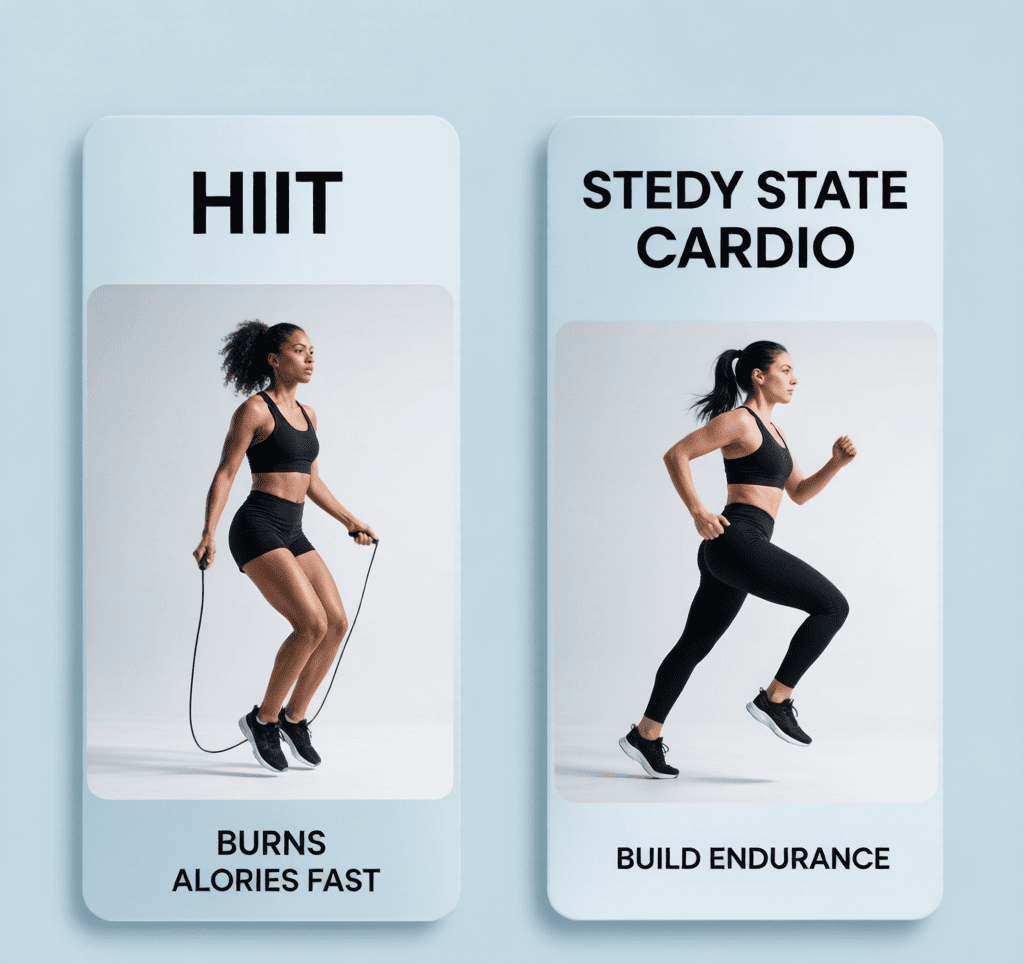
HIIT vs. Steady State Cardio: Which Is Better for Fat Loss?
By Liam Smith — Fitness enthusiast and founder of Apexfito. I test gear at home and share what actually works.
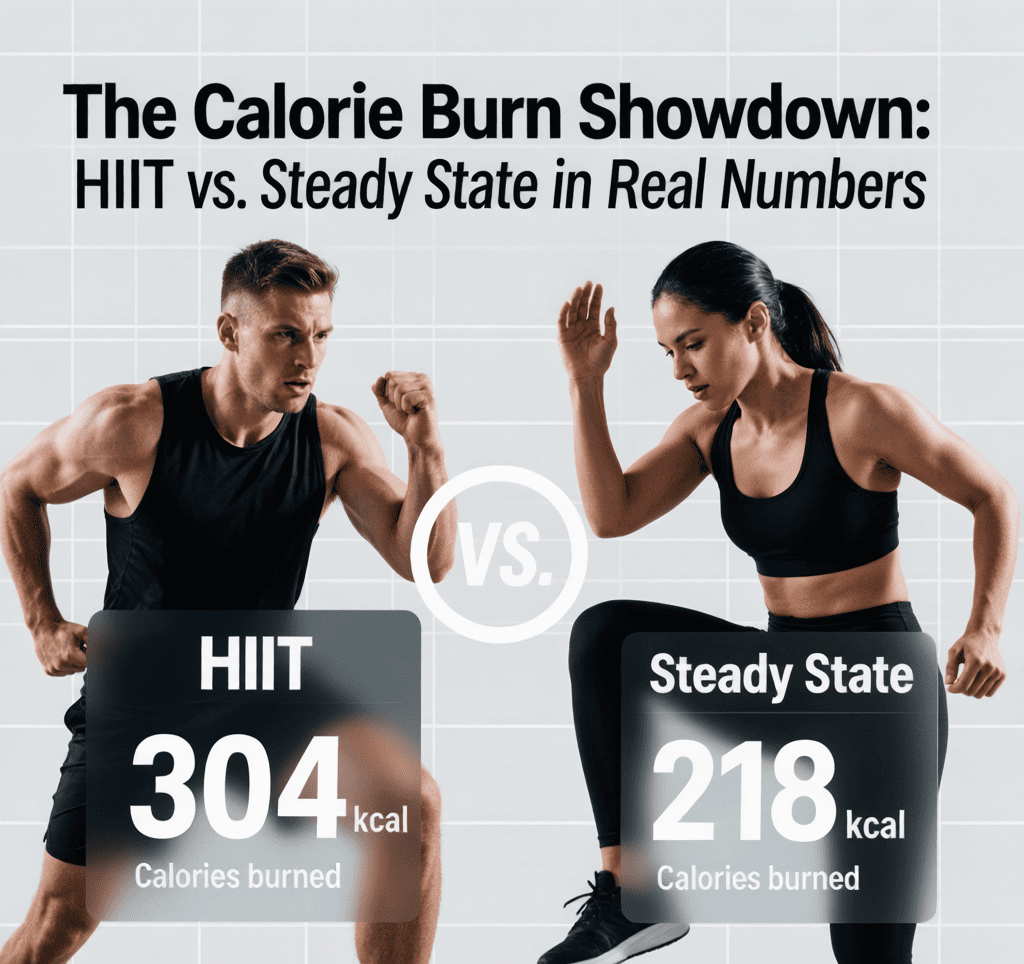
The Calorie Burn Showdown: HIIT vs. Steady State in Real Numbers

When you’re trying to drop body fat, the first question is usually: which burns more calories? The answer isn’t as simple as comparing a 30-minute jog to a 30-minute sprint session. Let’s look at the numbers and the science behind them. Harvard Health notes that hIIT and steady-state cardio both improve fitness, but HIIT yields faster gains in a shorter time.
During the workout itself, steady state cardio wins the per-minute calorie race. A 155-pound person running at a moderate pace (6 mph) burns about 370 calories in 30 minutes. The same person doing a HIIT workout — say, 30 seconds of all-out sprinting followed by 30 seconds of rest — might burn around 300 calories in the same 30 minutes. That’s a 70-calorie difference in favor of steady state during the session.
But the story doesn’t end when you stop moving. HIIT triggers a phenomenon called excess post-exercise oxygen consumption (EPOC), or the afterburn effect. Your body uses extra oxygen to restore itself to its pre-exercise state — clearing lactate, replenishing ATP, and repairing muscle tissue. This process requires energy, meaning you continue burning calories at an elevated rate for hours after your workout.
How much extra? Research shows EPOC from HIIT can range from 6 to 15 percent of the total calories burned during the workout. For that 30-minute HIIT session, that’s an additional 18 to 45 calories. Not exactly the hundreds of extra calories some fitness influencers claim. But over time, it adds up. Steady state cardio, on the other hand, produces a much smaller EPOC — typically less than 5 percent of workout calories.
Add it all up, and a 30-minute HIIT session (including EPOC) can produce a total calorie burn comparable to 45 to 60 minutes of steady state cardio. That’s a big deal if your schedule is tight. I’ve had clients who could barely find 20 minutes to exercise, and HIIT gave them results they couldn’t get from longer, lower-intensity sessions.
But here’s the catch: EPOC is modest. You won’t burn an extra 200 calories just by sitting on the couch after a HIIT session. The afterburn effect is real, but it’s not a magic bullet. If you’re doing HIIT and expecting to torch hundreds of extra calories passively, you’ll be disappointed.
The practical takeaway: If you have limited time, HIIT gives you more bang for your minute. If you have an hour and prefer a lower-intensity grind, steady state works fine for fat loss. Both can help you lose fat — the best choice is the one you’ll actually do consistently.
Fat Burning vs. Total Fat Loss: Why the ‘Fat-Burning Zone’ Myth Persists

Walk into any gym and you’ll see people camped on treadmills, heart rate monitors glowing green, convinced they’re in the mythical ”fat-burning zone.” The idea is simple: keep your heart rate low enough, and your body will preferentially burn fat for fuel. It’s a neat concept, but it misses the bigger picture.
During low-intensity steady state cardio, your body does indeed use a higher percentage of fat for energy. At 50-65% of your max heart rate, fat oxidation is at its peak. But here’s the catch: total calories burned per minute are relatively low. You might burn 5-7 calories per minute on a brisk walk or light jog. Meanwhile, during HIIT, you’re burning more carbohydrates and fewer fat calories during the workout itself—but you’re torching 10-15 calories per minute. Over a 20-minute HIIT session, that’s 200-300 calories. Over 40 minutes of steady state, you might burn 280-350. The difference isn’t huge, but the time commitment is half.
What matters for fat loss is the total calorie deficit across the whole day, not the fuel mix during exercise. I’ve had clients obsess over staying in zone 2, only to eat back those calories with a post-workout snack because they felt they ”earned it.” Meanwhile, others doing HIIT often report less hunger afterward—likely due to appetite-suppressing hormones like PYY and GLP-1. The net result: HIIT can create a larger deficit in less time, even if it burns a lower percentage of fat directly.
Research backs this up. A 2018 meta-analysis in the British Journal of Sports Medicine found that both HIIT and moderate-intensity continuous training produce similar reductions in body fat percentage when total energy expenditure is matched. The key phrase: when total energy expenditure is matched. If you run for 30 minutes at a moderate pace, you’ll burn about the same calories as a 15-minute HIIT session. Over weeks, the fat loss is comparable—assuming you don’t compensate by eating more.
So why does the fat-burning zone myth persist? Marketing. Treadmills and ellipticals display those flashy heart rate zones, and fitness magazines love simple rules. But your body doesn’t care about the fuel mix during exercise. It cares about the net deficit. I’ve seen people do 20 minutes of HIIT, lose 10 pounds in 8 weeks, and never once worry about their heart rate zone. The best cardio for fat loss is the one you actually do consistently, not the one that burns a slightly higher fat percentage during the workout.
Practical advice: Don’t let zone 2 dogma dictate your cardio choice. If you enjoy long walks or jogs and can stick with them, great. If you prefer short, intense bursts that get you out of the gym faster, that works too. The real fat-burning zone is your kitchen, your sleep, and your consistency. Pick the method that fits your schedule and keeps you coming back.
Muscle Preservation and Metabolic Adaptation: How Each Cardio Style Affects Your Physique
When you’re cutting calories to lose fat, your body doesn’t just burn fat — it can also break down muscle for energy. That’s a problem because muscle tissue is metabolically active: the more you have, the higher your resting metabolic rate. So the type of cardio you choose plays a big role in whether you preserve that hard-earned muscle or lose it along with the fat.
Steady state cardio, especially long sessions over 45–60 minutes, can raise cortisol levels. Cortisol is a stress hormone that, when chronically elevated, signals your body to break down muscle protein for fuel. I’ve seen this happen with clients who run for an hour five days a week while dieting. Their weight drops, but their strength numbers tank and they end up looking softer rather than leaner. That’s not what anyone wants.
HIIT, on the other hand, tends to be more muscle-sparing. The short, intense bursts recruit fast-twitch muscle fibers — the same ones you hit during heavy lifting. This stimulates anabolic signals like mTOR activation, which tells your body to preserve or even build muscle. In a 2018 study from the Journal of Sports Sciences, participants who did HIIT three times per week while in a calorie deficit retained more lean mass compared to those doing moderate-intensity steady state for the same calorie burn.
But here’s the catch: too much HIIT can backfire. If you’re doing five or more HIIT sessions per week on top of resistance training, your cortisol can spike just as badly as with excessive steady state. Recovery becomes compromised, sleep quality drops, and muscle loss starts creeping in. I’ve made this mistake myself — two-a-days with HIIT and lifting left me overtrained, irritable, and actually weaker after six weeks.
So what’s the sweet spot? For most people, 2–3 HIIT sessions plus 1–2 steady state sessions per week provides a balanced approach. This schedule supports fat loss, protects muscle, and keeps recovery manageable. Here’s a practical weekly structure:
- Monday: Lower body strength + 20 min HIIT (bike sprints: 30 sec on, 90 sec off)
- Tuesday: Upper body strength + 30 min steady state (brisk incline walk)
- Wednesday: Rest or light mobility
- Thursday: Full body strength + 20 min HIIT (rower intervals)
- Friday: 40 min steady state (jog or elliptical)
- Saturday: HIIT only (20 min, no lifting) — optional if energy is high
- Sunday: Rest
If you’re already lifting weights, keep your HIIT sessions short — 15–20 minutes of work, not including warm-up and cool-down. And always prioritize recovery: sleep, protein intake, and at least one full rest day per week. More cardio isn’t better; better recovery is.
Have you tried combining HIIT and steady state for fat loss? Share your experience in the comments.
Your Practical Cardio Strategy: How to Choose and Combine HIIT and Steady State for Results
By now you know the science: both HIIT and steady state cardio can help you lose fat, but they work differently. HIIT torches more calories per minute and boosts your metabolism for hours after. Steady state is easier to recover from and lets you accumulate volume without crushing your central nervous system. The best approach depends on your preferences and schedule.
Start Where You Are
If you’re new to cardio or coming back after a break, don’t jump into all-out intervals. I’ve seen too many motivated beginners burn out — or worse, pull a hamstring — because they tried sprinting on day one. Build a base first with steady state, 3–4 times per week for 30–45 minutes. A brisk walk, a light jog, or an incline walk on the treadmill is perfect. Do that for three to four weeks. Your joints, heart, and brain will thank you.
Once you can handle that comfortably, you can start swapping in one HIIT session per week. After another two weeks, add a second HIIT day if recovery allows.
A Sample Week That Works
Here’s a realistic template I’ve used with clients and myself:
- Monday: HIIT — 20 minutes of 30-second sprints / 90-second recovery on a bike or treadmill
- Tuesday: Steady state — 40-minute incline walk at 3.5 mph, 4–6% grade
- Wednesday: Rest or light walk
- Thursday: HIIT — 20 minutes of 40-second hard efforts / 20-second easy on a rower or assault bike
- Friday: Steady state — 45-minute jog or elliptical
- Saturday: Active recovery — 30-minute walk outdoors
- Sunday: Rest
Adjust the volume based on how you feel. If your legs are heavy or your sleep suffers, drop a HIIT session and add steady state. If you’re recovering well and want more challenge, push the work intervals slightly harder rather than adding more sessions.
Choose Your Weapons Wisely
If you hate running or have cranky knees, steady state on a bike, elliptical, or incline walk is kinder on your body. HIIT on a rower or assault bike can be a lower-impact alternative to sprinting — I personally prefer the rower because it’s full-body and spares my shins. For HIIT, avoid high-impact moves like box jumps or burpees unless you’re already conditioned; the risk of injury isn’t worth it for fat loss.
Track What Matters
Don’t obsess over the calorie readout on the treadmill — those numbers are notoriously inflated. Instead, track your average heart rate, distance covered, or perceived exertion on a scale of 1–10. For steady state, aim for a 5–6 out of 10. For HIIT, your work intervals should feel like an 8–9, and your recovery should drop you back to a 3–4. Consistency over months beats perfection in a single workout.
If you want to dial in your intensity, a simple heart rate monitor can help. Check current prices on Amazon for reliable options like the Polar H10 or a basic chest strap — they’re more accurate than wrist-based optical sensors during intervals. An interval timer app on your phone works fine too; no need to buy anything fancy.
Here’s the thing: there’s no single ”best” cardio for fat loss. HIIT saves time and spikes your metabolism; steady state is gentle and sustainable. The real win comes from matching your routine to your life. If you love sprinting, sprint. If you’d rather zone out on a long walk, do that. And if you can blend both — like the sample week above — you get the benefits of each without burning out. Start with what feels doable, build slowly, and adjust as you go. That’s how you make progress that lasts.
Have you tried combining HIIT and steady state? What worked for you? Share your experience in the comments below — I read every one and often reply with suggestions. And if you’re looking for gear to make your sessions more effective, check current prices on Amazon for heart rate monitors or interval timers.
Related Reading
Medical & Editorial Review: This article was reviewed by Liam Smith, founder of Apexfito, for accuracy and safety. Content is for educational purposes and is not a substitute for professional medical advice. Consult your physician before starting any exercise or nutrition program.



One Comment