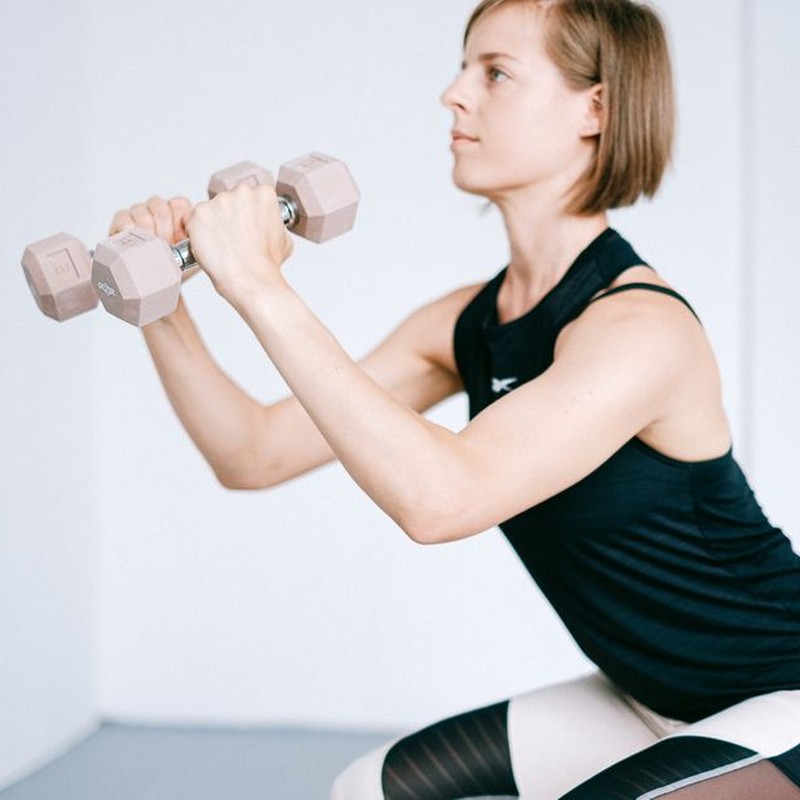
The Ultimate Dumbbell-Only Leg Day Workout You Can Do at Home
Full disclosure: Some links in this article are affiliate links. We may earn a small commission at no extra cost to you if you make a purchase through them. Our recommendations are based on what real users report, not on commission size.
Why Skipping Leg Day Hurts Your Progress More Than You Think
I’ve coached enough home lifters to know the pattern: upper-body days get done, leg day gets postponed. You tell yourself you’ll do it tomorrow, but tomorrow looks exactly like today. Skipping legs might spare you some soreness, but it also means missing out on the biggest return your training can offer.
Your quads, glutes, and hamstrings are the largest muscles in your body. Training them with dumbbells burns more calories, improves your posture, and takes pressure off your knees. Strong legs support your spine and stabilize your hips, which makes everything from carrying groceries to playing with kids feel easier. That’s why a consistent leg day doesn’t just build lower-body strength. It boosts your overall progress.
You Need Almost Nothing to Start
For a home leg day, the equipment list is short: a pair of adjustable dumbbells, a non-slip mat, and enough floor space to lunge without kicking the coffee table. That’s it.
If you’re buying from scratch, I’d go straight to an adjustable pair like the Bowflex SelectTech 552 Adjustable Dumbbells. They go from 5 to 52.5 pounds and adjust in seconds, which makes it easy to move from goblet squats to split squats without losing momentum. Lighter options like the Amazon Basics Neoprene Dumbbell Set are handy for warm-ups, but you’ll outgrow them quickly once you start loading squats and deadlifts.
Pick a Weight You Can Control
Start with weights that let you keep perfect form on every rep. If you’re new, that means finishing a set with one good rep left in the tank, not grinding through the last two reps with your lower back doing the work.
If your dumbbells are on the light side, don’t buy new gear yet. Slow the lowering phase down to a four-second count. Pause at the bottom of a squat. Or switch to single-leg moves like Bulgarian split squats and single-leg Romanian deadlifts. I’ve made a 20-pound pair feel brutal using nothing but a slower tempo and a longer range of motion.
Once you have a pair of dumbbells and a clear patch of floor, you’re ready for the workout ahead. Your legs will thank you, after they stop shaking.
Warm-Up for a Safer Dumbbell Leg Day
I used to skip warm-ups and pay for it later with creaky knees and a grumpy lower back. Leg day is the worst day to skip prep work. Your hips, knees, and ankles are about to handle squats, lunges, and hinges, and they need blood flow before they take on weight. Five minutes now can save you from a tweaked hip later.
Start by raising your heart rate for five minutes. March in place while you pick a playlist. Walk briskly around the house. If you have a low stair or a sturdy step, step up and down slowly. You want a light sweat, not a full cardio session.
Then move into dynamic stretches. Leg swings, both forward and side-to-side, wake up the hip joints. Bodyweight walking lunges open the hip flexors and get your balance dialed in. Glute bridges fire up your hamstrings and glutes, which your lower back will thank you for later. Hold each position for a few seconds, but don’t force anything. No bouncing. Move through a comfortable range and let it open up.
Now do 10 bodyweight squats and 10 reverse lunges per leg. These lock in the movement pattern before you add load. Watch your depth. If your heels lift or your knees cave in, fix it before you grab a dumbbell.
Finish with one set of 10 light goblet squats. Use a weight you can control for 15 clean reps. If you have an adjustable pair like the Bowflex SelectTech 552 Adjustable Dumbbells, set it to 10 or 15 lb for these, then dial up without leaving your spot. Fixed dumbbells work too, and a light Amazon Basics Neoprene Dumbbell Set can handle the warm-up, though you’ll want heavier pairs once the working sets start.
That last warm-up set should feel easy. No grinding, no breath holding. You’re telling your hips and knees that heavier reps are next, so your nervous system is ready to coordinate the movement under load.
Here’s the full warm-up as a checklist:
- 5 minutes of marching, brisk walking, or step-ups
- Leg swings: 10 forward and 10 side-to-side per leg
- Bodyweight walking lunges: 10 per leg
- Glute bridges: 15 slow, controlled reps
- Bodyweight squats: 10 reps
- Reverse lunges: 10 per leg
- Light goblet squats: 1 set of 10 with an easy weight
Plan for about 10 minutes total. Some days you’ll need an extra minute of marching or a few more leg swings. That’s fine. If your legs still feel cold, add another set of bodyweight squats.
For the first two weeks, keep the warm-up at this length. Starting week three, add one extra set of goblet squats with a moderate 15 to 20 lb dumbbell. That gives you a smoother bridge to your heaviest working sets.
Once your hips and ankles feel loose and your squat pattern feels smooth, you’re ready to pick up the dumbbells for real.
The 5-Move Dumbbell Leg Day Workout
I’ve run this exact leg day in my living room on days when a trip to the gym just wasn’t happening. It’s short enough to fit a busy schedule, but don’t let the short list fool you. By the time you finish all five moves, your legs will know you worked.
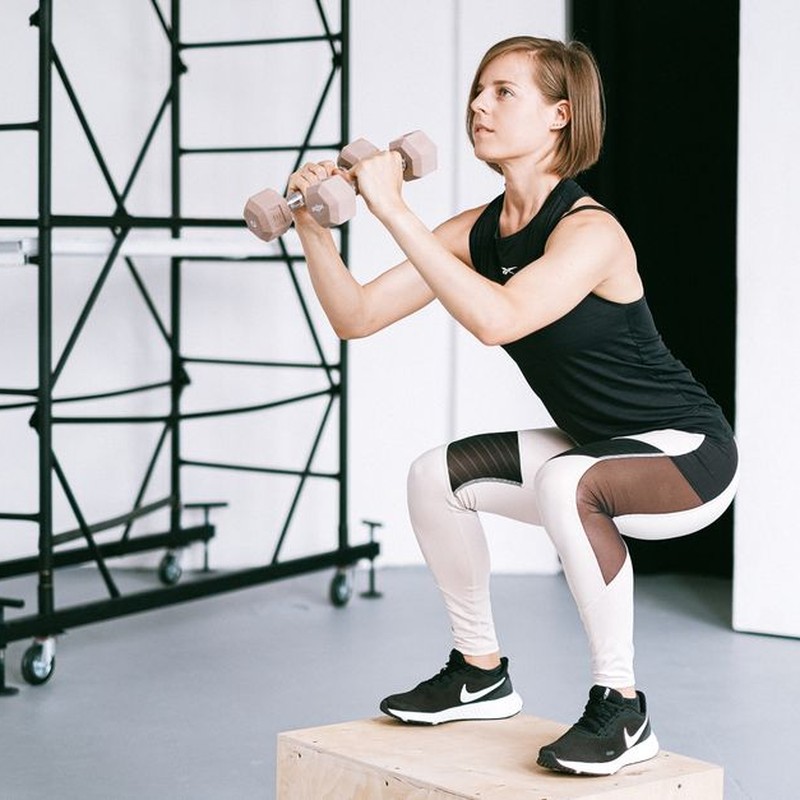
- Goblet Squat — 3 x 10-12
- Reverse Lunge — 3 x 10-12 per leg
- Romanian Deadlift — 3 x 10-12
- Glute Bridge — 3 x 10-12
- Calf Raise — 3 x 10-12
Rest 60 to 90 seconds between sets. Once you finish all three sets of one exercise, take a longer break—about 90 seconds to 2 minutes—before starting the next move. If you’re still catching your breath after that, take what you need. The goal is to work hard, not to race through the clock.
Use a 2-1-1 tempo on every rep: take 2 seconds to lower the weight, pause for 1 second in the stretched position, then press up in 1 second. I know it’s tempting to rush the lowering phase, especially when your legs are burning. That pause is what makes the movement count. It kills momentum and forces the muscle to do all the work.
For reverse lunges, step back far enough so your front shin stays vertical and your back knee hovers just above the floor. A short step makes your front knee cave in and shifts the work to your lower back. Play with the distance until you feel your glute catch at the bottom. It took me a few sessions to find the right spot, but once you do, you’ll feel it immediately.
Level-up tip: If you want more from the last set of each move, try a drop set. Cut the weight by about 20 percent and rep out until your form starts to slip. So if you’re goblet squatting with 50 pounds, drop to 40 and do as many clean reps as you can. If you’re new to leg training, skip this for now. Just finish all three sets with good form and build the habit first.
To keep this workout moving, you need dumbbells you can adjust without digging for a wrench. I’ve used the PowerBlock Elite EXP 5-90 Adjustable Dumbbells at home, and being able to change the load in seconds makes a big difference when you’re going from goblet squats to Romanian deadlifts. That’s all the gear talk you need—the weights matter less than your willingness to show up and do the reps.
Do this workout twice a week, with at least one full day of rest between sessions. Your legs are large muscles, and they need time to rebuild. If you’re still sore after two days, wait one more. Consistency beats extra volume every time.
Give it a shot this week. When you finish all five moves with clean tempo, come back and tell me how it went in the comments. If you’re shopping for a set, you can see current pricing on Amazon—but don’t let the shopping become an excuse to skip the workout.
How to Schedule Leg Day and Keep Making Progress
Two focused leg days per week are enough to build serious lower-body strength at home. If you’re only doing one, that’s fine. Start there and add a second once you can use the stairs without groaning.
Here is a simple weekly split that leaves room for work, family, and recovery:
- Monday: Leg day #1
- Tuesday: Upper-body push — push-ups, shoulder press, triceps
- Wednesday: Off or light cardio
- Thursday: Leg day #2
- Friday: Upper-body pull — rows, curls, rear delts
- Saturday: Core and cardio
- Sunday: Full rest
If you train legs twice, put at least 48 hours between sessions. Monday to Thursday gives you 72 hours. That beats jamming two leg days into back-to-back days and then paying for it all weekend.
Progression Rule That Doesn’t Ask You to Overthink
I use this rule with my own training: add weight in the smallest increment your dumbbells allow only when you can hit 12 clean reps on every set. Clean means no swinging, no jerking, no lower back folding. Every rep should look like the one before it.
If that feels too aggressive at first, start by adding reps instead. Pick a weight you can handle for 8 controlled reps, work up to 12 reps per set, and only then increase the weight. This works especially well for beginners because it keeps you moving forward without forcing you into heavier loads before your body is ready.
Small jumps matter. If your adjustable dumbbells let you move in 2.5-pound increments, like Bowflex SelectTech 552 Adjustable Dumbbells, you can nudge the load upward without wrecking your form. With fixed dumbbells, the next jump is often 5 or 10 pounds, so stay disciplined and repeat the same weight until every set is clean.
Recovery Is Part of the Program
Don’t do sprints or high-intensity intervals the day after a heavy leg day. If you want to move, take a 20-minute walk or an easy bike ride. That helps blood flow without draining the energy you need for Thursday.
Eat enough protein and sleep at least seven hours. The workout triggers growth; recovery is where it actually happens. I have run leg days on poor sleep and short protein, and the difference is obvious. My reps slow down, my knees ache, and the split starts to feel like a chore instead of something I look forward to.
Track your numbers too. Write down the weight and reps for each leg move so you know exactly when to increase the load. If you did 20 pounds for 10 reps last week and 20 pounds for 12 today, that is progress. Write it down, then chase the next increment.
If you’ve been skipping leg day, tell me what split got you back on track. I’m curious what’s working for you, so leave it in the comments.
Choosing the Best Dumbbells for Home Leg Day
You can do the whole workout with one pair of dumbbells, but only if they’re heavy enough. For squats, split squats, lunges, and Romanian deadlifts, I wouldn’t start below 40 to 50 pounds per hand. Lighter sets are useful for glute bridges or warming up, but they won’t force your legs to adapt for long. If your current dumbbells max out at 20 pounds, you’re not doing progressive overload; you’re doing cardio with weights.
Here’s how the best adjustable sets handle leg day, based on what I’ve actually tested at home and in training clients.
Bowflex SelectTech 552: The quick-shift option
I unboxed the Bowflex SelectTech 552 Adjustable Dumbbells a few years ago. The dial system lets you adjust from 5 to 52.5 pounds per hand in small increments, which is great for steadily adding load to walking lunges or goblet squats. The cradle holds both dumbbells in a compact base that takes up maybe 2 square feet of floor space. On carpet it still needs a clear spot, but it’s not a rack.
The trade-off is the width. Because the weight plates sit outside the handle on a wider frame, goblet squats feel bulky against your chest at first. I had to hold the dumbbell a bit higher and let my elbows track between my knees. Once I found that groove, it stopped being an issue. If you want fast changes and don’t need more than 50 pounds per hand, this is the pair I’d get.
PowerBlock Elite EXP 5-90: Built for heavy hinges
The PowerBlock Elite EXP 5-90 Adjustable Dumbbells use a pin selector instead of dials. Slide the pin into the weight stack, pull the handle, and you’re ready. This set tops out at 90 pounds per hand, which is more than most home lifters need for deadlifts and squats, and the extra headroom means you won’t outgrow them.
I’ve used these for Romanian deadlifts more than any other adjustable. The blocky frame feels dense, the weight sits centered over the handle, and they don’t wobble when I hinge into position. The steel frame has held up fine after regular use at home. The main downside is the shape: it doesn’t feel like a classic dumbbell, and you’ll want to set it down with control.
If heavy leg work with a rugged build is the priority, pick these. No other model I’ve tested gives you 90 pounds per hand with this much stability.
NUOBELL Max 80: The traditional-feel pick
If the PowerBlock’s blocky style doesn’t appeal to you, the NUOBELL Max 80 Adjustable Dumbbells look and handle like a fixed dumbbell. They adjust with a rotating collar, and you can move in small increments, which is helpful for adding just 2.5 pounds per hand on strict lunges.
The range goes up to 80 pounds per hand, so they’ll cover the same heavy squat and hinge work. They are longer than the Bowflex or PowerBlock, so make sure you have enough room to move during exercises like split squats. I kept them on a flat bench area and switched the collars on a stable surface. If you want a set that doesn’t feel like a machine, this is the one.
Yes4All Adjustable Dumbbells 80LB: The budget pick
The Yes4All Adjustable Dumbbells 80LB is the opposite of the quick-change adjustables: no dials, no pins. It’s bars, plates, and collars. You load what you need and tighten everything down. Changing weights takes longer, but the up-front cost is a fraction of what you’ll pay for the Bowflex or PowerBlock.
I point beginners to this when they still need to buy a mat, a bench, or a squat stand. The set breaks down flat, so it stores under a bed or in a closet. Before ordering, double-check the listing to see whether that 80LB number is total weight or per hand; the math matters when your working sets need 40 to 50 pounds per hand. Once you know that, the savings are real.
A quick note on fixed dumbbells
If you already own a fixed set like the CAP Barbell Coated Hex Dumbbell Set, keep them for warm-ups and upper-body work. The coated hex shape is awkward in a goblet squat rack position, and most home lifters outgrow the set within a few months of leg training.
Same goes for lighter neoprene pairs like the Amazon Basics Neoprene Dumbbell Set. They’re fine for hip flexor activation, but I wouldn’t point someone at them for the main