Desk Job Posture Fixes: What Works and What’s a Waste of Money
What 8 Hours in a Chair Really Does to Your Body
A client brought me a posture brace a while back. He’d worn it almost every workday for six weeks and was thrilled with the results. Then he played 18 holes of golf without it, and by the 12th hole his upper back had folded forward like a beach chair. “Feels like my back forgot how to do its job,” he said.

That one sentence covers more ground than most posture articles manage in 2,000 words.
Your body gets extremely good at the thing you do most
Tissue adapts to repeated demand. You don’t get to opt out of that rule. You only get to pick which demand you repeat.
Sit eight hours a day and here’s the pattern I see constantly in desk workers: hip flexors and hamstrings settle into shortened positions and feel grippy when you finally stand up. Glutes go quiet. The deep neck flexors, the small muscles at the front of your throat that help hold your head up, stop pulling their weight, so the big muscles on top of your shoulders take over. Your mid-back gets stiff because it has spent the day parked in a mild slump while your arms reach for a keyboard.
None of that is damage. It’s specialization, and specialization is reversible. The tissues aren’t ruined, they’re trained, which means they can be trained in another direction. Most clients tell me that happens faster than they expect. A few weeks of consistent work and standing up no longer feels like unfolding a lawn chair.
One more piece worth knowing: your discs don’t have the direct blood supply that muscle does. They take in nutrients through diffusion, and that exchange happens better when the spine loads and unloads through movement instead of holding one shape for hours. Another reason “change position” beats “find the perfect position.”
There is no perfect posture
Here’s where the internet gets it wrong. There is no single correct arrangement of bones you’re supposed to hold from 9 to 5.
The research on office workers keeps landing in the same spot. Wim Dankaerts and his colleagues at the University of Queensland spent the mid-2000s tracking how office workers with and without chronic low back pain actually sat, and the difference wasn’t a “right” posture. It was that the workers with ongoing pain tended to sit in more end-range, unchanging positions and returned to them out of habit. The 90-90-90 setup (ankles, knees, hips) came out of industrial ergonomics, where the goal was cutting fatigue in factory and typing jobs. It’s a reasonable starting point. It is not a moral standard, and your spine doesn’t file a complaint because you slouched for 20 minutes.
Physical therapists repeat a line worth stealing: the best posture is your next one. If you’ve been sitting the same way for 40 minutes, your body doesn’t care whether your ears are stacked over your shoulders. It cares that nothing has moved.
The neck math is real. The brace still isn’t the fix.
Your head weighs somewhere around 10 to 12 pounds. Kenneth Hansraj’s 2014 modeling paper made the rounds for a reason: as you bend your head forward, the effective load on your cervical spine climbs fast. At roughly 45 degrees of forward tilt, the model puts it in the 40-to-50-pound range. At 60 degrees, higher still.
That’s a model, not a measurement of your personal pain. It does explain why your traps and the base of your skull feel cooked after a long typing day with your chin drifted forward over the keys.
What works is boring and effective: change positions more often, and build endurance in the muscles that hold your head and shoulders up. Chin tucks against a wall, band or cable rows, rear delt work, thoracic extensions over a foam roller, and loaded carries all fit. Bodyweight and a doorway are enough to start.
Support devices pull in the opposite direction. Muscles that get carried stop carrying. Studies on lumbar belts show reduced trunk muscle activity while people wear them, which is the wrong trade to make five days a week. You end up with a strong brace and a weaker you.
Pain is not a photograph of your posture
You can walk into a clinic with a spine that looks questionable on an X-ray and feel nothing. You can have near-textbook alignment and be miserable. Posture explains a piece of your discomfort, not all of it.
Sleep debt, work stress, a quarterly deadline, and how much you move outside work hours all feed into whether your low back or neck pipes up this week. I’ve tracked this informally with clients for years, and the weeks with the most neck complaints are deadline weeks, not heavy-training weeks. Same chairs. Same desks. Different nervous systems.
So the picture is messier and more encouraging than the headlines suggest. Your tissues adapt to sitting, and they adapt back. There’s no perfect posture to fail at. The neck load math is real, but it’s an argument for moving and getting stronger, not for buying equipment. And the standing desk or brace you’ve been considering is a trade-off with its own costs, not a cure. Which leaves the only question that matters between now and Friday afternoon: what do you actually do about it?
The Fixes That Actually Matter, Ranked by Payoff
I’ve tested a lot of desk setups over the years. A couple of expensive chairs, a $10 cushion, a $90 lumbar roll I used for a month and then gave away. What actually changed how my neck and low back felt by Friday afternoon? Three things, and none of them required a new office.
Here’s the ranking, highest return first.

1. Movement breaks (the clear winner)
No ergonomic setup beats getting out of the chair. You can park yourself in a chair that costs more than your rent and still feel wrecked by 3 p.m. if you never move.
The prescription: stand up or walk for 2 to 3 minutes every 30 to 45 minutes. A $12 kitchen timer does that job as well as any app with a subscription attached. I set mine for 40 minutes, and when it goes off I walk to the kitchen, refill my water bottle, or pace the hallway. The first week felt like an interruption. By day four, the dull headache I’d been getting most afternoons was gone.
Why this outranks every piece of equipment on this list: your body wants movement variety, not one perfect position. Even good posture held for three hours becomes a problem. Standing up takes load off your discs, gets blood moving, and lets your neck and shoulder muscles reset. A timer costs less than lunch and does more than most gear.
2. Chair and monitor setup (free, five minutes)
You don’t need a new chair yet. Adjust the one you already have.
Chair: Set the height so your elbows rest near 90 degrees when you type, forearms roughly parallel to the floor. Feet flat on the ground. If your feet dangle, stack books or a cardboard box under them. I used an old statistics textbook as a footrest for about six months before I bothered buying anything, and it worked fine the whole time.
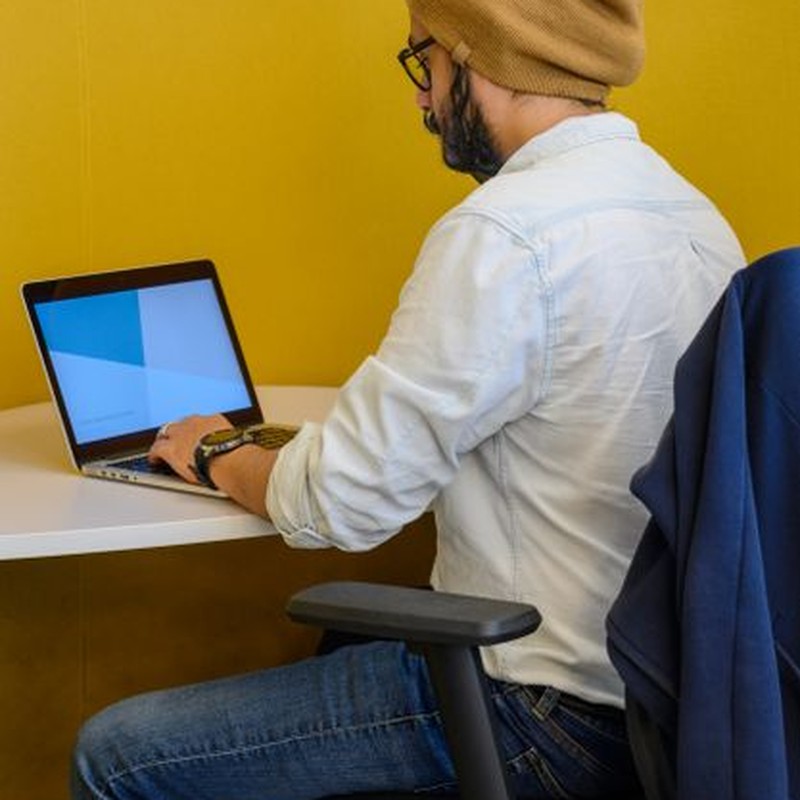
Monitor: Top of the screen at or slightly below eye level, about an arm’s length from your face (20 to 24 inches, or 50 to 60 cm). If you work on a laptop alone, you’re dragging your neck down and forward all day. Raise the screen on a stack of books or a basic stand, then add a separate keyboard and mouse. That one change, screen up and keyboard down, did more for my upper traps than anything else I tried. My neck felt looser within two days.
A cheap stand and keyboard together usually run $30 to $50. That’s a one-time cost, not a recurring one, and it stays fixed once you set it up.
3. Build the muscles that hold you upright (two short sessions a week)
You can have textbook ergonomics and still feel terrible if your upper back is weak. A weak upper back cannot hold a decent position for eight hours. So you’re training capacity, not hunting for a permanent stretch that fixes everything.
Two short sessions a week, roughly 15 minutes each, is enough. I do Tuesday and Friday. Rows and band pull-aparts are the core of the program. If you only ever do those two, you’ll still get most of the benefit. Dead bugs and a hip hinge are optional additions for your trunk and hips.
- Rows, 2 to 3 sets of 10 to 15 reps. A dumbbell, a resistance band, a cable machine, or a sturdy backpack loaded with books all work. Start around 10 to 15 lb (4.5 to 7 kg). No weights at all? Lie under a sturdy table, grab the edge, and pull your chest up toward it with your heels on the floor. Squeeze your shoulder blades together at the top.
- Band pull-aparts, 2 sets of 15 reps. Hold a light band at shoulder height, pull it apart until your arms are straight, then return slowly. No band? Do prone Y-T-W raises on the floor, or slow wall slides.
- Dead bugs, 2 sets of 8 per side (optional). On your back, arms up, knees bent 90 degrees. Lower one arm and the opposite leg toward the floor, then switch. Keep your low back pressed down.
- Hip hinge, 2 sets of 10 reps (optional). Push your hips back like you’re closing a car door with your butt, keep your spine neutral, then stand up. Bodyweight works. A kettlebell or dumbbell just adds load, around 15 to 25 lb (7 to 11 kg) if you have one handy.
No stretching routine is required, though stretching isn’t worthless. It feels good in the moment. It just doesn’t build the endurance your postural muscles need to hold a position all day. I stretched my chest and neck daily for a month and still had a nagging ache between my shoulder blades. Two weeks of rows and pull-aparts did more than all of that combined.
Load tolerance matters here. Muscles adapt to the demands you place on them. If your upper back never gets challenged, it won’t magically hold you upright through eight hours of email. Start light and stay consistent.
One safety note: if your pain is sharp, or it comes with numbness, tingling, or weakness down an arm or leg, skip the loading and get it looked at first.
A 10-Minute Desk Mobility Routine With No Equipment
Everything below takes ten minutes, happens in work clothes, and requires nothing you can’t find in an office or a hotel room. No bands, no foam roller, no $40 “mobility stick” you’ll use twice. I ran a version of this in a spare-bedroom office for a full year before writing it down, and the moves that survived are the ones that changed how my neck and mid-back felt by Thursday afternoon.
Do them in the order listed. The neck and upper back work comes first because it undoes the forward-head position you’ve been holding since your first email, then the stretches open the hips and chest that tightened up while you sat still. Rest 20 to 30 seconds between moves if you need it. Don’t let the whole thing stretch past 15 minutes — longer is not better here.
The Routine, In Order
- Chin tucks — 2 sets of 10, 3-second hold. Sit tall with your feet flat. Glide your head straight back, like you’re trying to make a double chin without lowering your gaze. Your chin stays level the whole time. The mistake I see most often is people tipping their chin down toward the chest — that’s a nod, not a chin tuck, and it doesn’t do much for the deep neck flexors. Think “back,” not “down.” Hold each rep for a slow three count, then release halfway. You should feel a light lengthening at the base of your skull and a gentle effort in the front of your neck. Not pressure behind your eyes, not strain.
- Wall angels — 2 sets of 8 to 10. Find an actual wall, not a cubicle panel. Back and head against it, feet a few inches out, ribs pulled down so your lower back isn’t arched off the wall. Slide your arms up and down like a slow snow angel, keeping your wrists as close to the wall as you can manage. If your wrists peel off near the top, stop where they leave and come back down. That’s your range for now. Most desk workers find the bottom half of this movement surprisingly hard the first two weeks.
- Seated figure-4 glute stretch — 30 to 45 seconds per side. Cross one ankle over the opposite knee, sit tall, then hinge forward from the hips rather than rounding your back. If you slump your spine instead of tilting your pelvis, you’ll feel it in your low back instead of your glute. Push the crossed knee down gently with your hand if you want a bit more.
- Doorway pec stretch — 30 seconds per side in a split stance. Forearm on the door frame, elbow around shoulder height, step through into a split stance and let your chest move forward until you feel a mild pull across the front of the shoulder and chest. Stay at a 3 or 4 out of 10. A hard stretch here just makes the shoulder joint guard harder.
- Half-kneeling hip flexor stretch — 30 to 45 seconds per side. Back knee down, front foot flat, then squeeze the back glute and tuck your pelvis under. If you’re arching your low back to get lower, you’ve stopped stretching the hip flexor and started compressing your spine. The tuck is the whole move.
- Thoracic extension over a rolled towel — 8 to 10 slow reps. Roll a bath towel into a cylinder about three or four inches thick, lie back with it across your mid-back just below the shoulder blades, hands behind your head, elbows wide. Exhale as you extend over the roll, then come back up under control. This is not a crunch in reverse, so keep the pace slow. No floor space? You can lean back over the top of your chair instead, but a hard chair edge is a lot less forgiving — cut the range in half and put your hands across your chest rather than behind your head. Skip this one entirely if it pinches your neck or back or leaves you dizzy, and substitute a few extra wall angels.
Why This Isn’t the Same as the Strength Work
This routine restores range of motion. It does not build the capacity to hold good positions through hour seven of your day. That’s what the twice-weekly strength work earlier in this article is for — the rows, the carries, the upper back loading. Stretching without loading is like oiling a hinge that’s pulling out of the frame. Do both, and the mobility you gain here actually sticks around.
When to Run It During the Workday
The full sequence works best midday, ideally right before lunch, when morning stiffness has peaked and you still have half a workday to benefit from it. If your calendar is call-heavy, block it as a recurring 10-minute event or it will simply never happen.
After work, run a shorter version: chin tucks, wall angels, and the hip flexor stretch, about four minutes total. That combo covers the neck, shoulders, and hips, which is where sitting damage accumulates fastest.
One scheduling note matters more than which moves you pick: two or three moves done daily beats seven moves done twice a month. If ten minutes feels like too much on a given day, do the chin tucks and wall angels for two minutes and call it done. Consistency compounds here in a way intensity doesn’t.
If Something Pinches
Sharp pain, numbness, tingling down an arm or leg, or a pinching sensation in the front of the shoulder means back off, not push through. Scale it down instead:
- Wall angels pinch your shoulder? Do them lying on the floor instead, or drop your arms into a low “W” position and slide through only the bottom third of the range. Elevation is usually what causes the pinch, not the movement itself.
- Thoracic extension bothers you? Use a thinner towel roll, cut the range in half, and put your hands across your chest instead of behind your head. If it still pinches, drop it. You’re not losing anything — the wall angels and chin tucks cover similar ground.
- Chin tucks cause headaches or dizziness? Reduce the force dramatically. A chin tuck should feel like a 20 percent effort, not a max contraction. If symptoms persist past a week, get it looked at by a physical therapist rather than troubleshooting it yourself.
- Hip flexor stretch pulls in the front of the hip joint? You’re reaching too far. Shorten the lunge, tuck harder, and reduce how far forward you travel.
A mild stretching sensation is fine. Anything that feels sharp, electric, or leaves your hand or foot buzzing is your signal to stop that specific move and move on to the next one.
Nothing on this list requires a purchase, and that’s the point. If you were about to buy a stretching strap, a posture brace, or a mobility gadget to fix your desk body, run this for two weeks first and see whether the problem is a range-of-motion issue at all. If you do decide you want something — a firmer roller, a thicker mat for the floor work — check current prices on Amazon before you commit, because these items swing wildly in price week to week. And tell me in the comments which move gave you the most relief and which one you had to modify. That feedback is how this list keeps getting better.
What to Skip, How to Make It Stick, and Where to Spend Your Money
Disclosure: some links in this article are affiliate links, and I may earn a small commission if you buy through them, at no extra cost to you. None of this is medical advice. If you have a diagnosed disc problem, pain that shoots down an arm or leg, or pain that wakes you up at night, see a physician or physical therapist before trying any of it.
Quick note on who’s writing this: I’ve been a CSCS-certified strength coach for about a decade, most of it working with people who sit nine hours a day and then wonder why their right shoulder blade aches by Thursday. I’ve also bought and thrown away a lot of posture junk. Most of the advice below comes from that pile.
What to skip
Posture braces sit at the top of the skip list. I wore one for three weeks a couple winters ago, and by day four my upper back felt strangely relaxed, which sounds like a win until you remember the brace was doing work my muscles should have been doing. When I took it off, my shoulders slumped harder than before. You get dependence, not strength. External support cuts the demand on your own muscles in the short term, so you tend to come out of it no stronger than you went in. The research on back belts and posture supports is mixed. Some studies find reduced muscle activity while you wear them, and others find no lasting change in posture or pain after you stop. Plausible short-term assist, lousy long-term strategy.
Cervical traction pillows follow the same logic in a different shape. Ten minutes of gentle neck traction feels great and changes nothing about how you sit at 2 p.m. on a Tuesday. Posture-correcting shirts are compression gear with a marketing budget. Skip all three unless a physical therapist prescribed one for a specific diagnosis.
The boring stuff that earns its keep
- A laptop stand that puts the top of your screen near eye level. Adjustable height matters more than brand.
- A lumbar cushion that matches the curve your chair is missing, not a generic block that pushes your low back into an arch you don’t have. Straps help it stay put.
- An anti-fatigue mat if you already stand for chunks of the day.
That’s the whole shopping list. Prices on all three swing hard. I watched the same laptop stand go from $22 to $47 and back within six weeks.
Habit stacking beats willpower
You won’t remember to take posture breaks because you decided to remember. You’ll remember because you bolted the break onto something that already happens: the end of a meeting, hitting send on a big email, finishing your coffee, walking back from the bathroom. Pick one anchor and stack a 60-second reset on top of it.
The reset in plain terms: stand up. Tuck your chin straight back like you’re making a double chin, hold for two seconds, release. Roll your shoulders back and down five times. Walk to the water cooler. No app, no timer, no $15 subscription.
The entire strength program for most desk workers
If you already lift twice a week, you don’t need a separate posture routine. Add two sets of rows and two sets of pull-aparts at the end of sessions you’re already doing. Rows can be dumbbell, cable, or inverted. Pull-aparts use a light band, 15 to 20 reps, squeezing your shoulder blades together at the end of each rep. Two exercises, twice a week, about ten minutes.
If you don’t lift at all, start with band pull-aparts at home. One set of 15 daily for two weeks, then add the second set. That’s enough to notice a difference in where your shoulders sit by the end of the month.
Track one number
For two weeks, count how many times you get up during the workday. Not how straight you sit. Not how often you catch yourself slouching. Just the up-and-down count, written on a sticky note.
Mine averaged four last spring. By week two I was at nine, and my neck felt noticeably looser on Friday afternoons. That count tracks how your body feels better than any posture selfie ever will.
One change at a time
Try one change for a week before adding the next. Week one: laptop stand. Week two: stack a reset on the end of meetings. Week three: add the rows and pull-aparts. Change five things at once and feel better, and you won’t know which one did it. Feel worse, and you won’t know what to drop.
If you’re shopping for a stand, cushion, or mat, check current prices on Amazon first, since the listings move around and a five-minute price check can save you $20. Then tell us in the comments what helped and what flopped. I’m curious whether the lumbar cushion or the mat made the bigger difference for you, and which anchor you ended up stacking your break onto.