Strength Training During Menopause: How to Build Muscle and Bone When Your Hormones Change
Full disclosure: Some links in this article are affiliate links. We may earn a small commission at no extra cost to you if you make a purchase through them. Our recommendations are based on what real users report, not on commission size.

What Changes in Perimenopause and Menopause (And What Doesn’t)
Perimenopause plays out over years, and it looks different for every woman. Some notice skipped cycles, mood swings, and sleep changes in their mid-40s. Others feel fine until their periods stop and the hot flashes move in.
Four things happen underneath all of that, and they explain why the way you train has to adjust.
Estrogen fluctuates before it falls. Estrogen and progesterone rise and fall unevenly for a while, then estrogen settles at a much lower level than your body has been used to.
That matters for muscle and bone. Estrogen does more than run a monthly cycle. It helps maintain muscle tissue, and it keeps bone remodeling in balance, where old bone gets cleared and new bone gets laid down at roughly the same rate. Once levels drop, muscle mass tends to decline faster than age alone would cause, and bone density slips faster too. That is the shift behind the sentence you keep hearing: lifting stops being optional and becomes a priority. You are training to hold onto the tissue that lets you carry groceries up a flight of stairs, get up off the floor without help, and catch yourself when you trip over the dog.
Sleep gets choppy. Night sweats and 3 a.m. wake-ups drain the energy you would normally bring to a session, and they slow recovery. A rigid six-day split that worked fine at 35 tends to fall apart here.
Where your body stores fat shifts. Hormones influence fat distribution, and lean mass is dropping at the same time, so the same eating and activity pattern that once held your weight steady can now tip toward a bit more fat around the middle. Energy balance, sleep, and daily movement still matter, so hormones are not overriding all of it. But if your habits have not changed and your midsection has, you are not imagining it, and it is not a discipline problem. A stricter diet will not reverse it in two weeks.
Worth separating two things, though. Hormones clearly influence muscle retention, bone density, fat distribution, sleep quality, and how quickly you bounce back from a hard session. They do not change the mechanics of getting stronger. Muscle still responds to overload, bone still responds to load, and both still respond to consistency.
What changes:
- Recovery takes longer, so hard days need more space between them.
- Joints and tendons feel the load sooner, which makes warm-ups and controlled tempo non-negotiable.
- Sleep and energy swing week to week, so flexibility beats a fixed plan.
- Where your body stores fat shifts, often toward the midsection.
What does not change:
- Muscle still grows from progressive overload: more weight, more reps, or better control over time.
- Protein still matters, spread across the day rather than saved for one big dinner.
- Consistency still beats intensity. Two solid sessions a week for a year outperforms six weeks of heroics followed by a burnout.
- Beginners still get the biggest early returns. You do not need a decade of gym experience to benefit.
The conversation around this stage has gotten louder, too. WILX in Jackson, Michigan reported in early October 2026 on a fitness center offering specialized training for women in menopause, FOX 5 in Washington, DC ran a segment on strength training tips for the same stage, and Google Trends shows search interest in menopause running above its 12-month US average.
So the plan that follows starts at two full-body sessions a week, with an optional third on the weeks sleep and energy cooperate. I would rather see you finish two sessions than plan five and skip three. Two is the floor, not a compromise. Sleep badly and you can drop the load, shorten the session, or move it a day, and you are still doing the work that protects your muscle and your bones. Show up twice a week for a year and you will be ahead of almost everyone who waited for the perfect stretch of good sleep to start.
A Beginner Template: Two or Three Full-Body Sessions a Week
Two full-body sessions a week, spaced at least 48 hours apart, is the entire starting point. Monday and Thursday. Tuesday and Saturday. Whatever fits around work and kids. Run that for a month before you change anything.
Those 48 hours are not padding. That window is when the tissue actually rebuilds, and it is why the boring version of this plan outperforms the version people improvise. When a session ends and you feel like you could run it again the next morning without trouble, add a third day. Not before.
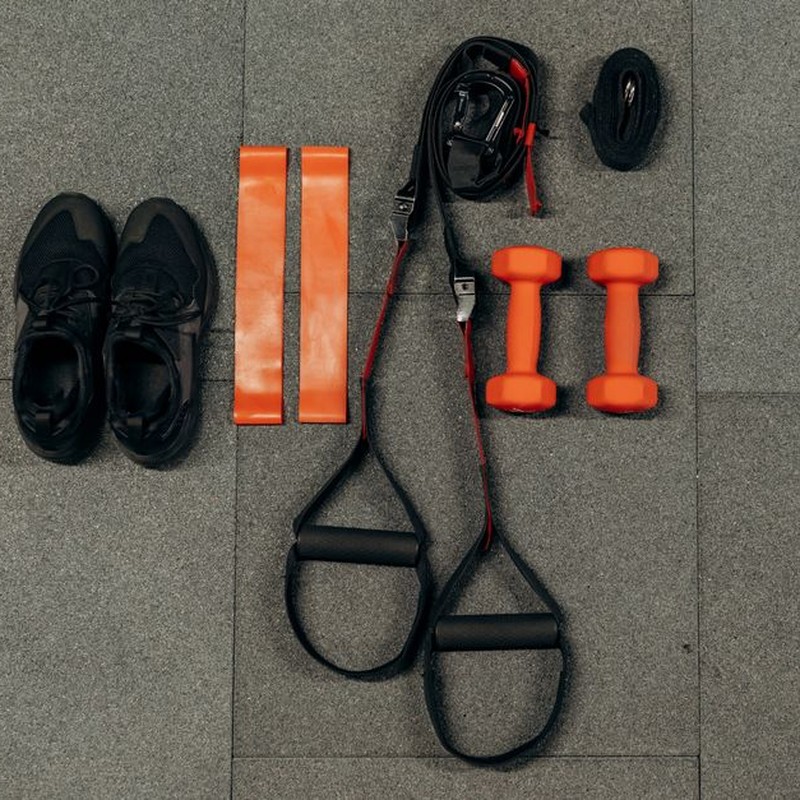
Gyms are starting to build classes around this stage of life, which tells you the demand is real. A fitness center in Jackson, Michigan began offering menopause-specific training in early October 2026, and a Washington, D.C. television station ran a strength-training-during-menopause segment the same week. Reassuring to see, and also not required. A pair of dumbbells, a band or two, and a patch of floor cover every exercise below.
The Six Patterns, Week-One Version
Each session hits the same six movement patterns. Six patterns usually comes out to five or six exercises depending on how you pair them, and this is what trains your hips, spine, and shoulders instead of just your biceps.
Treat this as the week-one list. Later in this article I swap harder variations into two of these slots once you have a few weeks of consistency behind you, so the plan evolves without changing shape.
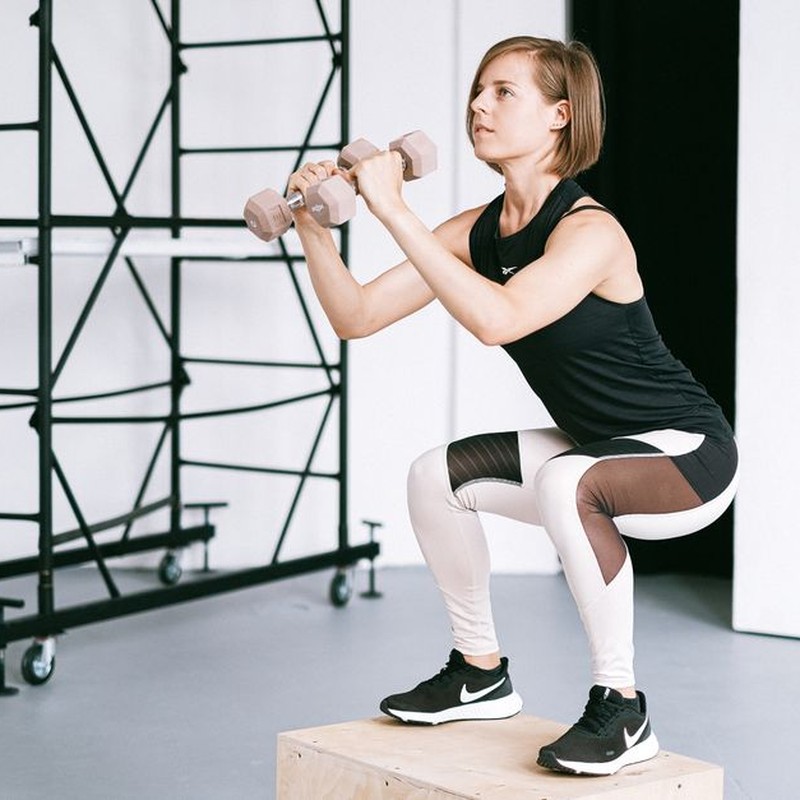
- Squat – goblet squat holding one dumbbell at your chest, or a chair sit-to-stand if you would rather start seated.
- Hinge – dumbbell Romanian deadlift. Push your hips back, keep your spine long, feel it in your hamstrings.
- Push – floor press with dumbbells, or an overhead press if your shoulders tolerate it well.
- Pull – one-arm dumbbell row with a hand on a chair, or a band row anchored in a doorway.
- Carry – farmer carry. Pick up two dumbbells and walk to the end of the hallway and back.
- Core – dead bug. Slow and controlled, low back pressed into the floor.
If a goblet squat and a carry already have your grip and legs talking to each other, trim a set somewhere else rather than adding exercises. Adding more is the most common way beginners turn a 35-minute session into an hour they start skipping.
Running a Session
Start with five minutes of easy movement. Bodyweight squats, arm circles, a few band pull-aparts. Nothing heroic.
Two sets of each exercise, 8 to 12 reps per set, 60 to 90 seconds of rest between sets. The whole thing lands around 30 to 40 minutes, and that is a complete workout, not a warm-up for one.
Two sets per exercise is plenty for the first month, and this is the part I watch people fumble most often. I have seen women add a third set in week two because it felt more serious, then miss the next four sessions because everything ached. The dose you can repeat next week beats the dose that flattens you this week. Leave the third set alone until the third day has been part of your routine for a few weeks.
How to pick your weight: choose a dumbbell or band tension where the last two reps of a set take real effort but your form still holds together. If your back rounds on rep seven of the Romanian deadlift, the weight is too heavy. If you finish 12 reps and could have done 20, it is too light.
How to Progress Without Wrecking Yourself
One progression rule governs everything here. When you can hit 12 clean reps on both sets, move up to the next dumbbell or a thicker band, then drop back to 8 reps and build toward 12 again.
Bands are less precise to progress since they do not come in tidy 5-pound jumps. Shorten your stance, step further from the anchor point, or add a second band to increase tension. Write down what you used.
Expect your lower body to move faster than your upper body, and give it a real timeline rather than a vague one: legs often jump a dumbbell size every three to four weeks, while an overhead press can sit at the same pair of dumbbells for six to eight weeks before it budges.
Adding the Third Day
Once two sessions feel routine and soreness clears within a day, add the third. Monday, Wednesday, Friday suits a lot of people. Monday, Thursday, Saturday also works and gives you a weekend slot if weekdays are crowded.
Keep the same six patterns on the third day. Variety for its own sake makes it harder to load a movement heavier and harder to track honestly. Repetition is the point.
Protein at meals, sleep, and enough calories to support the work all matter as much as the sets and reps do. A plan that ignores them tends to stall around week six, and it will feel like your body’s fault. It usually is not.
Keep a simple log of the weight, the band, and the reps for each exercise. Without that record you are guessing every session, and guessing is what quietly stalls people out.
Adjusting on Hard Weeks: Sleep, Joints, and Recovery
There is a version of strength training that only works on good weeks. That version falls apart in perimenopause, when Tuesday and Monday can feel like two different bodies. The fix is not more discipline. It is a short decision routine you run before every session, so a rough day reshapes the workout instead of deleting it.
Mine takes about fifteen seconds. Before I pick up a dumbbell, I rate my energy from 1 to 10. No app, no chart. Just a gut number.
- 1 or 2: Skip the session. Take a walk, stretch, come back tomorrow.
- 3 or 4: Train, but cut one set from every exercise. Same weights. Do not add anything.
- 5 to 7: Run the workout as written.
- 8 to 10: Push. This is the day to add a rep or a small weight bump.
The 3-and-4 days matter most. Those are the days women either quit the plan or grind through it and feel wrecked for three days afterward. Dropping from three sets to two keeps the habit and the training signal intact while respecting what your body is giving you that morning.
After a few months of rating myself, the pattern got obvious. My 3s and 4s cluster after bad sleep, during weeks when hot flashes wake me at 3 a.m., and in the stretch right before my period. Once I could see it, low-energy days stopped feeling like personal failure. They became scheduling data.
When your joints are the problem
Aching joints and heavy legs are different from injury, and they call for a different response. On a joint-ache day, pull the impact out first. Jump squats become bodyweight squats to a chair. Running becomes a brisk walk, a bike ride, or an incline treadmill. Cycling is friendly to cranky knees if the seat and handle height are set right.
One line I keep taped inside my training notebook: sharp pain is a stop signal, muscle soreness is not. Sharp, pinpoint, or one-sided pain that appears during a rep means end that exercise. Dull, spread-out soreness the next day is normal, especially when you are new to lifting or coming back after a break.
This is the same gap that menopause-specific programs are trying to fill. WILX reported in October 2026 on a Jackson, Michigan fitness center building specialized training for women in menopause, and FOX 5 DC ran menopause strength-training guidance the same week. The common thread in that coverage is not fancy equipment. It is symptom-aware programming. You can copy the idea at home with a rating system and a substitution list.
Give muscle something to rebuild with
Training is the stimulus. Food is the material. The 1.2 to 1.6 grams of protein per kilogram of body weight daily is a reasonable target, but worth framing honestly: that range comes largely from research in adults and older adults doing resistance training, not from menopause-specific trials. Think of it as sensible guidance rather than a settled number. For a 150-pound woman, it lands around 82 to 109 grams a day.
Spreading it across three or four meals beats cramming it into dinner. I aim for 25 to 35 grams per sitting, which in practice looks like Greek yogurt at breakfast, a chicken or tofu salad at lunch, and fish, lean beef, or lentils at night. A protein shake is a tool, not a philosophy. It helps on the days you are behind.
Sleep and the timing of your session
Regular strength training tends to support sleep quality over time. That benefit shows up across weeks, not after one workout, so do not judge it on a single night.
The catch is timing. A heavy leg session at 8 p.m. can backfire if you already lie awake at 2 a.m. running through your to-do list. When you can, move training earlier in the day and keep the hardest sessions out of the two hours before bed. Any evening session you do keep should lean lighter: bands, bodyweight, a couple of easy sets. Save the heavy deadlifts for a time of day when your nervous system has room to cool down afterward.
Keep moving on rest days
Rest days are not couch days. Ten to twenty minutes of easy walking eases stiffness in the hips and low back, lifts mood, and does not take anything meaningful out of recovery. I walk after dinner most nights, no pace goal, no step target.
If you are shopping for adjustable dumbbells or a band set for these lower-energy days, check current prices on Amazon before you commit, since they swing a lot. And if you have a substitution that works on your achy-joint days, drop it in the comments. Other women reading this will use it.
This article is general information, not medical advice. If a joint is swollen, hot, or painful at rest, talk to a doctor or physical therapist before you train through it.
Bone Health, Consistency, and Your First Four Weeks
Bones are living tissue, and they do respond to load. I want to be straight with you about how much, though. The effect of exercise on bone density is modest and site-specific. The bone that gets loaded is the bone that may adapt, which is why changes tend to show up at the hip and other loaded sites rather than everywhere at once. Progressive resistance training is still one of the better things you can do during and after menopause. It is just not a guaranteed reversal of bone loss. Some women hold steady, many slow the decline, and a few gain a little. All of those are wins worth showing up for.
What drives the adaptation is the load getting heavier over time, not the exercise itself. So the number on the dumbbell matters. Log it. I keep a spiral notebook in my gym bag and write down the weight and reps for every set. Seeing last week’s numbers is what tells me whether to add a rep or grab the next dumbbell. Progress you can read on paper beats progress you are trying to remember.
Before your first session, check with your clinician if you have osteoporosis, a history of fractures, or you are on hormone therapy. Some movements, especially loaded spinal flexion – weighted crunches, heavy good mornings – may need to be swapped or skipped entirely. A physical therapist or a trainer who works with menopausal women can help you make those swaps in an afternoon. Do not skip this step if any of it applies to you. Training smart beats training scared.
Here is the first four weeks. Two sessions a week, six exercises per session, two sets each. That maps to the same six movement patterns used earlier in the plan: squat, hinge, push, pull, carry, and core.
- Squat: goblet squat or dumbbell sit-to-stand
- Hinge: dumbbell Romanian deadlift or band pull-through
- Push: overhead press or incline push-up
- Pull: dumbbell row or band row
- Carry: suitcase carry or farmer’s carry, 30 to 40 steps or 30 seconds
- Core: dead bug or band Pallof press
Week one: use the same weights in both sessions and stay well short of failure. Weeks two through four: keep the weights and add reps instead, starting around 8 and building toward 12. Once you hit 12 clean reps on both sets, bump the weight slightly the following month and drop back to 8. Rest 60 to 90 seconds between sets. Two days a week is enough to begin with. If you slept badly or your joints are angry, take the extra rest day without guilt.
For equipment, a pair of adjustable dumbbells and a set of loop bands cover nearly everything here. I have used both at home and in a commercial gym, and the adjustable dumbbells are the one purchase I would make again. Prices swing a lot on them, so check current prices on Amazon before you buy rather than assuming last month’s number still holds. Loop bands are cheap, pack flat, and travel well.
Hiring a trainer who understands menopause can be money well spent. Ask two questions before you book: do you program for bone density, and will you adjust around symptom flare-ups like hot flashes, joint pain, or fatigue? A fitness center in Jackson, Michigan, recently began offering specialized training for women in menopause, per WILX, and a FOX 5 DC segment last October covered strength training during menopause as well. Both are signs this kind of coaching is getting easier to find. If one-on-one is out of budget, a small group or a well-built online program can work just fine.
Searches for “menopause” have been running above their 12-month average in the US, according to Google Trends. Which is a long way of saying you are not the only one figuring this out right now.
Tell us how it is going in the comments. The first month is the hardest stretch to stick with, and swapping notes with other readers about what worked, what did not, and what almost made you quit makes it easier for everyone reading along.