Squat Variations: 5 Types of Squats for Stronger Legs
Squat Variations: 5 Types of Squats for Stronger Legs
The squat is the most functional movement you can train. Every time you sit down, stand up, or pick something off the floor, you’re squatting. But the right variation for you depends on your goals, mobility, and equipment.
There are over 80 documented squat variations in the exercise science literature. I’m not going to list all of them. But I will break down the five that matter most for building real lower body strength — and exactly how to do each one with proper form.
Why Squats Matter
Squats are a compound movement. They hit your quads, glutes, hamstrings, adductors, and core all at once. No leg extension machine can replicate that. Done correctly, squats improve hip mobility, build bone density, and make everyday movement easier.
But here’s the thing — your squat mechanics are unique to your body. Your femur length, hip socket depth, and ankle mobility all affect how you squat. Some variations will feel natural. Others won’t. That’s fine. Pick the ones that work for you.
1. Barbell Back Squat
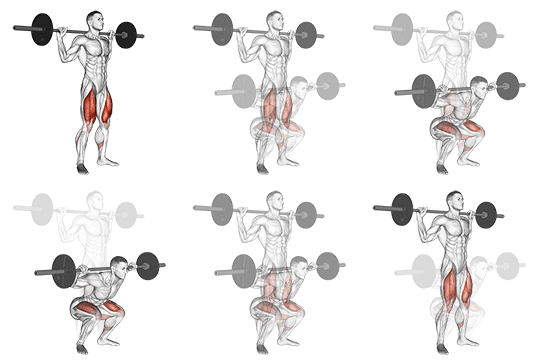
This is the gold standard. The barbell back squat — 7 steps in the standard movement breakdown — targets your quads and glutes with some hamstring and core activation as stabilizers.
How to Set Up
Step 1: Position the bar on your upper traps, not on your neck. Squeeze your shoulder blades together to create a shelf of muscle.
Step 2: Grip the bar with your hands just outside shoulder width. Your wrists should be straight, not bent back.
Step 3: Unrack the bar by driving up with your legs. Take two steps back. Keep your feet shoulder-width apart with toes slightly turned out.
How to Execute
Step 4: Take a deep breath and brace your core. Push your knees out and sit back like you’re lowering into a chair.
Step 5: Descend until your hip crease is below your knee. This is parallel or below — anything above is a half-rep.
Step 6: Drive through your whole foot to stand back up. Keep your chest up and knees tracking over your toes.
Step 7: Exhale at the top. Reset your brace and repeat.
Common cue I use: “Spread the floor” — push your knees outward as you descend. This activates your glutes and saves your knees.
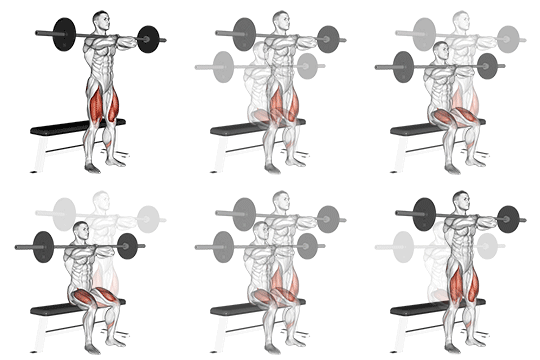
2. Barbell Front Squat
The front squat shifts the bar from your back to the front of your shoulders. This forces a more upright torso and puts more emphasis on your quads. You’ll need more ankle and hip mobility than the back squat.
Setup and Execution
Clean the bar into position — or unrack it from a squat rack set at shoulder height. Rest the bar on the front of your shoulders, not your collarbone. Your elbows should be high and pointed forward. If your wrists can’t handle a front rack position, use straps or cross your arms.
Keep your torso upright throughout the descent. Your knees will track forward more than in a back squat. That’s normal. Descend to parallel or slightly below. Drive up through your heels and midfoot.
You’ll likely use 10-20% less weight on front squats compared to back squats. That’s expected. The movement is harder, and your quads feel it more.
3. Goblet Squat
The goblet squat is the best teaching tool for beginners. Hold a dumbbell or kettlebell at your chest with both hands. Your elbows should point down, not out.
Setup and Execution
Stand with your feet slightly wider than shoulder width. Hold the weight at your chest. Brace your core. Sit back and down, keeping your torso upright. Push your knees out as you descend. Go as low as you can while keeping your heels flat.
The weight in front of your chest acts as a counterbalance. This lets most people squat deeper with better form than they can with a barbell. I’ve seen beginners hit full depth on their first goblet squat when they couldn’t get within six inches on a bodyweight squat.
Do 3-4 sets of 8-12 reps. Increase the weight once you can hit depth consistently.
4. Bodyweight Squat
Don’t skip this just because there’s no weight. The bodyweight squat is a diagnostic tool. Your ability to do one with perfect form tells you everything about your mobility and movement patterns.
Setup and Execution
Stand with your feet shoulder-width apart, toes turned out 15-30 degrees. Extend your arms straight out in front of you for balance. Keep your chest up, spine neutral.
Initiate the movement by pushing your hips back. Your knees should track in line with your toes — not collapsing inward. Lower until your thighs are at least parallel to the floor. Pause, then drive through your midfoot to stand up.
If you can’t hit parallel, work on ankle mobility (dorsiflexion) and hip mobility. A simple fix: put a 2.5-pound plate under your heels. This reduces the ankle range needed and lets you feel the squat pattern. Do that for a few weeks, then try without the plate.
5. Bulgarian Split Squat
This is a single-leg squat variation that hits your quads and glutes like nothing else. You’ll need a bench or box about knee height.
Setup and Execution
Stand about two feet in front of a bench. Place the top of your back foot on the bench. Your front foot should be far enough forward that your shin is vertical at the bottom of the squat. Hold a dumbbell in each hand, or a barbell on your back.
Lower your back knee toward the floor. Keep your torso upright. Your front knee should track over your toes but not past them. Descend until your front thigh is parallel to the floor — or as deep as your mobility allows. Drive through your front heel to stand back up.
This exercise exposes strength imbalances. Your weaker leg has nowhere to hide. Do all reps on one side before switching. Start with just your bodyweight, then add dumbbells once you can do 12 reps per leg with control.
Common Mistakes Across All Squats
Knees Caving In
This is called valgus collapse. It happens when your adductors overpower your glutes. Fix it by actively pushing your knees outward throughout the entire squat. Use a mini-band around your knees as a warm-up to wake up your glute medius.
Heels Coming Off the Floor
If your heels pop up, your ankle mobility is limited or the weight is shifting too far forward. Try squatting with your heels on a small plate. Better yet, spend 2 minutes a day stretching your ankles in a kneeling lunge position.
Butt Wink (Pelvis Tucking Under at the Bottom)
If your lower back rounds at the bottom of the squat, your hips are pushing against their range of motion. This can load your lumbar spine. Solution: widen your stance, turn your toes out more, and don’t squat as deep until your mobility catches up.
Good Morning Squat
If your hips rise faster than your chest on the way up, you’re doing a good morning with a squat attached. The fix: keep your chest up, brace harder, and let the bar travel over midfoot. You may need to drop the weight.
Which Variation for Which Goal
- Building raw strength: Barbell back squat. It loads the most weight and builds the most systemic strength.
- Quad development: Front squat or Bulgarian split squat. Both force more knee flexion and upright posture.
- Glute emphasis: Barbell back squat with a wider stance, or Bulgarian split squat with a longer stride.
- Learning the movement: Goblet squat or bodyweight squat. Master these before touching a barbell.
- Injury rehab or low back issues: Goblet squat or band squat (using a resistance band looped around your knees to add glute activation without spinal loading).
- Home gym with minimal equipment: Bodyweight squat, goblet squat (one dumbbell), and Bulgarian split squat (a bench and dumbbells).
Conclusion
You don’t need to do every squat variation. You need the ones that fit your body and goals. Start with the goblet squat to learn the pattern. Graduate to the barbell back squat for strength. Add front squats or Bulgarian split squats for targeted quad and glute work.
Focus on depth, knee position, and keeping your chest up. The weight will come. The form has to come first.
Medical & Editorial Review: This article was reviewed by Liam Smith, founder of Apexfito, for accuracy and safety. Content is for educational purposes and is not a substitute for professional medical advice. Consult your physician before starting any exercise or nutrition program.
Related: Squat Frequency Per Week