Dumbbell Bicep Curl: 5 Variations for Bigger Arms
Dumbbell Bicep Curl: 5 Variations for Bigger Arms
There are over 50 documented bicep exercises in the training literature. I’ve tried most of them. Some work. Some are just ego lifts that tweak your wrist.
The dumbbell bicep curl is the foundation. But if you only ever do one curl variation, you’re leaving arm growth on the table. Different angles, grips, and positions hit the biceps differently — and your biceps need that variety to grow.
Here are five dumbbell bicep curl variations that cover every angle of your arms. Use them. Rotate them. Your arms will thank you.
Why Bicep Curls Matter
The biceps brachii has two heads — the long head (outer biceps) and the short head (inner biceps). Full development requires hitting both. The long head gives your arms that peak look. The short head adds thickness.
Your brachialis (a muscle under the biceps) and brachioradialis (forearm) also play a role. Hammer curls target these. So if you want bigger arms, you need curls that work all of these muscles, not just the standard palm-up curl.
Curls also improve elbow health and carryover to pulling exercises like rows and pull-ups. You can’t row big weight if your biceps can’t handle the load.
1. Standard Dumbbell Curl
This is the baseline. Master this, and all other curls get easier.
Form Breakdown
Stand with your feet shoulder-width apart, holding a dumbbell in each hand. Palms facing forward. Keep your elbows pinned to your ribs. Don’t let them drift forward or back.
Exhale and curl the dumbbells toward your shoulders. Squeeze your biceps at the top. Lower the weights under control — take about 2-3 seconds on the way down. That eccentric phase is where most of the muscle growth happens.
Common mistakes I see: swinging your body to get the weight up (using momentum instead of muscle), and flaring your elbows out wide. If your elbows leave your ribs, you’re turning a curl into a front raise.
Use a weight where you can complete 8-12 strict reps. The last two should be hard but not ugly.
2. Hammer Curl
The hammer curl uses a neutral grip (palms facing each other). This shifts the work to your brachialis — the muscle that pushes your biceps up and makes your arms look thicker from the side.
Form Breakdown
Stand with your feet shoulder-width apart. Hold dumbbells at your sides with palms facing each other. Keep your elbows pinned to your ribs. Curl the dumbbells up toward your shoulders, keeping your palms facing inward the whole time. Squeeze at the top. Lower under control.
You can do hammer curls standing, seated, or alternating. I prefer alternating because I can focus on each arm individually and control the eccentric better.
You can usually go 10-20% heavier on hammer curls than standard curls because your brachioradialis (forearm) assists. Don’t let that trick you into swinging. Keep it strict.
Hammer curls also build grip strength. If your forearms are lagging, throw these in twice a week.
3. Concentration Curl
The concentration curl isolates the biceps with zero body momentum. You’re seated, elbow braced against your thigh. There’s nowhere to hide.
Form Breakdown
Sit on a bench with your legs spread. Hold a dumbbell in one hand. Lean forward slightly and press the back of your working arm against your inner thigh. Your palm faces forward. The starting position has your arm fully extended with the dumbbell hanging between your legs.
Curl the weight toward your shoulder. Squeeze hard at the top. Lower slowly — I mean, really slowly. Let the negative stretch your biceps.
I like to add a slight supination (twisting the pinky toward your shoulder) at the top of the movement. This extra rotation engages the short head of the biceps more completely.
Go lighter than you think. 15-20 pound dumbbell is plenty for most people. The focus is on the contraction, not the weight on the rack.
4. Incline Dumbbell Curl
This is the most humbling curl variation. Set a bench to 45-60 degrees. Lie back with a dumbbell in each hand, arms hanging straight down toward the floor. Palms facing forward.
Form Breakdown
The incline position stretches your biceps at the bottom. You’ll feel a deep stretch in your upper chest and front delts too. Curl the dumbbells toward your shoulders. Don’t let your shoulders roll forward — keep your shoulder blades pinned to the bench.
Lower the weights slowly. The stretch at the bottom is where the magic happens for biceps growth. If you rush through it, you’re missing the best part.
You’ll need to drop the weight significantly compared to standing curls. That’s normal. I use about 40-50% of my standing curl weight. The range of motion and stretch make it more effective for hypertrophy, not ego.
This variation targets the long head of the biceps. If you want that biceps peak, the incline curl is your best friend.
5. Alternating Dumbbell Curl
Alternating curls let you focus on one arm at a time while keeping the other arm under tension. You can also rotate your wrist as you curl — starting palms facing your body, then rotating to palms facing up at the top.
Form Breakdown
Stand with dumbbells at your sides, palms facing each other. Curl one dumbbell up while rotating your wrist so your palm faces your shoulder at the top. Squeeze. Lower it under control while the other arm starts its curl.
The alternating pattern keeps constant tension on your biceps. There’s no rest between reps like there is in a standard curl where both arms come down at the same time.
Keep your torso stable. If you’re twisting your body to help the weight up, drop 5 pounds and try again.
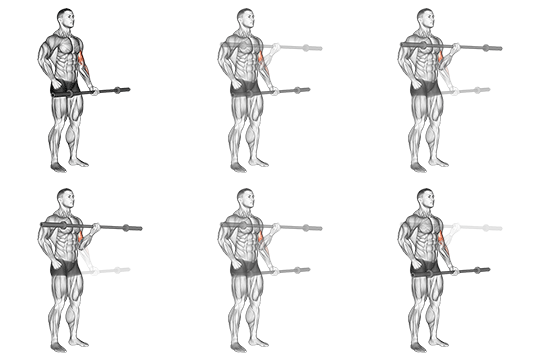
The barbell alternate biceps curl follows a similar 7-step pattern — setup, grip, starting position, curl, squeeze, lower, reset. Dumbbells just give you more freedom of wrist rotation and unilateral focus.
Form Tips That Apply to All Curls
- Keep your wrists neutral. Don’t bend them back to cheat the weight up. Your wrist should be in line with your forearm throughout the movement.
- Don’t swing. If your hips or torso are moving to generate momentum, the weight is too heavy. Strict reps build bigger arms than sloppy heavy reps.
- Control the negative. The lowering phase is as important as the curl phase. Count 2-3 seconds on the way down. Your biceps grow from time under tension.
- Squeeze at the top. Pause for half a second at the peak contraction. That’s where the muscle fibers get the maximum recruitment signal.
- Full range of motion. Extend your arms fully at the bottom. Partial reps (stopping at 90 degrees) shortchange your biceps growth.
- Breathe. Exhale as you curl. Inhale as you lower. Don’t hold your breath.
- Elbows stay put. If your elbows drift forward or back, you’re reducing biceps activation. Pin them to your ribs.
How to Choose Weight
This is where most people mess up. They grab a weight they can barely move, then swing their whole body to get it up. That’s not a bicep curl — it’s a back and shoulder strain.
Use this rule: pick a weight where you can do 10 strict reps in a row. The 10th rep should be hard but possible without body swing. If you can do 12+ reps with perfect form, go up 5 pounds. If you can’t do 8 without using momentum, go down 5 pounds.
For standard and hammer curls, most men start around 20-30 pounds and most women start around 10-15 pounds. For incline and concentration curls, cut those numbers in half.
Write down your weights. Track your progress. If you did 25-pound dumbbells for 8 reps last week, try 25 for 9 or 10 this week. Progressive overload is the engine of muscle growth.
Conclusion
Five variations. Different angles, grips, and positions. That’s all you need to build bigger, stronger arms. Rotate through them every 2-3 weeks — pick 2-3 variations per workout and hit them hard.
Standard curls for the foundation. Hammer curls for forearm and brachialis thickness. Concentration curls for isolation and mind-muscle connection. Incline curls for the long head peak. Alternating curls for constant tension.
Use good form. Control the weight. Add reps or weight over time. That’s the whole formula.
Medical & Editorial Review: This article was reviewed by Liam Smith, founder of Apexfito, for accuracy and safety. Content is for educational purposes and is not a substitute for professional medical advice. Consult your physician before starting any exercise or nutrition program.