Best Home Gym Equipment for Apartments: Quiet, Compact Picks That Won’t Bother Your Neighbors
Full disclosure: Some links in this article are affiliate links. We may earn a small commission at no extra cost to you if you make a purchase through them. Our recommendations are based on what real users report, not on commission size.
Why Apartment Gyms Fall Apart (and How to Fix Yours Before You Buy Anything)
Six years ago, I set up my first home gym in a second-floor walk-up. I had an XMark folding bench, a cheap CAP 45-pound barbell, and one iron plate. On paper it looked like a starter kit. In practice, it was three mistakes waiting to happen. The bench took up my entire living room. The barbell couldn’t be reracked without crashing. And the plate made a dull boom every time it touched down.
On day three, I found out how loud that boom was. I had just finished a deadlift set and reracked the bar a little too fast. The plate bounced off the upright, slid across the floor, and slammed into the baseboard hard enough to crack the plaster behind it. My downstairs neighbor texted me within twenty minutes to ask if everything was okay. That crash taught me Rule #1: nothing that bangs hard surfaces. The other two rules were sitting right there in my setup.
Apartment training isn’t a smaller version of garage training. It’s a different sport. Most home gym content assumes you have a basement, a spare garage bay, or at least a ground-floor room. That content doesn’t help when your ceiling is someone else’s floor and your walls are shared with people who go to bed early. So before you buy anything, write down these three rules:
- Nothing that bangs hard surfaces. A dropped 45-pound iron plate is the obvious offender. But a swinging kettlebell that clanks onto the floor is just as bad. And a barbell reracked too aggressively will send force through the joists. If the movement can’t be done without a thud, it doesn’t belong above someone’s bedroom.
- Nothing that takes up a corner permanently. A power rack is out. A bulky all-in-one machine will slowly turn your living room into a storage unit. Even a folding squat stand takes up floor space unless you actually fold and store it every single time. In an apartment, the phrase “it can be moved” usually means “it never gets moved.”
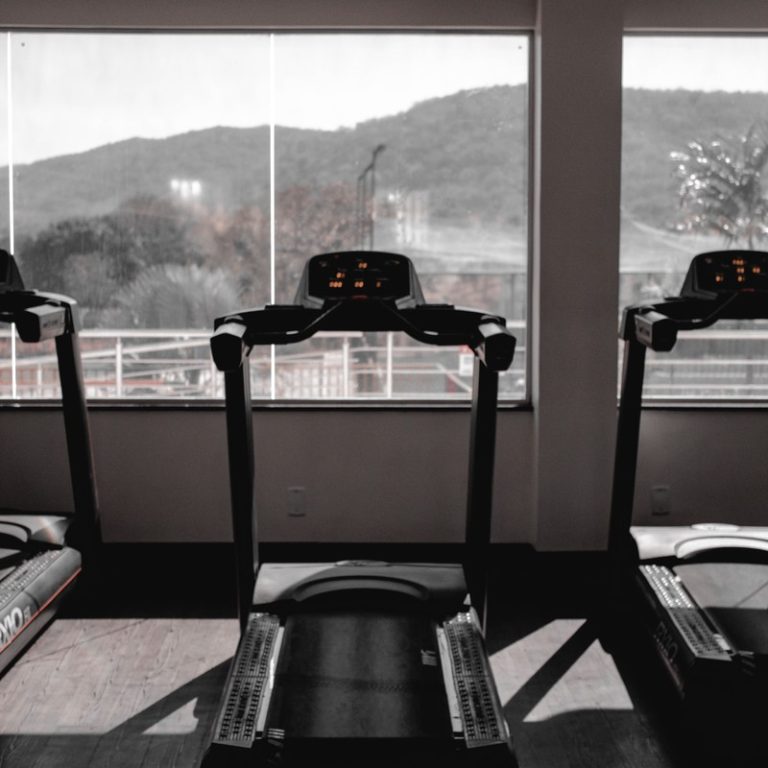
- Nothing that needs a heavy-duty rack to be useful. You don’t need a barbell if you can’t safely deadlift it in a narrow space. You don’t need a lat pulldown tower if a door anchor can handle the same job. And about treadmills: skip them in most apartments. Even a quiet treadmill vibrates through the floor at walking speed, and the footprint eats a quarter of your room. If you truly need cardio, a walking pad that slides under the couch is a better call.
I learned these rules the hard way. After the plate incident, I kept buying gear that sounded good in a warehouse showroom. I had a folding squat stand that worked in theory but still felt shaky every time I repped out. I bought a heavy kettlebell and discovered I couldn’t do swings without worrying about the floor. Eventually I sold both and rebuilt around smarter pieces: adjustable dumbbells, a good band set, a pull-up bar, and a compact bench that folds under my bed.
That setup taught me something surprising. A full home gym doesn’t need a power rack, a barbell, or a treadmill. On a 4×6-foot stall mat in the corner of my second bedroom, I can train my entire body. I can squat, hinge, press, row, and load up single-leg work without ever leaving that mat. The neighbors haven’t complained once since I made the switch.
Every pick in the rest of this guide comes back to those same three rules. Quiet, compact, and neighbor-friendly is not a compromise. In an apartment, it’s the upgrade. When you’re ready to buy, check current prices on Amazon to compare. And if you’ve already built an apartment gym that works without driving your neighbors crazy, share your experience in the comments.
The Quiet Flooring and Sound Control You Can Install in One Afternoon
Flooring matters more than the equipment. The loudest thing in an apartment gym isn’t the clang of a plate; it’s the thud of a dumbbell hitting the floor or the stomp of a lunge. That noise travels through carpet pad and wood joists straight to the neighbor below. Put something dense between your feet and the floor, and most of the noise disappears before it starts.
I learned this in a second-floor unit. My first setup used puzzle foam mats because they looked like the obvious choice. The echo was miserable. Every rep sounded like a drumbeat, and the mats shifted under me during burpees. Two weeks later I pulled them up and drove to a farm supply store.
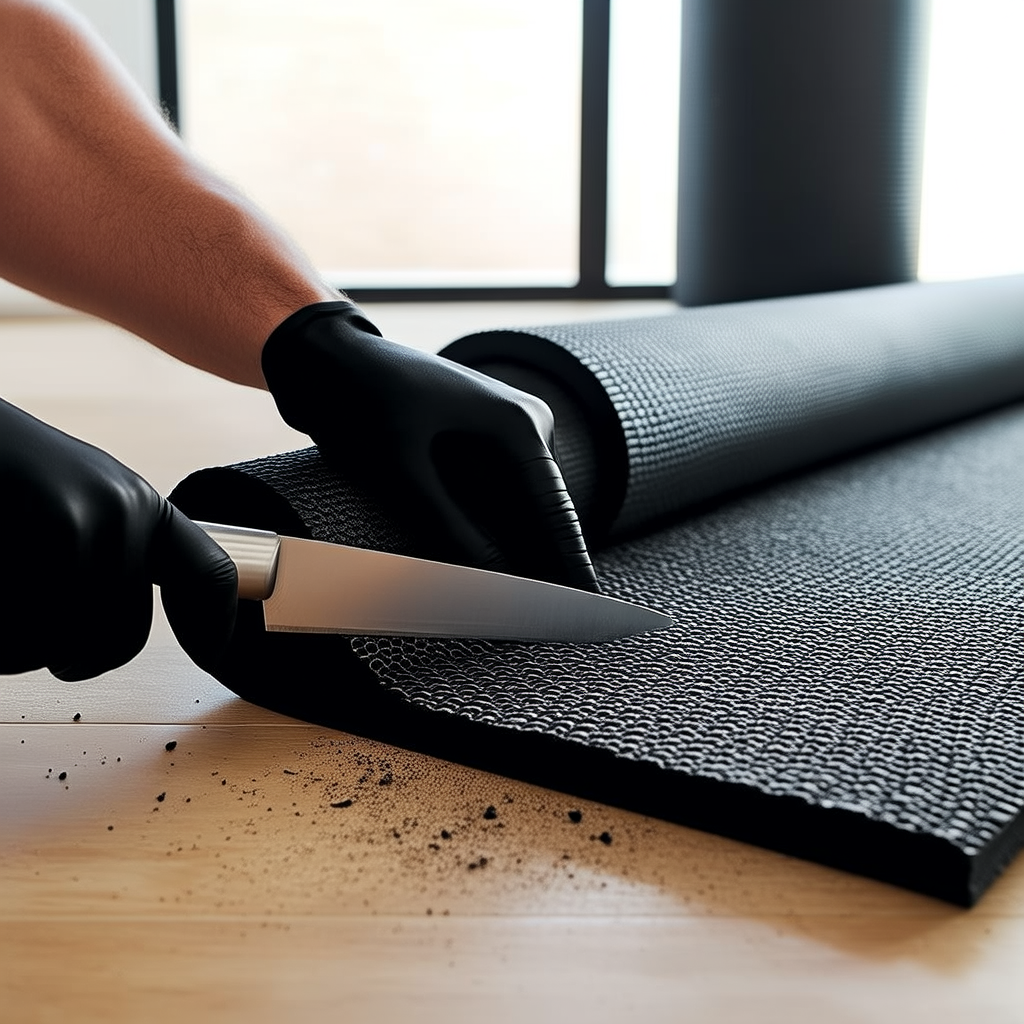
What actually worked was a half-inch rubber mat stock with a textured surface. It killed most of the thud. The texture gave enough grip for heavy lunges without slipping. You can find the same stuff as rubber tile stock or horse stall mats at a farm supply store, and they’re cheaper than branded fitness mats. A single 4×6-foot mat covers the area where you plant your feet during deadlifts, kettlebell swings, or lunges — it doesn’t need to cover the whole room. If you’re only using dumbbells up to 20 pounds, a 6mm mat may suffice; for anything heavier, stick with the half-inch.
One thing nobody mentions: new rubber mats smell strong. The odor fades after a few days, but it’s worse indoors. Unroll it outside or in a garage for a day or two if you can.
Installing it takes one afternoon. You need a utility knife, a straightedge, and measuring tape. Score along the straightedge a few times, bend the mat to crack the scored line, then finish the cut. Lay the pieces so the seams are tight, then tape them with rubber mat seam tape — not duct tape, which peels and leaves residue. Seam tape keeps the edges from curling and stops the mat from shifting when you set up for deadlifts. I skipped this step on my first install and the seam caught my foot during a lunge. Tape it.
The flooring handles most of the noise, but the equipment itself matters too. A foam roller, a yoga mat, or a thick towel under a bench, kettlebell, or dumbbell rack catches the small vibrations that travel through floor joists. I keep a foam roller under the base of my squat stand while I work. It sounds small, but the room below feels the difference. That low rumble, not the loud bang, is what bothers people in an apartment.
If you rent, the best part is that this is temporary. Rubber mats come up in minutes without leaving marks, and you can take them with you when you move. No glue, no permanent changes.
Before you buy any flooring, check current prices on Amazon for rubber mat stock or horse stall mat alternatives. Prices vary a lot. And if you have a flooring setup that worked in your apartment, leave a comment below to share your experience.
Compact, Quiet Gear That Will Not Get You a Noise Complaint
Apartment workouts fall apart when every rep sounds like a bowling alley. I learned this the hard way in a third-floor unit, so I put together a small kit that works without turning neighbors into enemies. I tested the Bowflex SelectTech 552, a NÜOBELL adjustable set, Fit Simplify bands with a door anchor, and a Flybird folding bench. Here’s what made the cut.
Adjustable Dumbbells Are the Backbone
One adjustable set from roughly 5 to 50 pounds replaces a whole rack of individual dumbbells. The Bowflex SelectTech 552 uses a dial on the handle to switch between 15 weights. NÜOBELL’s twist-select works the same way and keeps the plates in the base while you change loads. Both are fast enough that I don’t cheat myself by skipping a heavier set.
Dial systems are the popular choice because you can go from 10 to 35 pounds in under five seconds. Pin-lock sets are quieter than most people expect. The plates sit locked on the handle, so there’s no loose metal clanking when you set them down. The trade-off is speed. I use dials when I’m doing dropsets, but a pin-lock set is fine if you’re doing straight sets.
No matter which type you pick, keep an eye on the base. A 40-pound dumbbell still hurts if it comes down hard. Control every rep, and put a 6mm rubber mat under your bench and standing area. That mat also keeps the metal off the wood floor, which is better for your security deposit.
Resistance Bands With a Door Anchor
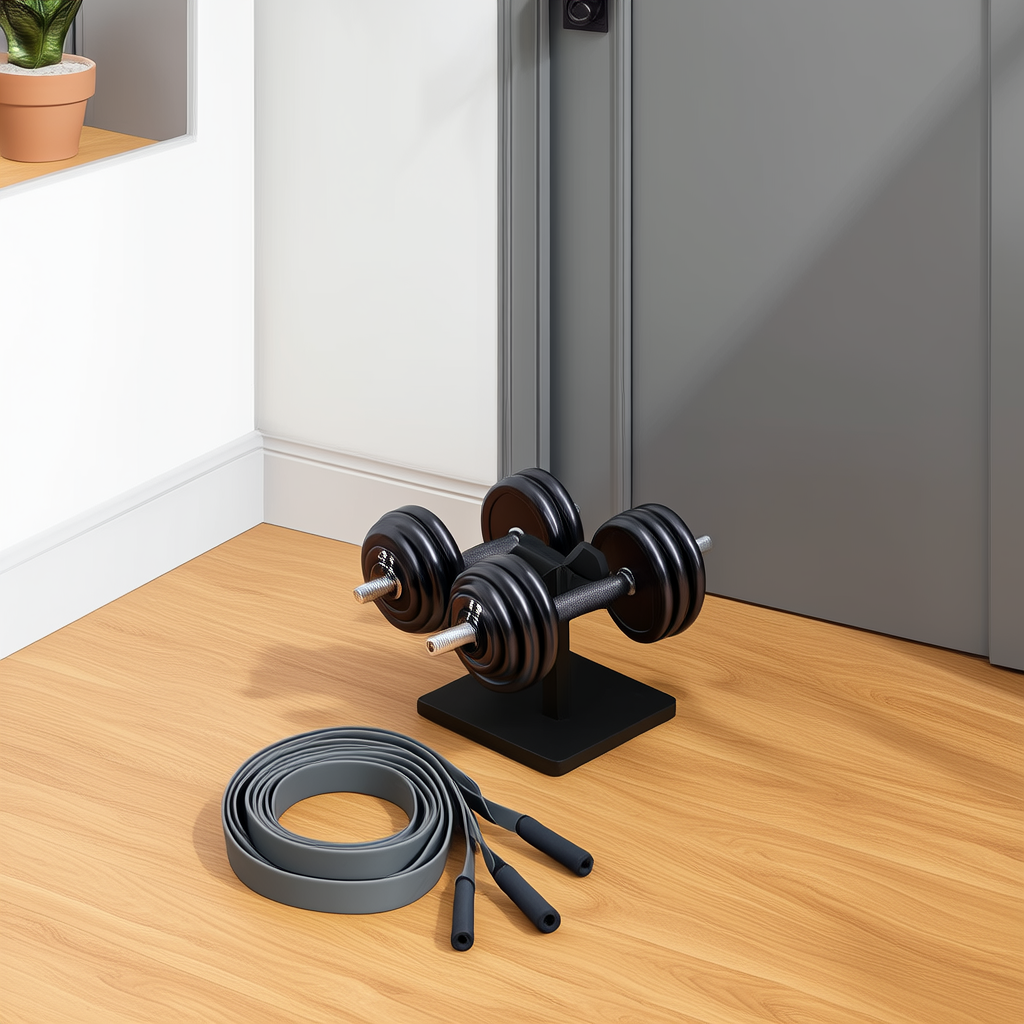
Resistance bands are the quietest thing you can own. A kit like the Fit Simplify 11-piece set comes with a door anchor, handles, and a few tubes for under $25. I keep the anchor in a kitchen drawer. Setup takes ten seconds: slide the strap between the door and frame, close the door, clip the band, and go.
In an apartment, bands give you a workout when you can’t drag out the dumbbells. Presses, rows, leg curls, face pulls, and lateral raises all work with a door anchor at different heights. The tension curve is different from dumbbells, so I treat them as a separate stimulus, not a replacement. If you’re new to them, start with the lightest tube and focus on slow reps.
A Folding Bench That Disappears
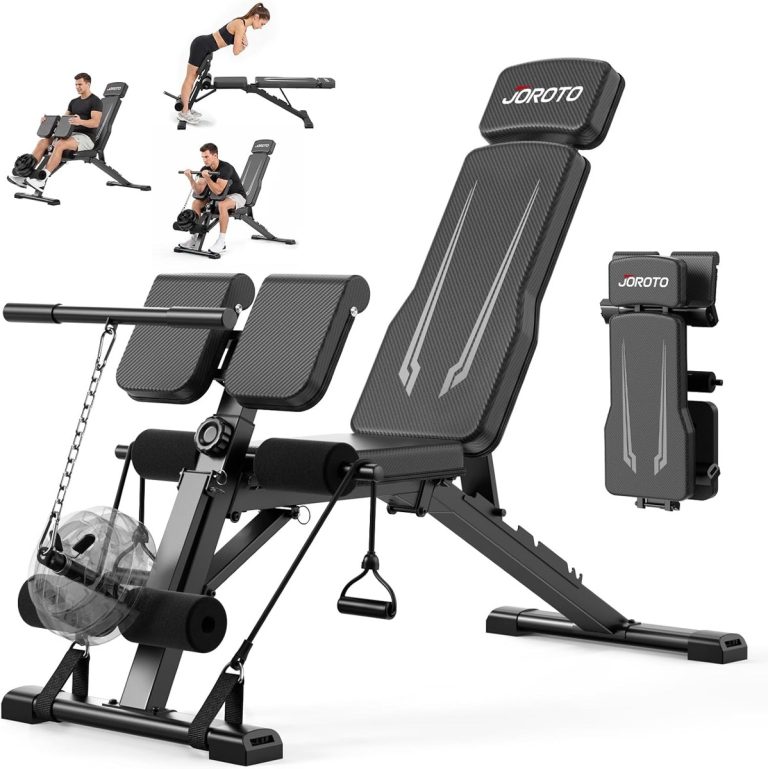
A folding bench is the biggest upgrade for floor space. I use a Flybird F1 adjustable bench, which folds flat and slides under my couch. It has a 660-pound weight rating and six back positions. When it’s folded, you wouldn’t know it’s there.
Having a bench changes your pressing. Lying down gives you a longer range of motion than floor presses, and you can do seated dumbbell shoulder work without dragging a chair into your workout area. Before you buy any bench, check the weight rating against your dumbbells. Most cheap folding benches are rated for 300 to 600 pounds, which is plenty for a 50-pound dumbbell set. But if you plan to go heavier, buy a higher-rated bench now. You don’t want to replace it after a few months.
What to Skip in an Apartment
Skip heavy kettlebells. A kettlebell swing that slips out of your hand is a missile aimed at the floor, and even a controlled set-down after a hard set can rattle the ceiling below. Skip slam balls for the same reason. The entire point is to throw them down, which is the exact opposite of being a good neighbor.
Skip barbell clips and the iron plates that go with them. The clips aren’t the problem; the clang of steel on steel is. A barbell setup also eats up floor space and begs you to let the loaded bar crash down. If you want the feel of plates in your hands, use a pair of plate-loaded dumbbells with rubber-coated weights. They still need a mat, but you control the weight with your hands, and no bar is bouncing across the floor.
Those four pieces are enough to put together a solid home gym in a one-bedroom apartment. The setup is quiet, folds away, and won’t leave a permanent mark on your flooring. If you want to compare current prices, look up the Bowflex SelectTech 552, NÜOBELL, Fit Simplify bands, and the Flybird bench on Amazon. After you’ve tried a setup like this, drop a comment with what worked in your space.
How to Build a Small-Space Setup That Actually Fits Your Life
I set up my first apartment gym in a corner that also held a bookshelf and a cat tree. The version that lasted had one thing going for it: it took under two minutes to get ready and did not make the room feel like a storage unit. The exact brand and model matter less than that.
Here is the layout I use now, followed by the first circuit I would run on it.
The Layout
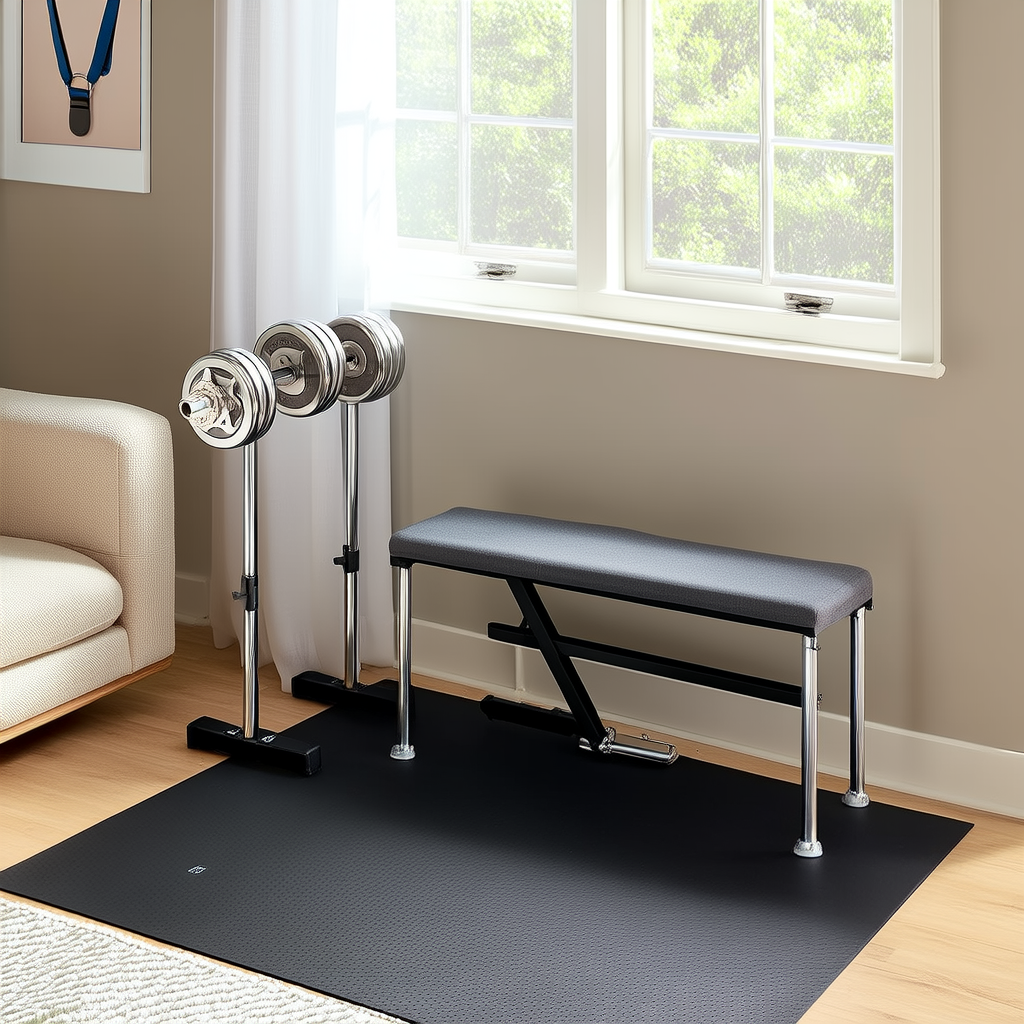
Put a 4×6-foot rolling mat in a corner of your living room or bedroom. That mat gives you 24 square feet of floor for stretching, core work, and bodyweight exercises. I leave mine down all week. Its low profile makes it look more like a rug than gym equipment, and that alone keeps me from talking myself out of a session.
Position the mat so the open edge faces into the room and you have at least two feet of clearance in front of it. If you need a little more space for push-ups, angle the mat or move the coffee table a few inches during your workout. The point is to know exactly where the mat will go before you buy anything.
Keep the adjustable dumbbells on a small stand against the same wall. Before you set it, check the foot traffic. If you have to squeeze past the stand to reach the couch or the door, shift it a foot or two. The goal is a clear walking path even when the gym is out. The bench tucks under the couch when it is not in use.
Hang a band door anchor on a hallway door near the main living area. You can leave it hooked on the door or pull it off and keep it in a drawer. It takes about ten seconds to set up either way.
The mat itself is 24 square feet. The rest tucks away, so the total footprint on the room is that mat plus a narrow stand against the wall. In my 700-square-foot apartment, this setup left the room walkable and every piece of equipment within one step of the mat.
A few small habits make the easy-to-grab part work:
- Set the dumbbells to the weight you use most often so you do not have to adjust them on workout days. When you need to change them, you will know because you will be reaching for the dial before the exercise.
- Keep a folded hand towel and a water bottle next to the mat. If you have to go into another room for water, you will find reasons to stop.
- Put the bench under the couch before you sit down at night. It takes one shove, and you won’t trip over it in the dark.
Start With a Simple Full-Body Circuit
You do not need a complicated program to get moving. Run this circuit three times, two or three days per week, with at least one rest day between sessions:
- Goblet squats — 8 to 12 reps
- Push-ups — 5 to 15 reps depending on your level
- Dumbbell rows — 8 to 12 reps per side
- Shoulder presses — 8 to 12 reps
- Band pull-aparts — 12 to 15 reps
Take 60 to 90 seconds between rounds. If the first week feels hard, do two rounds instead of three. Two or three sessions per week is enough to build strength without leaving you sore for days.
Keep a controlled tempo on the goblet squats and dumbbell rows: about two seconds down and two seconds up. That slow movement is what actually works your muscles, and it keeps the weight from clanking on the floor. Set the dumbbells down gently between sets instead of dropping them.
I like this order because it hits your legs, chest, back, and shoulders in one pass. The band pull-aparts at the end wake up your upper back after all the pushing. If standard push-ups are too tough, do band push-ups: loop a resistance band across your upper back, hold one end in each hand, and lower to the floor. The band takes some of your body weight off your chest. Same movement, lighter load.
Track the Small Numbers That Actually Signal Change
Open the notes app on your phone and write down your weights and reps after each workout. A line like squats 20 lb x 8, row 20 lb x 8 is enough. On each exercise, aim to reach the top of the rep range with good form on your first two working sets. When you can hit that for two clean sets in a row, bump up to the next dumbbell setting.
For push-ups, the same logic works with difficulty instead of pounds. Add a slow tempo on the way down, do more reps, or elevate your feet on the bench once the standard version gets easy. Make the next workout slightly harder than the last one, and you won’t be guessing at progress.
That progression is where results come from. The equipment is just the carrier for it.
Make It Yours Before You Make It Complicated
I have seen people buy a full squat rack for a 500-square-foot apartment and use it twice. I have also seen people do nothing but a pair of dumbbells and a mat for a year and get noticeably stronger. The difference is whether the gear fits the room and the schedule.
If the bench or the door anchor does not work in your exact setup, do not force it. Leave the bench out for a week and see if it gets in the way. Try the band anchor on a closet door instead. The right arrangement is the one you will actually walk to on a Tuesday when you are tired.
Before you buy anything, check the current prices on Amazon to see where these picks stand today. Then come back and tell us in the comments which setup you went with and how it is working in your apartment. The best home gym for an apartment is the one you can actually set up, use, and step away from without tripping on it.
Medical & Editorial Review: This article was reviewed by Liam Smith, founder of Apexfito, for accuracy and safety. Content is for educational purposes and is not a substitute for professional medical advice. Consult your physician before starting any exercise or nutrition program.