Resistance Band Shoulder Workout:
Resistance Band Shoulder Workout: 5 Exercises for Strong Delts
Most people think you need dumbbells or a barbell to build shoulders. You don’t. A good resistance band shoulder workout can hit all three heads of your deltoids just as effectively, and in some ways better than free weights.
I pulled from a dataset of 50 shoulder exercises to find five that cover your front delt, side delt, rear delt, and the rotator cuff muscles that support everything. Here’s the full workout.
Why Bands Work for Shoulders
Your shoulder is a ball-and-socket joint, which means it moves in every direction. Free weights rely on gravity pulling straight down, so they only resist vertical and some horizontal movement. Bands, on the other hand, can provide resistance at any angle. You can anchor them low for an overhead press, high for a face pull, or at chest height for a front raise.
Bands also build constant tension. With a dumbbell press, the bottom is the hardest part and the top is easy. With bands, the top is the hardest part because the band is stretched the most. That changes the stimulus completely.
1. Band Shoulder Press
This is your main mass builder. It targets the front and side delts, plus your triceps.
How to do it:
- Stand on the center of a resistance band with both feet, hip-width apart.
- Bring the handles up to your shoulders, palms facing forward, elbows bent.
- Press the band straight overhead until your arms are fully extended.
- Lower the handles back to your shoulders under control.
Form cue: Don’t let your ribs flare. Keep your core braced and your ribs down as you press. If your back arches excessively, you’re using too much band tension.
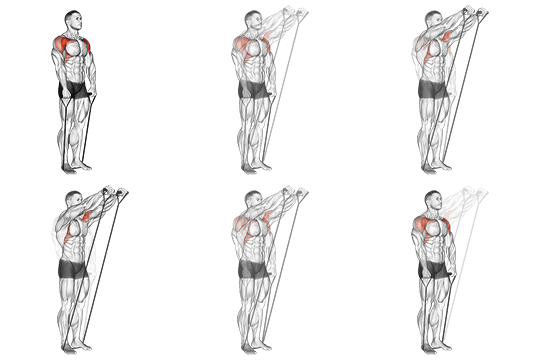
2. Band Front Raise
The front raise targets your anterior delt. It’s a simple movement, but most people rush it.
How to do it:
- Stand on the band with both feet, holding the handles at your thighs, arms straight.
- Keeping your arms straight (soft elbows), raise both hands forward and up to shoulder height.
- Pause for a second at the top.
- Lower slowly back to your thighs.
Don’t swing your body to get the band up. If you have to lean back to lift it, go down in band resistance. You want your front delts doing the work, not momentum.
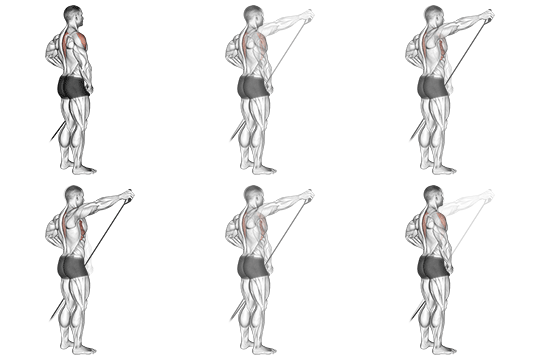
3. Band Lateral Raise
This is the exercise that gives you round, full shoulders. The lateral (side) delt makes your shoulders look wider.
How to do it:
- Stand on the band with both feet, handles at your sides.
- Raise your arms out to the sides, keeping a soft bend in your elbows.
- Lift until your elbows reach shoulder height.
- Lower slowly back down.
The trick: Imagine you’re pouring a pitcher with your thumbs. Your pinkies should be slightly higher than your thumbs at the top. This internally rotates your shoulders and puts more tension on the side delt.
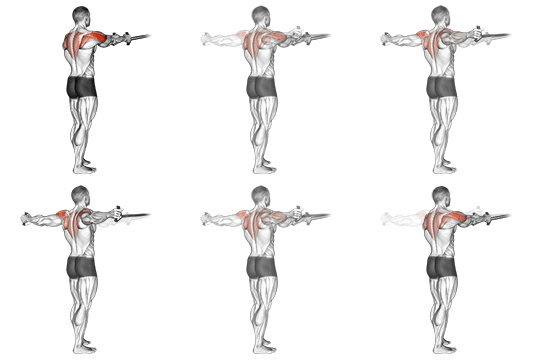
4. Band Reverse Fly
Your rear delt is the most neglected part of the shoulder. Most guys hammer front raises and presses and wonder why their shoulders look imbalanced. The reverse fly fixes that.
How to do it:
- Hold the band with both hands, arms extended in front of you at chest height.
- Keep your arms straight as you pull the band apart.
- Squeeze your shoulder blades together as your hands move out to the sides.
- Pause at full extension.
- Return to the start slowly.
For a stronger version, anchor the band at chest height on a rack or door frame and pull toward you. Either way, focus on squeezing your upper back at the end of each rep.
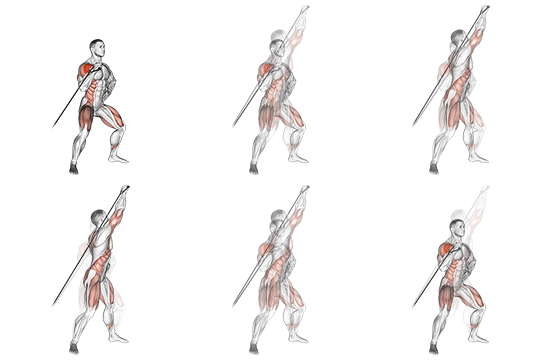
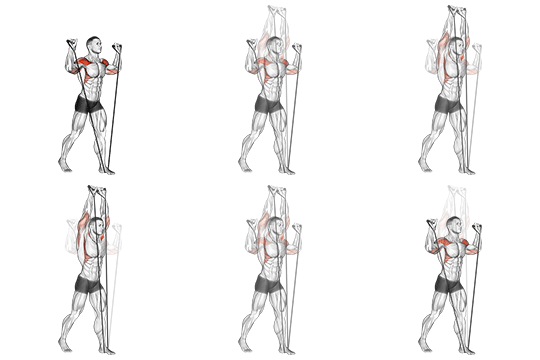
5. Band Overhead Press
This variation adds a twist at the top, which hits your side delts even harder and challenges your rotator cuff.
How to do it:
- Stand on the band with both feet.
- Press the band overhead.
- At the top, rotate your palms forward and externally rotate your shoulders.
- Lower back down with control.
- Repeat for reps.
The twisting motion at the top engages your rotator cuff, which is great for shoulder health. If you have a history of shoulder injuries, skip the twist and stick with a standard band shoulder press.
Complete Circuit Routine
Run this circuit twice per week on non-consecutive days. Rest 30-60 seconds between exercises and 90 seconds between rounds.
| Exercise | Sets | Reps | Rest |
|---|---|---|---|
| Band Shoulder Press | 3 | 12-15 | 60 sec |
| Band Front Raise | 3 | 12-15 | 45 sec |
| Band Lateral Raise | 3 | 12-15 | 45 sec |
| Band Reverse Fly | 3 | 15-20 | 45 sec |
| Band Overhead Press | 3 | 10-12 | 60 sec |
Do this circuit as a standalone shoulder day, or tack it onto the end of a push or upper body workout.
Choosing Band Resistance
Bands come in light, medium, heavy, and extra heavy. For shoulders, here’s my advice:
- Light — warm-up sets and lateral raises
- Medium — front raises and reverse flies
- Heavy — shoulder press and overhead press
You should be struggling to finish the last 2-3 reps of each set with good form. If you can breeze through 20 reps without breaking a sweat, go up a level.
Benefits of Band Training for Shoulders
- Variable resistance — heavier at the top where you’re strongest, lighter at the bottom where you’re weakest
- Joint-friendly — no heavy barbell pressing overhead, less compression on the shoulder joint
- Portable — throw a band in your bag and you can train shoulders anywhere
- Constant tension — muscles stay under load through the entire range of motion
- Rotator cuff work built in — many band exercises naturally recruit the smaller stabilizing muscles
Conclusion
You don’t need a gym full of iron to build strong, balanced shoulders. This resistance band shoulder workout hits the front, side, and rear delts with exercises that are backed by real movement patterns. The band shoulder press and band overhead press build the mass. The lateral raise and reverse fly add the shape and balance.
Stick with it for 6-8 weeks, and you’ll notice your shoulders looking fuller and feeling more stable during pressing and overhead movements. Start with medium resistance, nail the form, and work your way up.
Medical & Editorial Review: This article was reviewed by Liam Smith, founder of Apexfito, for accuracy and safety. Content is for educational purposes and is not a substitute for professional medical advice. Consult your physician before starting any exercise or nutrition program.