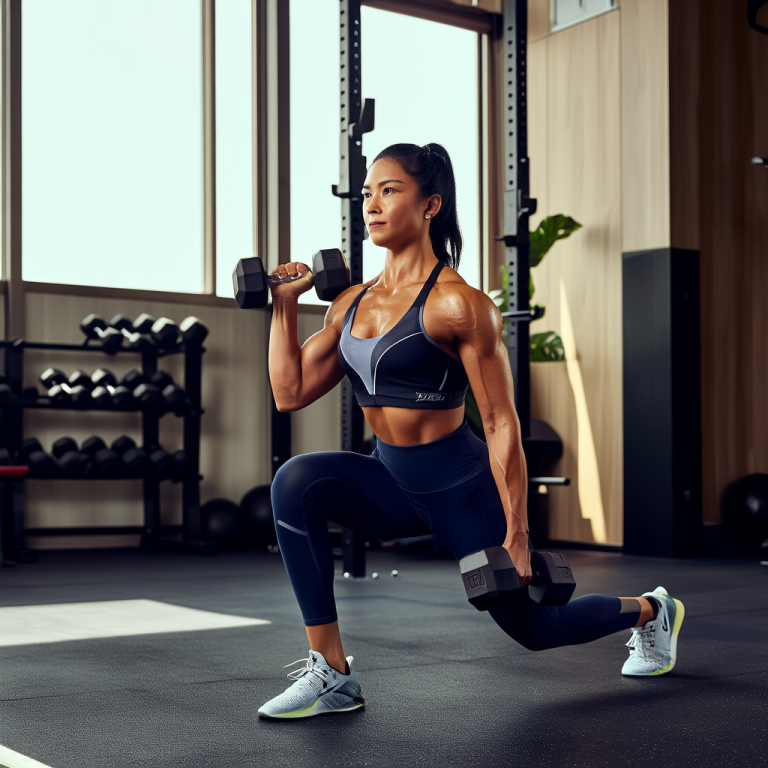
Dumbbell-Only Workout Plan for Women Over 40: A Beginner’s Strength Training Guide
Full disclosure: Some links in this article are affiliate links. We may earn a small commission at no extra cost to you if you make a purchase through them. Our recommendations are based on what real users report, not on commission size.
Why Dumbbell Strength Training Matters More After 40
You notice it in small moments: the stairs feel steeper than they did a few years ago, or you brace yourself before lifting a grocery bag with a few extra cans. That’s not just you being tired. After 40, women tend to lose muscle mass more quickly than they rebuild it. If you don’t challenge those muscles, the slow decline keeps going.
Strength training flips the script. When you lift weights, you send a clear message to your body: “Keep this muscle—I still use it.” Your body responds by preserving muscle and even adding a little. That gives you real-world strength for things like picking up a grandkid, carrying laundry upstairs, or getting up from the floor during a picnic.
Here’s the part many of us don’t consider in our forties: bone density. Your bones are living tissue, and weight-bearing exercise like dumbbell lifting stresses them just enough to keep them strong. That matters because bone loss speeds up after menopause. You’re not just working out for today—you’re investing in your future mobility.
Dumbbells are the perfect entry point. They let you start with a weight that feels almost too easy, learn the movements without pressure, and add small increments as you get stronger. You don’t need a gym membership, a barbell, or a long equipment list. Just a pair of dumbbells and a few square feet of floor.
This plan is built for beginners. It includes three full-body sessions per week, using only dumbbells. Each workout takes about 45 minutes, including a quick warm-up and a cool-down. Before you lift, spend 3-5 minutes warming up: march in place, do arm circles, and practice a few slow bodyweight squats. This gets your blood flowing and preps your shoulders, hips, and knees for the work ahead.
Expect the first two weeks to feel uneventful visually. You probably won’t wake up with visible changes. But by week three or four, the weights feel a little lighter, you can do more reps with control, and everyday movements feel smoother. That’s the day you start looking forward to your sessions.
Practical advice to start strong:
- Pick a weight that lets you finish every rep with control, with the last two reps feeling genuinely hard.
- Form matters more than load. If you can’t keep your spine neutral and your chest open, the dumbbells are too heavy.
- Don’t chase soreness. A mild burn is fine; sharp pain or extreme muscle ache is a sign to pull back.
- Schedule your three sessions on non-consecutive days—Monday, Wednesday, and Friday works well.
Start with the warm-up, then move through the first exercise slowly. That’s all today needs to be.
Your Weekly Dumbbell-Only Workout Schedule
Three full-body sessions a week is enough to build real strength, especially when each session hits your whole body. I know that sounds too simple, but it’s exactly why this plan works for women over forty. You’re not trying to live in the gym. You’re trying to get strong, feel capable, and stay consistent for the long haul.
Set your training days on Monday, Wednesday, and Friday, or any three nonconsecutive days that fit your week. The space between workouts is where your muscles repair, so don’t skip the off-days. They’re part of the plan.
Your weekly schedule at a glance
- Monday: Workout A — squat and press focus (30–40 minutes)
- Tuesday: Rest or easy walk
- Wednesday: Workout B — hinge and row focus (30–40 minutes)
- Thursday: Rest or easy walk
- Friday: Workout C — mixed pattern, lower volume (30–40 minutes)
- Weekend: Active rest, stretching, or whatever feels good
Each workout takes 30 to 40 minutes, including a quick warm-up: five minutes of brisk walking or marching in place, arm circles, cat-cow, and a few bodyweight squats. After that, you’re ready to lift.
Workout A: Squat and Press
This session hits your squat pattern and both upper-body pushes. Use a weight that lets you finish all reps with control. The last two reps should feel challenging but not impossible.
- Goblet Squat — 3 sets of 8–10 reps
- Floor Chest Press — 3 sets of 8–10 reps
- Dumbbell Shoulder Press — 3 sets of 8–10 reps
- Farmer Carry — 3 sets of 30 seconds
- Core Finisher (Plank or Dead Bug) — 2 sets of 30 seconds or 10 reps per side
Workout B: Hinge and Row
This session covers your hip hinge and your pulling muscles. It balances the pushing from Workout A and builds the posterior chain.
- Dumbbell Deadlift — 3 sets of 8–10 reps
- Single-Leg Romanian Deadlift — 2 sets of 8–10 reps per side
- Bent-Over Row — 3 sets of 8–10 reps
- Farmer Carry — 3 sets of 30 seconds
- Core Finisher (Plank or Dead Bug) — 2 sets of 30 seconds or 10 reps per side
Workout C: Mixed Pattern, Lower Volume
This is a lighter day in terms of total sets, but your effort stays the same. It pairs the squat pattern with the hinge pattern and throws in a press and a row to keep everything balanced.
- Goblet Squat — 2 sets of 8–10 reps
- Dumbbell Deadlift — 2 sets of 8–10 reps
- Bent-Over Row — 2 sets of 8–10 reps
- Dumbbell Shoulder Press — 2 sets of 8–10 reps
- Farmer Carry — 2 sets of 30 seconds
- Core Finisher (Plank or Dead Bug) — 2 sets of 30 seconds or 10 reps per side
Rest 60 to 90 seconds between sets. If you’re breathing hard after a heavy set, take the full 90 seconds. If you feel ready sooner, pick up the dumbbells and go again. Keep your form solid and your energy steady.
When you can complete the top of the rep range for every set with controlled form, add 2 to 5 pounds. This is your progression. It doesn’t have to happen every week; it just has to happen over time.
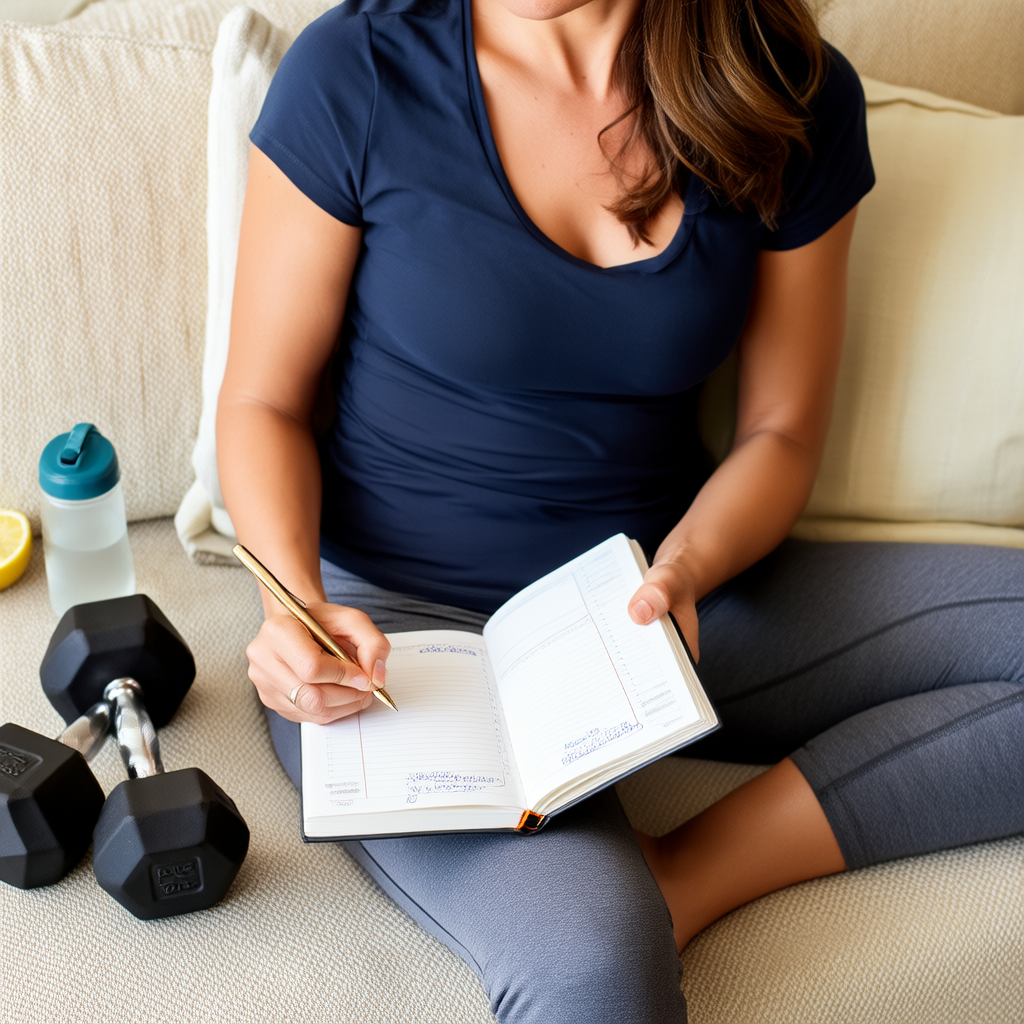
Keep a workout log. A small notebook or a notes app on your phone works. Write down the weight, reps, and how the set felt. I started logging my sessions in my early forties, and it changed my consistency. Last week I used 12-pound dumbbells for 10 reps, so this week I reach for 15s instead of guessing. That visible progress is a powerful motivator.
Some weeks you’ll only fit in two workouts. That’s okay. Two are still better than zero, and the following week you simply get back on schedule. Consistency over perfection is how strength gets built.
The Dumbbell Exercises That Build the Foundation
If you can master just six dumbbell movements, you’ve got a complete full-body strength routine. No rack of machines, no spotter, no complicated gymnastic positions. These six moves cover your legs, back, chest, shoulders, arms, and core. I’ve used this exact lineup with friends and clients who came back to training after years away. It works because it asks you to move the way your body is designed to move.
One thing before you start: don’t try to do all six in one session. That turns a smart session into a marathon. Instead, treat these as your movement library for the A/B/C plan. Workout A takes three of them, Workout B takes the other three, and Workout C circles back through a mix. You’ll rotate them through the week, and the exact split is below.
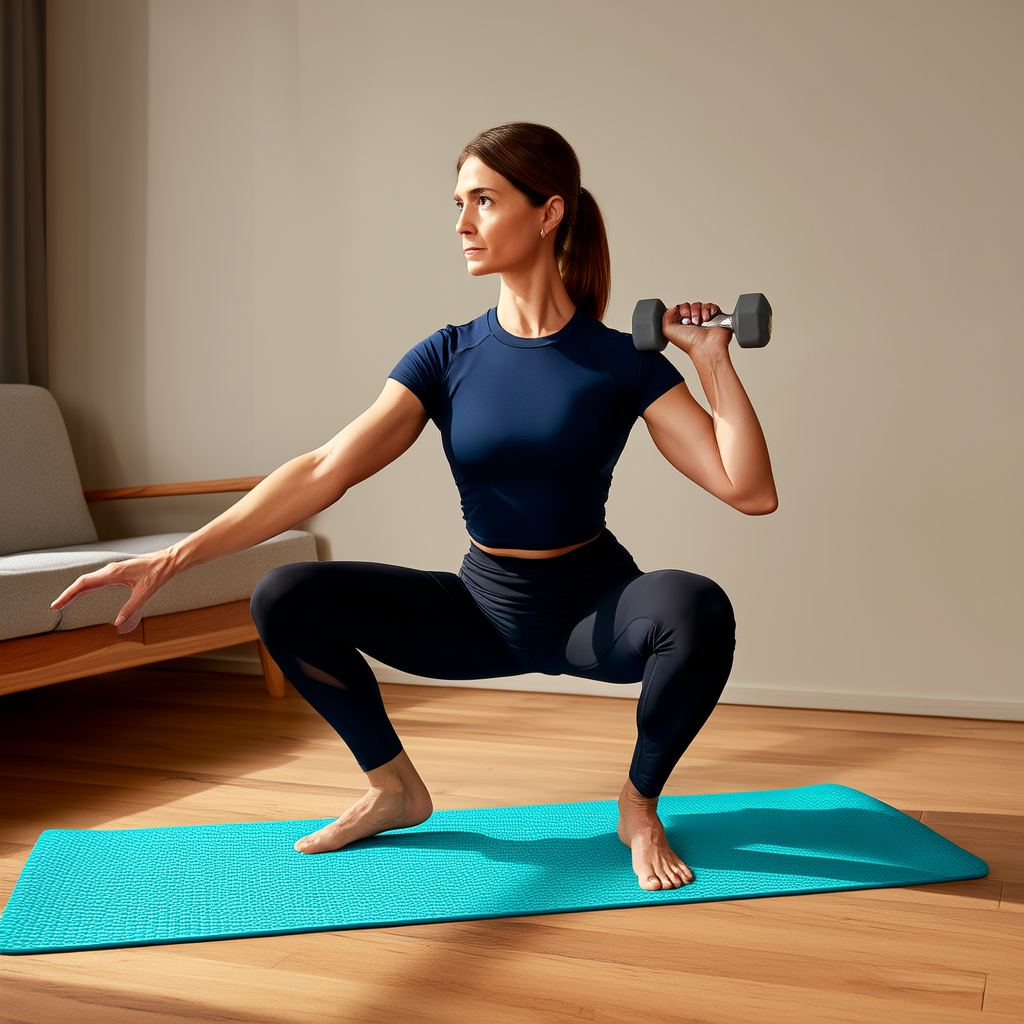
1. Goblet Squat
Hold one dumbbell vertically against your chest, cupping the top end with both hands. Stand with your feet shoulder-width apart, toes turned out slightly. Sit your hips back and down as if there’s a chair behind you, letting your knees track in line with your toes. Keep your chest up and your heels rooted to the floor. Press through your whole foot to stand back up.
The goblet squat is a forgiving way to build leg strength because the weight sits in front, which naturally encourages an upright torso. Your lower back doesn’t have to work as hard to stay safe. This one lives in Workout A.
2. Dumbbell Romanian Deadlift
Stand with feet hip-width apart, holding dumbbells in front of your thighs. Keep a soft bend in your knees, then push your hips straight back as you lower the weights along the front of your legs. You should feel a deep stretch along your hamstrings. Keep your back flat and your neck neutral. Imagine your tailbone reaching behind you. Squeeze your glutes to return to standing.
This move targets the hamstrings and glutes, the muscles that make climbing stairs and playing with grandkids feel effortless. Start with light weights until you can feel the stretch without rounding your back. It’s part of Workout B.
3. Single-Arm Dumbbell Row
Place your left hand and left knee on a sturdy chair or bench. Keep your back flat and your right foot on the floor. Let the dumbbell hang from your right arm, then pull it toward your hip, leading with your elbow. Lower with control. That’s one rep. After your set, switch sides.
Because you’re working one side at a time, you’ll catch strength imbalances early. Most people have a side that feels smoother. Let that side set the pace. This move belongs to Workout B.
4. Floor Press
Lie on your back with both knees bent and feet flat on the floor. Hold a dumbbell in each hand, upper arms on the floor, elbows bent at about 45 degrees from your torso. Press the weights up until your arms are straight, then lower them slowly until your elbows touch the floor. Keep your shoulder blades squeezed together throughout the movement.
The floor limits how far your elbows can drop, which is good for shoulder health. You still work your chest and triceps, just without the stress of balancing a barbell. If you only have one heavy dumbbell, you can hold it with one arm and do alternating presses, but two light ones are easier to manage at first. This is a cornerstone of Workout A.
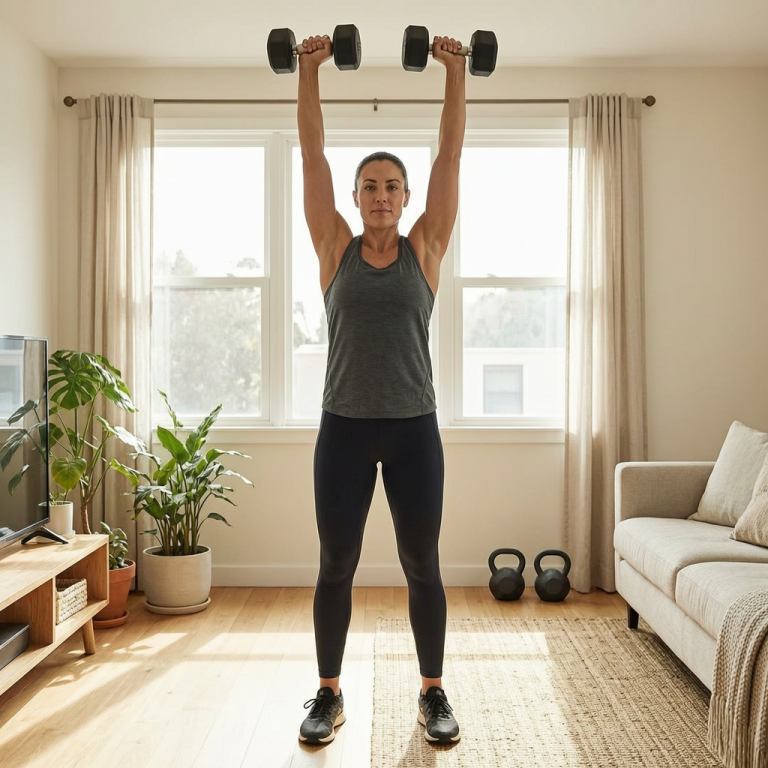
5. Standing Overhead Press
Stand with feet hip-width apart, dumbbells at shoulder height, palms facing forward. Squeeze your glutes and pull your ribs down before you press. Push the weights over your head until your arms are straight, then lower them back to shoulder height. Stay tight throughout.
This builds shoulder strength and teaches your core to brace. Don’t let your lower back arch. If you can’t press without arching, lighten the weight or practice pressing one arm at a time while holding a wall with your free hand. I had to do the one-arm version for two weeks before I felt solid enough to tackle both dumbbells. There’s no shame in that. It has a home in Workout B.
6. Farmer Carry
Hold a dumbbell in each hand and stand tall. Walk slowly and deliberately for 30 seconds, keeping your shoulders down and your abs braced. You can walk in a straight line back and forth in your living room or around the yard. That’s all there is to it.
Farmer carries build grip strength, core stability, and posture. They’re the closest thing to doing real-life hard work. As you get stronger, use heavier dumbbells or walk for longer. These finish Workout A in this plan.
How to Put It Together Across the Week
Each weekly session in this plan uses only some of the moves, so you’re fresh every time you walk back to the dumbbells.
- Workout A: Goblet Squat, Floor Press, Farmer Carry
- Workout B: Dumbbell Romanian Deadlift, Single-Arm Dumbbell Row, Standing Overhead Press
- Workout C: Goblet Squat, Single-Arm Dumbbell Row, Floor Press
Alternate like this: Week 1, do A, B, C on non-consecutive days. Week 2, do B, C, A. Week 3, start over at A. That gives you three full-body sessions without repeating the same workout back-to-back too often.
Use the same set-and-rep scheme for every dumbbell movement: 2 to 3 sets of 8 to 12 reps, with 60 to 90 seconds of rest between sets. For the farmer carry, aim for 2 to 3 sets of 30 seconds. Choose a weight that makes the last two reps challenging but not impossible. If you finish a set and feel like you could do five more, go heavier. If your form breaks down, go lighter.
Progress by adding weight every two to three weeks, not every session. Add just 2.5 to 5 pounds per side. That’s enough. If you only have a fixed set of dumbbells, do more reps and slower lowering phases before jumping up in weight.
Have you tried any of these moves before? Let me know in the comments. And if you’re looking for a good set of dumbbells for home training, check the current prices on Amazon first.
How to Add Weight and Reps Without Overthinking It
If you’ve ever stood in front of a dumbbell rack and guessed, you’re not alone. I kept a pair of 15 lb dumbbells in my living room for months and assumed they were doing something. Then I started writing my workouts down and realized I’d been doing the same 12 reps with the same weight every single week. Strength was never going to find me that way.
You don’t need a complicated spreadsheet. You need one rule: keep a weight until you can hit 10 to 12 clean reps on every set, two workouts in a row. Then add a little weight.
The 10-12 Clean Rep Rule
Clean means your form stays in control for the whole set. The last two or three reps feel hard, but you don’t swing the dumbbells, you don’t arch your back to press overhead, and you don’t dip your knees to curl the weight up. If you have to contort your body to finish, that weight is too heavy for now.
This rule gives you a simple target. Start any exercise with the heaviest dumbbells you can lift for about 10 clean reps. Some women start with 5 or 8 lb dumbbells for pressing movements and 15 or 20 lb for lower-body work. The number doesn’t matter. What matters is that you write it down.
How to Progress Each Week
Week 1 and 2: use the same weights for all three workouts. Your body is learning the movement pattern, and your tendons are catching up to your muscles. You don’t need to make everything heavier right away. You need to show up and log the reps.
Week 3: pick one upper-body exercise and one lower-body exercise. Add the smallest jump you have. If your gym has 2.5 lb plates or adjustable dumbbells, use those. If you only have whole dumbbell sizes, move up 5 lb and expect your rep count to drop. You might only get 7 or 8 clean reps with the new weight. That is still progress.
Leave your other exercises alone. Next week, pick two different movements and try to make a small improvement there. You are not behind because you didn’t increase everything. You are building slowly on purpose.
When your log shows 10 to 12 reps on all your sets with a weight, twice in a row, your body has adapted. Time to add 2.5 to 5 lb. If the next weight means you only get 8 reps, that’s normal. The job of your next few workouts is to turn those 8 reps into 9, 10, and finally 12.
Take a Lighter Week Every 4 Weeks
After three weeks of pushing, your joints often feel more tired than your muscles. That’s why this plan includes a lighter week. Same exercises, same number of sets, but use about half of your normal weight. You still move through the full range of motion, and your body gets a break from heavy pressure.
I have heard women worry this will make them lose gains. It doesn’t. After a lighter week, they usually come back and set a small record. Give yourself that room to recover.
Your Log Is the Real Progress Tracker
The mirror lags behind. The scale can be honest but insensitive. Your workout log will show you the truth far earlier than either of them. Write down the exercise, the dumbbells, the reps, and how the last set felt. If next week’s entry says 9 reps with the same weight instead of 8, that is progress even if nothing else looks different.
One thing that made this click for me: I stopped trying to make every workout feel completely different. I used the same small set of moves, recorded every number, and let the numbers speak. When I stopped guessing, I started getting stronger.
To keep it simple:
- Stay with your starting weights until you hit 10 to 12 clean reps on all sets, twice in a row.
- Add 2.5 to 5 lb and allow your reps to drop a little.
- Progress only one or two exercises per session.
- Keep the same exercises for 4 to 6 weeks.
- Take a lighter week every fourth week.
You do not need to overthink this. Pick a weight that challenges you, write it down, and make one small change at a time. That is how women over 40 build muscle without burning themselves out.
Recovery, Cardio, and Staying Consistent Long-Term
Your dumbbell sessions build the muscle, but the rest of your week decides whether that muscle sticks. Recovery isn’t passive. It’s an active part of this plan, and it doesn’t require fancy equipment or hours at the gym.
Strength training doesn’t have to replace your cardio. If you enjoy walking, cycling, or swimming, keep doing it. Add 20 to 30 minutes on your off days. You’ll improve your heart health, and you’ll probably feel more energized for the next lifting session.
If your schedule only allows cardio on lifting days, do it after your dumbbell work. That way your legs stay fresh for goblet squats and lunges. A short 15-minute walk after your workout also helps bring your heart rate down and makes for a solid cool-down.
Sleep and protein are less exciting than lifting, but they’re where the results show up. I’ve coached women who train hard and wonder why their arms don’t change, then admit they’re running on six hours and no breakfast. Aim for 7 to 8 hours of sleep. That’s when your body repairs the micro-tears from your dumbbell sessions. At each meal, pair protein with vegetables. A simple target is 20 to 30 grams of protein per meal: 4 ounces of chicken, 1 cup of Greek yogurt, or 3 eggs with a glass of milk. Adjust portions if you need to, but that range gives your body real material to rebuild with.
Expect some muscle soreness in the first two weeks. That dull ache after a new exercise is normal. But sharp joint pain is a warning sign. If your shoulder or knee protests during a movement, stop that movement. Lower the weight or shorten the range of motion, then reassess. There’s no shame in using lighter dumbbells while you build a stable foundation. After the first two weeks, if the last two reps of every set feel smooth, add 2 to 5 pounds and keep going.
Consistency wins because it’s built into a routine you actually enjoy. I’ve had clients stick with this plan for months because they schedule their three sessions like meetings and keep their rest days realistic. If you prefer to lift on Tuesday, Thursday, and Saturday, shift the rest days to fit your life. Here’s a sample week for someone lifting Monday, Wednesday, and Friday:
- Monday: dumbbell workout + 10-minute walk
- Tuesday: 25-minute brisk walk
- Wednesday: dumbbell workout
- Thursday: 25-minute bike ride
- Friday: dumbbell workout
- Saturday: active rest, light stretching
- Sunday: full rest
When you’re ready to buy, compare current prices on Amazon for adjustable or fixed dumbbells, then come back and share which set you picked and how your first week went in the comments.
Medical & Editorial Review: This article was reviewed by Liam Smith, founder of Apexfito, for accuracy and safety. Content is for educational purposes and is not a substitute for professional medical advice. Consult your physician before starting any exercise or nutrition program.