Eccentric Training: The Overlooked Lowering Phase That Builds More Muscle
Full disclosure: Some links in this article are affiliate links. We may earn a small commission at no extra cost to you if you make a purchase through them. Our recommendations are based on what real users report, not on commission size.

What the Eccentric Phase Really Is, and Why Your Lowering Rep Does More Work
Stand near the dumbbell rack and watch someone curl. The up portion is slow and deliberate, almost ceremonial. The down portion looks like they dropped the weight and caught it at the bottom. Eight reps, logged, moving on. Half of every one of those reps went in the trash.
Every repetition has two halves doing two different jobs. The concentric phase is where the muscle shortens while producing force: standing up out of a squat, pressing a bar off your chest, curling that dumbbell toward your shoulder. The eccentric phase is the reverse. The muscle lengthens while it is still producing force. Sinking into the squat. Lowering the dumbbell back to your side. Easing the bar to your chest instead of letting gravity take it.
That difference matters because your muscles are stronger while lengthening than while shortening. I ran into this years ago with pull-ups. I could not finish a single strict rep, but I could fight the descent for a solid five seconds. My lats were producing force the whole way down. They just could not produce enough to pull me back up.
Here is the clearest way to feel it for yourself. Load a barbell to a weight you can press for about three reps, then add 20 or 30 percent more. You will not press it. Now have a spotter help you lift that heavier bar off your chest and let you lower it alone. You will control it, probably without much strain. The same muscle that could not budge the weight upward can slow its descent just fine.
That extra capacity is not a party trick. It is the reason the lowering phase deserves its own training slot instead of being treated as the boring part of a rep.
The mainstream press has started paying attention. Women’s Running published an explainer on eccentric training in October 2026, and the framing matched what most coaches already see on the gym floor: people treat the lowering phase as a formality between reps rather than as the training stimulus itself. A Futura piece from October 7, 2026 made a similar argument, calling the eccentric phase an overlooked part of a workout that can quietly drive muscle gains.
Search interest reflects that slow rise in coverage. U.S. Google Trends data for eccentric training shows recent search volume averaging 2.7 against a 12-month average of 2.4. Those are low absolute numbers, so read the bump as a media trend rather than a mass movement. Nobody is rebuilding their program over it. But more lifters are asking the question, and that is where the useful part starts.
If you have plateaued on a lift, the eccentric phase is the most obvious place to look for a variable you never touched. Most intermediate lifters run a program with a clear plan for sets, reps, and load. Almost none of them have a plan for tempo. The bar goes up in two seconds and comes down in one because that feels natural, not because anyone chose it.
There is a cost. Eccentric contractions create more microscopic muscle damage than concentric-only work, which means more delayed soreness — the kind that shows up a day later and peaks around 48 hours. That soreness is not evidence you did something wrong. It is part of the adaptation signal. It is also why a hard eccentric block can wreck your week if you load it carelessly.
For now, the move is small and specific. Pick one or two lifts you already do. On those lifts, count the lowering phase in your head. Three seconds down. That is the entire intervention. No new equipment, no program overhaul. Just stop dropping the weight and start lowering it.
- Squat or leg press: three seconds from the top to the bottom, no bounce at the bottom.
- Bench press or dumbbell press: three seconds from lockout to chest, brief pause, then press.
- Dumbbell curl or row: three seconds from the top back to the start position.
Run that for three or four weeks and you will likely need to cut your working weight by 10 to 20 percent to keep your form clean. That drop is not a step backward. It is the point. You are handing the eccentric phase a real share of the work instead of letting momentum steal it.
Do not chase soreness as a scoreboard. Some extra stiffness in the first week is normal. Sharp joint pain, or soreness that lingers past four or five days, is not. Back off the tempo work or the load — not both at once.
Once a few weeks of controlled lowering feels automatic, eccentrics stop being a tempo cue and start being a loading method. That version means heavier weights, a rack or a spotter, and a recovery plan that treats the next 48 hours as part of the session.
If you need a set of adjustable dumbbells for tempo work at home, check current prices on Amazon. And if you have already tried counting your descent, tell me how the first week went in the comments.
What Eccentric-Focused Training Can and Can’t Do
Eccentric training didn’t just get discovered. Researchers have been loading the lowering phase in labs for decades, which is why I get skeptical when a headline promises a secret switch for muscle growth. The mechanism is real. How much you get from it depends entirely on how you use it.
Strength: yes, and it shows up at long muscle lengths
Accentuated eccentric loading, where the weight you lower is heavier than the weight you lift, has been compared with standard training plenty of times. Strength gains come out roughly equal at worst, and slightly ahead in some cases. The clearer edge is in the stretched position and at specific joint angles you struggle with. If your bench stalls two inches off the chest, or your hamstrings quit at the bottom of a Romanian deadlift, that’s the territory eccentrics touch.
The dumbbell version is simpler than most people expect. For curls, curl both arms up, then lower only one arm on a 3-4 second count. Set it down and repeat. The lowering arm handles more load than it could lift on its own. On barbell lifts, a training partner can add a plate on the way down and strip it at the bottom. That old-school trick still works on bench and squats.
Size: real, but conditional on recovery
Hypertrophy from eccentric emphasis runs on two drivers: higher mechanical tension and more muscle damage. Both are legitimate stimuli. Neither helps you if you’re so sore you skip your next session or spend a week training at 60 percent of your usual output.
I ran heavy eccentric squats and Nordic curls in the same week once and my hamstrings were wrecked for five days. Splitting them into separate weeks gave me the same stimulus without the lost sessions. That’s the trade you’re managing.
Tendon and injury resilience: the strongest case
Nordic hamstring curls are almost purely eccentric, and they’re a fixture in elite soccer injury-prevention programs for a reason. Teams that do them consistently see fewer hamstring strains. Eccentric strength appears to build tolerance in tendon and muscle tissue in ways concentric-only training doesn’t match. If you’re coming back from a tendon issue, or you play a sport with sprinting and hard cuts, this is where eccentrics earn their keep.
Start conservative: two sets of five Nordics with your hands out front for support, once a week. Can’t control the descent yet? Use a band or hinge slowly from a kneeling position instead. Expect serious soreness for the first two sessions. That’s normal, not a sign you did something wrong.
What doesn’t hold up
- Slower is always better. A ten-second lowering on every set of every exercise slashes your total volume and leaves you sore for days. Tempo is a tool you pick for a purpose, not a default setting.
- Eccentrics as a shortcut around progressive overload. They aren’t one. You still need more weight or more reps over time, enough calories, and consistent sleep. No tempo trick replaces any of that.
- Headline promises of sudden gains. Futura, a French science outlet, ran a piece in October 2026 framing eccentrics as an overlooked phase tied to faster gains, and Women’s Running covered the topic the day before. Read both as a prompt to experiment, not as proof that one tempo change rewrites your physique. Search interest has crept up over the past year, which mostly tells you the topic is trending, not that the underlying science just flipped.
- Throwing it at everything at once. Eccentric emphasis multiplies stress. Stacking it across your whole program is how you end up detrained instead of stronger.
How to test it on yourself
Pick one or two lifts, not your entire split. Add a 3-4 second lowering to those alone for three to four weeks, keep everything else identical, and log your reps. If your numbers at those joint angles move, keep it. If your recovery tanks and your other lifts slide, you overshot and should pull it back.
If a cheap tempo timer would keep your counts honest, check current prices on Amazon before you buy. Then post your results in the comments. I’m curious how the hamstring work treats people who aren’t soccer players.
How to Program Eccentric Work with Dumbbells and a Barbell
Tempo notation looks like a math problem the first time you see it. It isn’t. The numbers in 3-1-1 mean three seconds lowering, a one-second pause at the bottom, and one second to stand the weight back up. You already own that last number. The work lives in the first.
Start with 3-1-1 on your main lifts: back squat, bench press, Romanian deadlift, overhead press, row. Pick a load you could normally move for a comfortable set of eight, then run it for six reps. Count out loud. One-one-thousand, two-one-thousand, three-one-thousand is slower than you think, and almost everyone who believes they’re doing a three-second negative is running closer to one and a half.
Keep the load identical for the first two weeks. Not heavier. Not five extra pounds because the first set felt easy. The tempo is the training variable in that block, and stacking weight on top of it turns a controlled eccentric into a sloppy drop, which is just a normal set with worse mechanics. Once you can hold three seconds on every rep of every set without your lower back rounding, your knees caving, or your shoulders shrugging forward, add weight. Five to ten pounds on upper-body lifts, ten to twenty on lower-body work. When form breaks, the set is over. That’s a completion standard, not a suggestion.

Accentuated eccentrics: the cheapest upgrade you have
Accentuated eccentric loading means the lowering phase is heavier than the lifting phase. With dumbbells, the simplest version is two up, one down. Press two dumbbells overhead, lower with one arm. Same idea for rows, curls, and lateral raises. Your concentric strength is whatever you can press, and your eccentric strength runs higher than that. A load that’s brutal to lift can still be manageable to lower. You’re exploiting the gap.
With a training partner, the version gets better. Have them help you raise a weight 10 to 20 percent heavier than your normal working set, then own the descent yourself. That’s roughly the setup the recent Women’s Running and Futura coverage was circling in early October 2026. The lowering half of a rep gets skipped in most programs, and loading it deliberately adds stimulus without adding sets. The programming is where people get lost, not the concept.
Exercises worth your time
Not every lift rewards a slow lowering phase. These are the ones I keep coming back to, and they work with dumbbells, a barbell, or both:
- Romanian deadlift, four-second lower. The best eccentric lift in the gym for hamstrings. Set the bar down deliberately, feel the stretch, and don’t let it drift away from your legs.
- Back squat, three-second descent. Use safety pins if you’re running eccentric-only reps. Control beats depth until the tempo feels automatic.
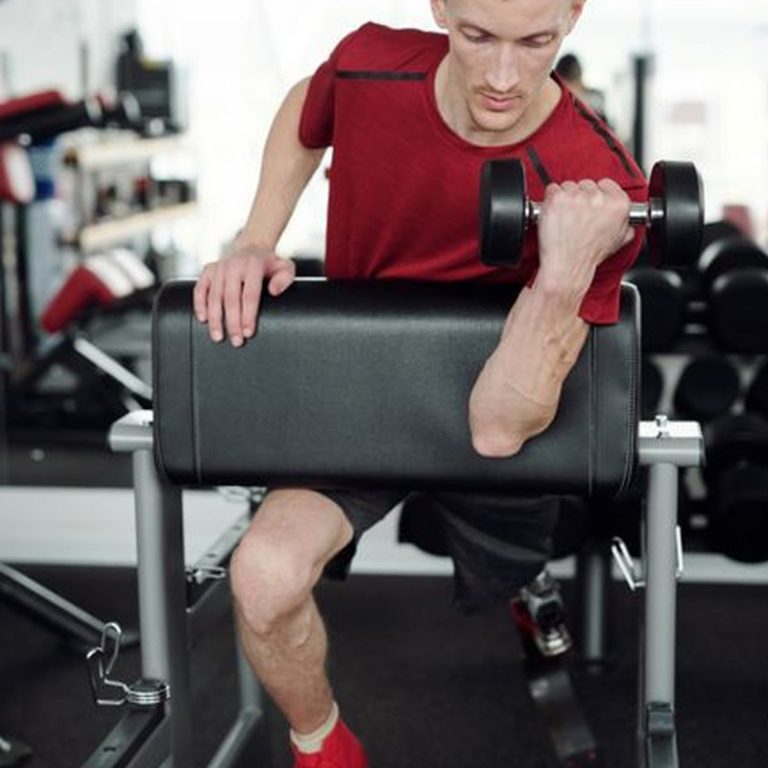
- Seated dumbbell curls, slow lowering. Underrated and easy to load. Three seconds down on each arm, with a few pounds off your normal working weight.
- Pull-up and dip negatives. Step or jump to the top, then take four to five seconds to come down. Bodyweight is plenty for most intermediate lifters.
- Nordic curls, or a Nordic strap anchored under a loaded barbell. Serious hamstring eccentric work with almost no equipment. In a commercial gym, anchor the strap under a loaded bar in a rack. In a garage, a barbell with a couple of plates on the floor does the same job.
Eccentric-only sets take longer than you expect, because the lowering phase is the rep. A rack with adjustable pins lets you set the bar down at the bottom without a spotter. I’d rather squat that way than free-rep it with a partner counting seconds out loud.
Volume, frequency, and a six-week run
Cap eccentric-only work at two to four sets of four to eight reps, finished at the end of a session, no more than twice a week. It supplements your main program. Make it the whole program and you’ll be too sore to train hard for the rest of the week.
Weeks one and two: tempo work on the big lifts only, nothing else changes. Weeks three and four: add one eccentric-overload exercise per session, three sets, placed last. Weeks five and six: keep the overload and trim total sets if soreness is still bleeding into your next workout. If you’re still limping on day three, that’s information. Cut volume before you cut the exercise.
Soreness from eccentric work tends to peak in the 24-to-72-hour window rather than the next morning, so don’t judge a session by how you feel the day after. That delayed curve is also why twice a week is plenty for most lifters, and why stacking eccentric work the day before a heavy lower-body session usually backfires.
If you’re picking up a Nordic strap or a second pair of dumbbells to run this, check current prices on Amazon, since they move around month to month. And if you’ve already run an eccentric block, post what worked and what wrecked you in the comments. The soreness stories are half the useful data.
Managing Soreness, Tracking Progress, and Knowing When to Back Off
Your first serious eccentric session will talk to you for two or three days. Not the sharp joint pain of an injury, but the deep, achy kind that shows up 24 to 72 hours later and turns stairs into a decision. That timeline is normal. The October 2026 coverage from Women’s Running and Futura zeroed in on eccentric training for exactly this reason: the lowering phase creates more muscle damage than most lifters expect, and that damage is the stimulus your body has to repair.
What surprises people is how fast it fades. Run the same session a week or two later and you will likely be far less sore. That is the repeated bout effect. Your nervous system, connective tissue, and muscle fibers adapt to that specific lowering stress, so the second and third exposures cause dramatically less disruption. Do not judge an eccentric block by the first workout. Session one is a calibration test, not a preview of every week.
Recovery is boring and effective in equal measure. Sleep is the biggest lever, protein is second, and supplements are a distant third. Most research supports roughly 1.6 grams of protein per kilogram of bodyweight per day as a reasonable target for strength and hypertrophy work, which is about 130 grams for a 180-pound lifter. If you are sleeping under seven hours and undereating protein, no tart cherry capsule or massage gun will rescue a heavy eccentric week.
Scheduling matters just as much. Never stack eccentric-focused work on top of a max-effort squat or deadlift day. Leave at least 48 hours between a hard eccentric session and your next heavy lower-body day, and give yourself more room if your elbows or knees are already cranky. A simple week:
- Monday: heavy compound lifting, normal tempo
- Wednesday: eccentric-focused session with controlled 3 to 5 second lowerings
- Friday: moderate volume, normal tempo or light pump work
- Weekend: walking, easy cardio, mobility, or full rest
That spacing lets the repeated bout effect work for you instead of against you.
Progress with eccentric training is not always a heavier dumbbell. Watch for these markers:
- The same load with cleaner tempo control. You hit the full lowering count without rushing or cutting depth.
- More reps at the prescribed lowering time. If you were doing 3-second lowers for 6 reps, you are now doing 8 or 10 with the same weight.
- Less soreness at the same volume. That is the repeated bout effect showing up in real life.
- Over six to ten weeks, visible size or strength changes on your main lifts. Slower than a pump, but it is the change that lasts.
Red flags are worth respecting. Sharp tendon pain in the Achilles, patellar tendon, or elbow is not soreness. Soreness lasting past four days is not normal adaptation. A strength drop that sticks around for more than a week means you overshot. In any of those cases, halve your eccentric volume before cutting it out entirely. Half the sets, half the reps, or a shorter lowering phase keeps the habit alive while your tissue catches up.
I use a phone timer for tempo because it stops me from lying to myself about a 4-second lower. A wall clock works too, but a timer is free and brutally honest.
You can run this entire approach with a barbell, a pair of dumbbells, and that timer. If you are shopping for a tempo timer, adjustable dumbbells, lifting straps, or a Nordic curl strap, check current prices on Amazon before buying. Prices move around, and none of it is required to start.
Give the lowering phase six to eight weeks of honest attention. Track your tempo, your reps, and your soreness. Then tell me what happened. Did session two feel easier? Did your main lifts move? Share your tempo experiment and results in the comments, especially if you found a setup that made eccentric work easier to recover from. Your experience helps the next lifter decide whether to slow down the negative or keep rushing through it.