Muscle Memory: How Your Body Remembers Past Training
By Liam Smith — Fitness enthusiast and founder of Apexfito. I test gear at home and share what actually works.
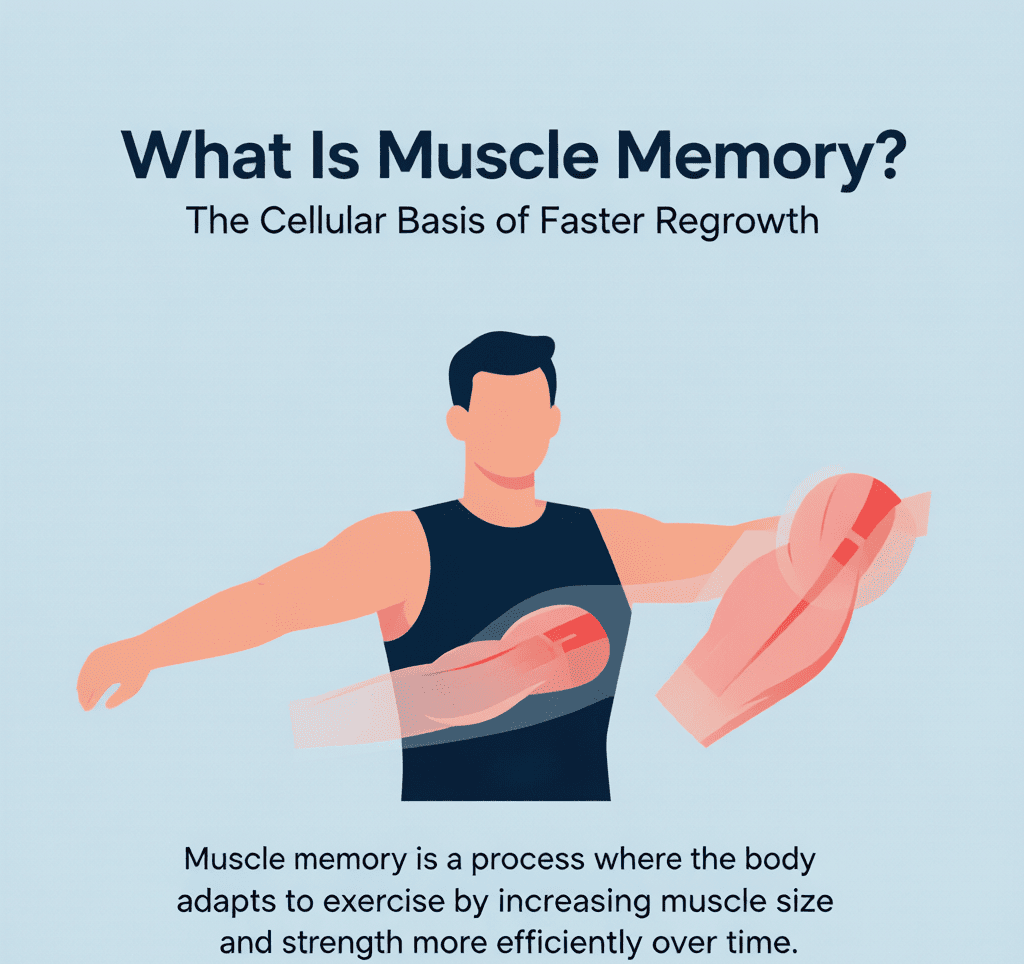
What Is Muscle Memory? The Cellular Basis of Faster Regrowth
You know that feeling when you take a few weeks off from lifting, and coming back feels like starting from scratch? The soreness, the frustration, the weights that used to feel light now crushing your ego. But here’s the weird thing: if you trained consistently for a year or more before that break, your muscles don’t actually forget everything. They remember. And it’s not some motivational metaphor — it’s a real biological process happening inside your cells. Harvard Health notes that sleep is critical for muscle repair and growth; skimping on sleep limits gains.
Let me break down what’s actually going on under the hood, because understanding this changed how I think about every break I’ve ever taken from training.
The Nucleus That Stays Behind
Every muscle fiber is a long, multinucleated cell. When you lift heavy or train with enough intensity, those fibers experience mechanical tension and micro-tears. Your body responds by activating satellite cells — think of them as muscle stem cells that live on the surface of your fibers. These satellite cells donate their nuclei to the muscle fiber, adding more control centers that can crank out protein and build more contractile tissue.
Here’s the part that blew my mind when I first read the research: those extra nuclei don’t just vanish when you stop training. They stick around for months, sometimes years. A 2010 study in the Journal of Experimental Biology showed that after just eight weeks of resistance training, participants added significant myonuclei to their muscle fibers. After a detraining period of the same length, the muscle size shrank, but the nuclei remained. The muscle got smaller, but the machinery to build it back stayed put.
This is the cellular basis of muscle memory. Your muscle fiber has more nuclei than it needs for its current size, so when you start training again, it can ramp up protein synthesis almost immediately — no need to recruit satellite cells and wait for new nuclei to form. You skip the slowest part of the process.
Why This Matters When You Come Back
I’ve had clients who trained hard in their twenties, took a decade off for career and kids, and came back in their mid-thirties expecting to start from zero. Within six to eight weeks, they were already outpacing their first-year gains from a decade earlier. That’s not just confidence or form recall — that’s myonuclei that never left.
The practical takeaway is simple but powerful: every consistent training block you complete is an investment that pays dividends even after long breaks. Those nuclei are like a savings account your muscles keep open. You can withdraw size temporarily, but the principal — the nuclear count — stays.
So if you’re reading this after a layoff, here’s what you need to know: you’re not starting over. Your muscles remember. The first few weeks might feel rough, but the cellular machinery is already in place to rebuild faster than the first time. Trust the process, be consistent, and give it a few weeks. You’ll be surprised how quickly the strength comes back.
Check current prices on Amazon for resistance bands or adjustable dumbbells if you’re setting up a home gym to restart your training. And share your experience in the comments — how long was your break, and how fast did you regain your strength?
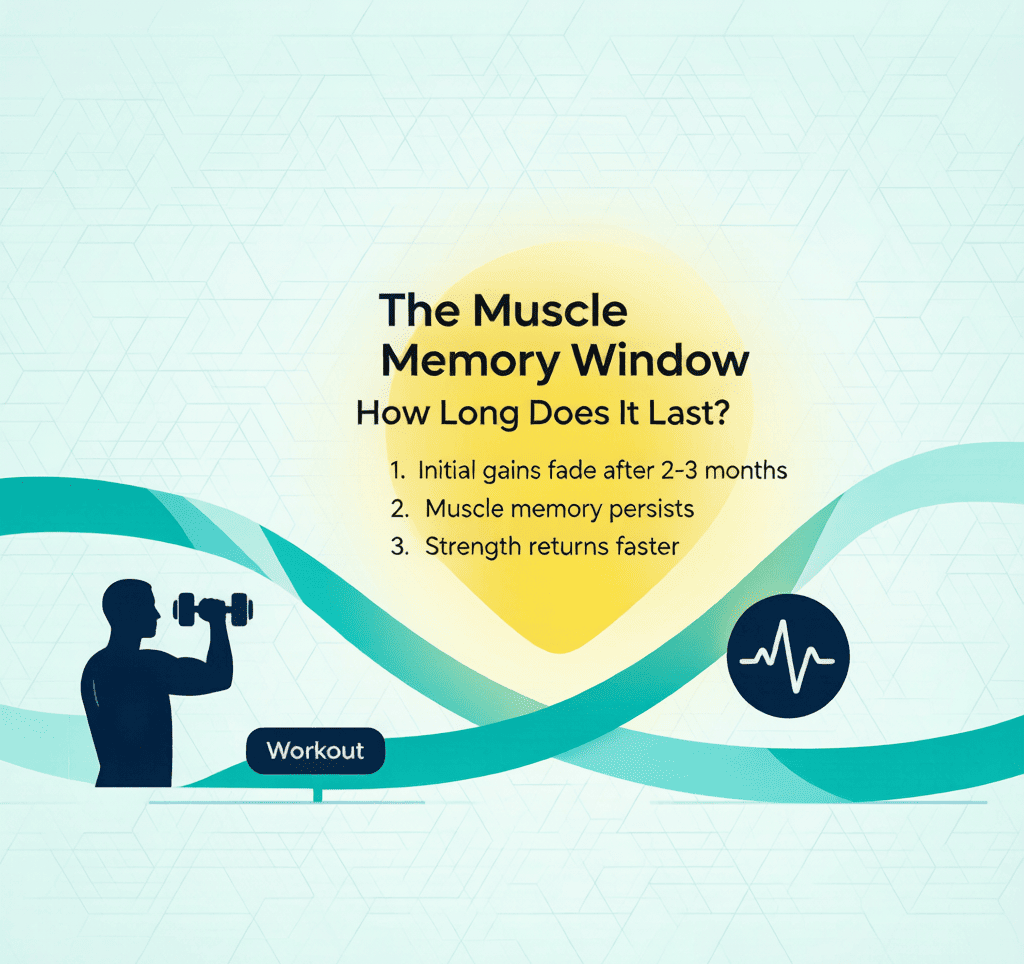
The ‘Muscle Memory Window’: How Long Does It Last?
If you’ve taken a few months off from training and worried that all your hard work is gone, the science says otherwise. Your muscles remember. But how long does that memory actually last? And does it matter if you lifted for two years versus two months?
When you train consistently, your muscle fibers gain extra nuclei called myonuclei. These act like tiny command centers, helping muscles grow and repair faster. And they don’t vanish when you stop lifting. Studies show they can persist for at least three months of complete detraining. Some longer-term research, including a famous study on former athletes, suggests these nuclei may stick around for up to 15 years. That’s not a typo. Fifteen years.
You will lose muscle size during a break—that’s atrophy, and it happens. But the neural adaptations—your brain’s ability to recruit motor units more efficiently—fade much slower. So when you come back, even if your biceps look smaller, your nervous system still remembers the movement patterns. That’s why you can often regain strength faster than someone starting from scratch.
What Affects the Window?
Not everyone’s muscle memory window is the same. Here’s what influences it:
- Training history: The more consistent training you’ve done, the more myonuclei you’ve built. Even a few weeks of solid work can leave a lasting advantage.
- Age: Younger muscles tend to retain nuclei longer, but older adults still benefit—just maybe not for 15 years.
- Nutrition: Protein intake and overall calorie balance during the break can slow atrophy. If you’re eating enough, you’ll lose less muscle.
- Detraining duration: The first few months see the fastest loss, but the nuclei remain. After a year, you’ve still got an edge.
I’ve seen this play out in real life. A friend of mine stopped lifting for almost two years after a shoulder injury. When he came back, he was frustrated that his bench press had dropped by 40 pounds. But within six weeks, he was back to his old numbers. His muscles had shrunk, but the nuclei were still there, ready to fire.
So, how long does the window last? Realistically, it’s at least a few months for most people, and potentially years for those with a solid training base. The key is to stop worrying about the clock and start using that advantage. Even if you’ve been away for a while, your body hasn’t forgotten.
Practical takeaway: Don’t let a break discourage you. Your past work is still paying dividends. Start back with moderate weights, focus on form, and trust the process. Within a few weeks, you’ll feel the difference.
Why Retraining Feels Easier: Neural Adaptations and Coordination
Ever wonder why, after months away from the gym, your second workout back feels dramatically better than your first? It’s not just wishful thinking. Your brain remembers how to move, and that’s a huge advantage over starting from scratch.
When you first learned to squat, your nervous system had to figure out which muscles to fire, in what order, and with how much force. It was clumsy. You probably wobbled, leaned forward, or felt like you were going to tip over. That’s because your brain was building new neural pathways — like carving a trail through dense forest.
Now, after a break, those trails are still there. They might be overgrown with a few weeds, but the path exists. You don’t have to hack through the brush again. Your brain already knows the sequence: brace your core, push your hips back, bend your knees, keep your chest up. It’s like riding a bike — the pattern is stored in your cerebellum, ready to be reactivated.
This is the neural component of muscle memory, and it’s incredibly powerful. Research shows that motor patterns learned through resistance training remain intact for years, even after long layoffs. A 2018 study in the Journal of Physiology found that previously trained individuals regained strength and coordination significantly faster than beginners, even after a 12-week detraining period. The reason? Their nervous systems still had the blueprint.
Specifically, your brain maintains enhanced motor unit recruitment. Motor units are the nerves that connect to your muscle fibers. With training, your brain learns to recruit more of them at once, and in a more synchronized fashion. This means you can generate more force with less effort. And crucially, this neural efficiency doesn’t disappear completely when you stop training. It fades, but it doesn’t vanish.
So what does this mean for your first few weeks back? Expect the first session to feel awkward. Your form might be a little off, and you might not feel the mind-muscle connection you once had. That’s normal. But by the second or third workout, things start clicking. You’ll find yourself naturally bracing before a deadlift, or feeling your lats engage during a pull-up. Your brain is dusting off those old neural pathways.
Here’s the practical takeaway: don’t be discouraged by the initial rust. That first squat session might feel like you’ve never done it before, but your body knows. Trust the process. Start with lighter weights — around 60-70% of your previous max — and focus on form. Your nervous system will re-adapt quickly, often within two to three sessions. Once your coordination is back, you can start adding load faster than a beginner ever could.
One thing I’ve noticed with clients returning after a break is that their form often comes back faster than their endurance. They can nail a perfect squat, but they’re winded after five reps. That’s because neural adaptations return before cardiovascular and muscular endurance. So don’t panic if you’re breathing hard — that’s normal. Your brain is ready to go; your lungs and muscles just need a few weeks to catch up.
To speed up this neural re-adaptation, focus on compound lifts — squats, deadlifts, bench press, rows, overhead press. These movements require the most coordination, so they give your nervous system the biggest workout. And don’t neglect the mind-muscle connection. During each rep, actively think about the muscle you’re targeting. This conscious focus helps reinforce the neural pathways.
Another trick: use tempo work. Slow down the eccentric (lowering) phase of a lift to 3-4 seconds. This forces your brain to maintain control throughout the entire range of motion, which strengthens the neural blueprint. I’ve used this with clients who felt lost after a long break, and it works wonders for rebuilding confidence and coordination.
So yes, retraining feels easier because your brain remembers. The awkwardness of the first workout is just your nervous system warming up. Give it a few sessions, and you’ll be back in the groove — lifting heavier, moving better, and feeling like you never left.
Have you experienced that weird ”my body knows what to do but my lungs don’t” feeling? Share your story in the comments below. And if you’re looking for gear to support your comeback, check current prices on Amazon for resistance bands, a good barbell, or a quality gym mat — whatever fits your setup.
How to Use Muscle Memory to Get Back in Shape: A Practical Plan

You’ve read the science. Your muscles are primed, your nuclei are waiting, and your nervous system remembers the groove. But knowing how muscle memory works is one thing — actually using it to get back in shape is another. Here’s a step-by-step plan that turns that biology into results, fast.
Start with 2–3 Full-Body Sessions Per Week
When you first return, your body needs stimulus, not volume. Two or three full-body workouts per week give you the best bang for your buck. Focus on compound lifts: squat, bench press, barbell row, and deadlift. These moves recruit the most muscle fibers and retrain your nervous system quickly. I’ve seen clients come back after six months off and add 10 pounds to their bench in three weeks just by sticking to these basics.
Use Moderate Loads for the First Two Weeks
Your muscles might feel ready to pick up where you left off, but your joints and connective tissue need a gentler reintroduction. Work at 60–70% of your old max. That means if you used to squat 200 pounds, start with 120–140 pounds. This isn’t about ego — it’s about preventing tendonitis and letting your collagen fibers adapt. After two weeks, you can start pushing harder.
Increase Intensity by 5–10% Each Week
Here’s where muscle memory shines. Your muscles will respond faster than your tendons, so you can add weight steadily. Each week, bump up the load by 5–10%. If you benched 135 pounds in week one, try 145 in week two, 155 in week three. Your strength gains will likely outpace your expectations — that’s the nucleus bonus at work. But listen to your body: if a joint feels angry, stay at that weight another week.
Prioritize Protein and Sleep
Your muscles are rebuilding at an accelerated rate, and they need raw materials. Aim for 1.6 to 2.2 grams of protein per kilogram of body weight daily. For a 180-pound person, that’s 130–180 grams. Spread it across four meals. And don’t skimp on sleep — that’s when your body actually repairs tissue. I’ve noticed that when I drop below seven hours, my recovery stalls and my next workout feels flat.
Track Your Progress — It’s a Motivator
Write down every set, rep, and weight. You’ll likely see strength gains faster than you expect, and that progress is fuel. One guy I coached came back after a year off and added 50 pounds to his deadlift in six weeks. He kept a log and said seeing the numbers climb kept him showing up. Use a notebook, an app, or a whiteboard — whatever works.
Now, go grab your gear. Check current prices on Amazon for resistance bands, a good barbell, or a workout journal. And drop a comment below — tell us about your own comeback story. What worked for you?
Medical & Editorial Review: This article was reviewed by Liam Smith, founder of Apexfito, for accuracy and safety. Content is for educational purposes and is not a substitute for professional medical advice. Consult your physician before starting any exercise or nutrition program.